
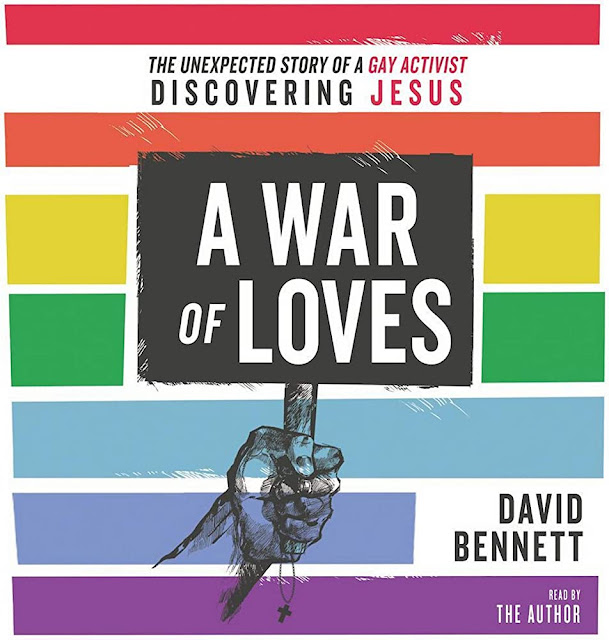
 |
| Free Audible Audiobook of A War of Loves Read by Author David Bennett |
David Bennett's account of his meeting with Jesus ... is alone worth double the price of the book. + N.T. Wright
The God who I thought hated me still haunted me, even through a fortune teller's words. And it wouldn't be the last time I wanted God to leave me right alone.
These words also continue to haunt me (in a good way) in relation to David Bennett's brave and profound story he generously shares with us all in A War of Loves: The Unexpected Story of a Gay Activist Discovering Jesus. This post will feature 3 moments in David's life in which he had an encounter with Jesus that would transform his experience of love. Recently, during a Surge Table meeting, we were talking about common grace, and I remembered David's story of meeting with a psychic, someone we wouldn't usually think God would use to point others to Jesus (a descriptive meeting, not prescriptive nonetheless). This is the 1st of 3 moments in David's story included below. But as N.T. Wright states in the quote at the top of this post, David's account of his meeting with Jesus is worth double the price of the book. So if what you read below makes you curious, I invite you to purchase the entire book to support David on his journey. It's a story that I think might collide with the questions and curiosities of many as it has certainly captured my attention.
If the gods we worship are exactly like us, are we just creating divinity to be like us or in our own image? ...
My quest for love must have a reason behind it. ...
Do I know what grace is?
| 1 | Grace Foretold through a Tarot Card-Reading Psychic with a Friend
Christians are bigoted.
I mean, I'm spiritual but the Bible's just horrible.
I can't stand how ignorance can shroud itself in religious ceremony.
I was meeting up with my best friend, Emma. I smiled and sat down. As I entered the café and ordered my usual soy chai, I looked around but barely recognized her. Her hair had been dyed black. "Hey! What have you done to your hair?" Emma put down her book. It was my favorite biography of Jean-Paul Sartre and Simone de Beauvoir, one I'd picked up at a writer's festival. "I'm sick of being valued just for my blonde hair. It's my statement for the cause of women!" she said enthusiastically.
I smiled and sat down. "Love it. So you're the token feminist and I'm the token gay activist. Is that how this is gonna play out?" We laughed.
"I actually just dyed it for fun; the protest is secondary," she said with a flourish of conscience. "Also, I'm doing a part for a theatre piece, and it fits with the character." She leaned toward me. "So you know how yesterday we were talking about getting in touch with our spiritual side? I saw a sign for psychic readings down the road. Have you ever had your cards read? I'm kind of curious. Want to go?"
I thought of my past obsession with Wicca and new age religion. I now considered myself an atheist, but I figured there was no harm in a simple reading. We walked down to the health food store, and as we entered, the pungent smell of vitamin, tablets, dietary supplements, and patchouli oil filled our senses. I strode up to the counter, where a woman with dreadlocks tied up in a bun was sitting, filing through the day's receipts. "Could we please have our tarot read?"
She looked at the clock. "Sorry, there's only one reading left for today. I can arrange it for one of you in 15 minutes. It's $20 for 30 minutes." Emma was happy to go another day, so we waited for my reading. I was filled with nervous excitement. When it was time, I passed through the beaded strands that hung in the doorway, clicking exotically together. A rosy-cheeked woman with dark hair and a large, purple velvet coat greeted me. Sandalwood incense filled the room; aromatic candles flickered in the background. The fragrance was effusive and intense but pleasant.
"Nice to meet you, David. I'm Rose," she said. "Let's begin."
We sat down at the table. She looked into my eyes for a moment, then pulled out her deck. Shuffling it, she placed the deck facedown on the table, and then drew tarot cards from the top, placing them faceup in front of me until a full reading had been laid out. I was skeptical, almost amused by the spectacle. People believe in this stuff? I mean, it's fun, but ... seriously?
Rose inspected my cards. She seemed to be consulting a spirit guide in the form of a Native American sketched on a paper next to her. Suddenly, she looked at me in amazement.
"Incredible! You are very blessed! I need to tell you this now. You are a child of the light, destined to be with the greatest mediator in the spiritual realms, Jesus Christ. He has chosen you!"
I was a bit glazed for the rest of my reading, not really listening to her half hour of babbling about the various cards laid before me. Jesus Christ? Back at the café, I fumed. "Emma, I think that medium is actually an undercover Christian evangelist."
She sipped her latte and cackled. "Uhhh ... what?"
"She said I was destined to be with Jesus. I don't think she knew who she was talking to!"
"Maybe she's right, David," Emma said matter-of-factly.
I made a face. "What do you mean? There's no way I'd ever become a Christian."
| 2 | Christmas Conflicts and the Spirit of Grace at the Holiday Table
I believed the Christian God was a moral monster who had punished his son on the cross as an act of divine child abuse.
Jesus had become a weapon in the hands of homophobes, used to deprive LGBTQI people of their rights.
It was as if we were being stripped of dignity and deleted from existence.
I came to understand that like many Christians my Aunt Helen had used the wrong words to communicate both her stance and her concern for me. My uncle Brendan also deeply cared for gay people. But in my mind, he and Helen were still bigots. Anyone who disagreed with me or had a different vision of marriage was automatically a bigot. No qualification needed. But on this Christmas day, I took my seat, trying to rise above their hatred. I'll just ignore them, I thought.
As we ate, I talked with my cousin next to me. Suddenly I overheard Uncle Brendan mention God and something about truth. Truth was a dangerous word. Through my university lectures, I had adopted the key doctrine of postmodern worldview: there are no absolutes. Such "truths" are just ways to control other people.
"Are you kidding me? There's no absolute truth and certainly no God," I proclaimed, breaking up the conversation around me. All my relatives stared at me, and the whole room went silent. Out of the corner of my eye, I saw Aunt Helen recoil at my assertion. "I've studied postmodern philosophy. I can tell you there is no absolute truth," I told my uncle. "You can't even communicate truth with language, so please don't try to talk to me about God. It's ridiculous, a delusion. You can't have an exclusive claim to know God. I have many atheist, Hindu, and Muslim friends. Do you really think they're going to hell because they don't know your Jesus?"
"David, there are a few issues with what you are saying," Brendan said, cutting through my exasperation. "Like what?" I asked irascibly. "You say, 'There is not absolute truth' as if it is an absolute truth, and you also used language to communicate that. You just doubly contradicted yourself," he said. He glanced at my aunt. "For me and your aunt, the truth is a Person we know, not just a concept in our heads. He's someone we have a real relationship with." He turned back to me.
"David, there are a few issues with what you are saying," Brendan said, cutting through my exasperation. "Like what?" I asked irascibly. "You say, 'There is not absolute truth' as if it is an absolute truth, and you also used language to communicate that. You just doubly contradicted yourself," he said. He glanced at my aunt. "For me and your aunt, the truth is a Person we know, not just a concept in our heads. He's someone we have a real relationship with." He turned back to me.
"Just because our understanding of Him isn't always perfect doesn't change that He's the absolute truth. It's his perfect grace, not 'perfect' knowledge of God, that saves us, David."
I pushed my plate away. "But what about all the evil the Church has done to LGBTQI people? Do you really think I'd believe you after all of that?" I shook my head. "I can't believe 'God' would create us this way and then punish us for it. And what about all of the other religions? ... " I stood up to leave.
My aunt and uncle also left soon afterward. Years later I learned that on the way home, they talked about my response. "When David was talking, I saw the Holy Spirit over him. He's going to be saved and baptized with the Spirit in three months' time," Brendan told my aunt confidently.
Aunt Helen stared at him, incredulous. "Are you sure? Didn't you see his reaction?" He nodded. My uncle wasn't one to push things like prophecy. He was reserved about making extraordinary claims, and yet this time he was adamant.
God's grace was reaching out to me in my deepest anger. He had started through my uncle's apologetic witness. And Brendan was right. One hundred percent. I had only three months of atheism left.
| 3 | Experiencing the Love of God at a Short Film Festival
The Bible was a dangerous book.
The Christian faith was bad news.
For everyone ...
Madeline was a finalist in one of the largest short film competitions in the world, a huge accomplishment for a young creative. Everyone was talking about her in my screenwriting class, and I wanted to interview her for the student magazine. It would easily make the best feature article. Unlike a lot of my peers, whose creative projects centered on them, Madeline was using her gifts to raise awareness for those often misunderstood or forgotten — people with disabilities. Having a disabled uncle, I found her work inspiring. As I approached, her brown eyes warmed in recognition, and we said hello. Her hair was cut short, and she wore red lipstick and a black dress. Right away I launched into the question I wanted to ask.
"How did you become a finalist? You just graduated!"
"That depends," she said. "Do you want the real answer or the interview answer?"
"That depends," she said. "Do you want the real answer or the interview answer?"
I laughed, unprepared for what would follow. "The real answer, of course!"
"God led me to make the film."
Madeline must have seen the shock on my face. I remembered the conversation with my aunt and uncle over Christmas lunch. Please don't mention Jesus, I thought. I couldn't see how Christianity had anything to do with her work. How could a faith that oppressed me and so many others motivate her to do such good?
"So, which God?" I asked, with a hint of sarcasm. "We talking, like, Vishnu here?" "Jesus," she said. A thousand objections flooded me as I thought of this God who stood in the way of my community's progress in society. And yet ... Madeline wasn't like the other moralizing, intolerant, anti-intellectual, homophobic, anti-feminist Christians I'd met.
She explained that she too struggled with Christian stereotypes and the small-mindedness found in parts of the Christian community. The key word in John 3:16, she said, was whoever: "God so loved the world that He gave His one and only Son, that whoever believes in Him shall not perish but have eternal life." ...
"Do you think there's a God?" she asked. Not a hint of ulterior motive or trying to convert me. Just an open question. "Well, I'm basically an atheist, but I believe there's a Something, I guess. I'm a spiritual person, and I think you have to be blind to believe there's absolutely nothing behind life," I said, looking down at my drink. "I just don't like organized religion. I'm gay, so I know this Christian God isn't an option for me. I've never understood how if he existed, he'd give me these desires, then condemn me."
I expected her to quibble or awkwardly change the subject, like many of my Christian friends. But Madeline didn't hesitate.
"David, have you ever experienced the love of God?"
"What do you even mean? No." My only impression of Him was that of an angry, distant diety. "God loves everyone right where they are," Madeline said. I wanted to recoil at her words, yet something drew me deeper. ... She paused. "... I'd never usually ask this, but ... can I pray for you?"
Instantly I had an internal war over how to respond. Should I say yes or no? A voice in my mind whispered, You're a good agnostic; you have to be open to prayer, because you don't know if there's a God. Any other response is intellectually dishonest and close-minded. Another thought, this one louder, came on its heels: Get away from this crazy fundamentalist! She's brainwashed like those Christians you read about in the newspaper! The gentler voice won. "Yes, you can pray for me," I said finally. "But I don't think anything is going to happen."
As Madeline laid her hands on me and prayed, the bustle of the pub faded away. I entered into a stillness, a peace. Soon I felt a soft tingling on the crown of my head that slowly intensified, as if someone was pouring oil over me. The warm sensation ran down my entire body like a current of water. It was unlike anything I'd ever felt before. In a moment, in that experience so totally from outside me, so totally unasked for, everything turned upside down in my mind. All my searching in religion, in relationships, in atheism — none of it compared with this love coursing through me like electricity.
For the first time, I knew God was real and that He loved me. This changes everything, I realized. As my eyes filled with tears, I heard a voice in my head say, softly at first, Do you want Me? It cut to my core, to a deeper place I never knew existed. ... If you are really there, then yes, I said, to my own surprise. As soon as I did, a laser-like pinprick of light pierced the darkness over my heart and entered that mysterious place deep inside me. I was later to find out that Jesus speaks of this place in John 7:38 as the innermost being, from which rivers of living water, God's Spirit, flow for those who believe in Him. Then I felt a wind, like someone breathing on me, filling me with life. It was as if I were taking my first breath.
"Madeline!" I said, both frightened and exhilarated, "I'm breathing without taking a breath! What's happening?" "David, that' the Holy Spirit filling you. He loves you," she said, unaware of my internal dialogue. As she kept praying, I heard the voice ask, Will you accept my Son, Jesus, as your Lord and Savior?
Immediately I was offended by the Christian nature of the question. Once again the war inside raged like a tug-of-war over my soul. I heard two voices. The first said, What you're feeling is a psychological reaction. It's just wish fulfillment! Get away from here! A calmer quieter voice followed it: I am calling you, David. This is real and true. You've never experienced anything like this in all your searching. This internal struggle felt like the longest moment of my life. Then the most reluctant of words came from my mouth: "Yes, I accept Your Son, Jesus, as my Lord and Savior." ...
I was dumbfounded.
I was an atheist gay activist, perhaps the least likely of anyone to ever find Jesus.
But in that moment, I knew I had become a new person.
As I opened the door to my parents' house, I could see the light was on. My mother was up later than usual. When I entered the living room, she saw my face and knew something had happened. "David? Is everything okay?"
I couldn't say it. It was as if admitting what had happened meant I had to eat my words and objections to my mother's faith. "Mum, tonight ... I ... uh ... think I've become ... uh ... a Christian," I said sheepishly. For a minute she stared at me, awestruck. The moment my news sunk in, she jumped up and hugged me. My mother's reactions always had a hint of drama about them — she had been an opera singer in her younger years, "David, I prayed that if He was truly the God of the impossible, God would save you, because you were so impossible to save! Now I know He can do anything!" she said, wiping away tears.
She told me Aunt Helen had been praying for 11 years that I would come to know Jesus. She also told me about Uncle Brendan's prophecy after Christmas lunch. I quickly did the math and realized that day was exactly 3 months ago. My salvation had been foretold more than once, it seemed.
I began to see I was the object of a benevolent divine conspiracy to reveal the love of God to me.
+ The adapted excerpts above are taken from Chapters 2, 4, and 7-8 of David's Unexpected Story of a Gay Activist Discovering Jesus. To hear a little bit more from David, you can also see him share:
+ A War of Loves (40 minutes)
+ Side A & B Gay Christians Debate Sexuality - Brandan Robertson & David Bennett (70+ minutes)
And to hear from more LGBTQ+ and SSA followers of Jesus about the worth, the cost, and the rest of abiding in Him with sexuality, the Spirit, and the Scriptures, I would encourage you to to take a look at the FREE 8-part series:
Bonus Story: Genia and Misha
Genia married first at 17 and had her first three children with a chronically unfaithful man. She tried to turn her marriage around, but it didn't work. Instead, she had an affair with another woman, who gave her the relational connection she craved. When her marriage finally broke up, Genia became depressed and suicidal. She was part of a church and had met a young woman named Misha through a friend in her Bible study group. Misha kept vigil over her. "We were at a lake house," Genia recalls. "I could have just walked out into the water."
Misha had no history of same-sex attraction, but one thing led to another and she and Genia fell in love. They moved in together, entered into common-law marriage, and (through a sperm bank) had a child. Everything was well until Misha's grandpa died. She started wondering about mortality and told Genia she wanted to go to church. "I was fine and happy until I went back to church," Genia said. "That was when God started tugging at my heart again." God's call became so clear that Genia told Misha they couldn't go on as they were. At first, Misha took it very badly. But after a period of resisting and even having an affair herself, Misha gave her life to Christ. "Her transformation was amazing," Genia recalls.
All this time, Genia's daughter and son-in-law, who pastors a church in Nashville, had been loving and praying for the two of them. When Genia and Misha came to Christ, they knew they couldn't continue in a sexual relationship. ... But as they prayed, they both felt called instead to restart their lives in the church family Genia's son-in-law served. That church had been deeply instrumental in Misha's faith journey and felt like their spiritual home. So in the end, all three of them moved in with Genia's daughter and son-in-law, who were also raising little girls. Rather than being broken up, their family grew, and their relationship changed. "We were lovers," Genia explains, "and now we're sisters." With words that brought tears to my eyes, Genia told me that she and Misha are closer now as sisters in Christ than they ever were as lovers." ... Today, most people associate non-traditional family—the sense of corporate closeness that doesn't depend on DNA—with LGBTQIA+ people. But the first pioneers of such community were Christians. As one second-century commentator put it, Christians have "a common table, not a common bed."
+ The Secular Creed, pgs. 56-57; also see No Longer Strangers: Belonging in a World of Alienation
Here are links to other recent City Notes (CN) books:
Red Skies; Story of God in a Sanitation Truck; The Artistry of What's Next; Seeds of Hope in the Rain & the Dark; Wrestling with God in Doubt; I've Seen What Hope Can Do; Baptism as the Way of Life; The Cross and Peacemaking Presence; Being with God; Knowing and Naming True Friends; Listening Closely & Paying Attention; Living and Loving Curiously with Wonder; Waiting is the Womb; In the Holy Wild; Yeshua
Next post: "Only One Thing Is Needed"
Christ is all,
Rev. Mike "Sully" Sullivan


