Showing posts with label God's Presence. Show all posts

Monday, May 4, 2026

Visual + Verse + Victory | May the Fourth Be with You. Always.


The Fourth Man by Anne Reid

May the 4th be with you.
Always.

Did we not cast three men 
bound into the fire?

But I see four men unbound, 
walking in the midst of the fire, 
and they are not hurt; 
and the appearance of the fourth 
is like a son of the gods.

+ Daniel 3:24-25

Another in the Fire
By UNITED w/ Taya Smith
2018 A.D.

There’s a grace 
When the heart is under fire,
Another way 
When the walls are closing in.
And when I look at the space
Between Where I used to be
And this reckoning,
I know I will never be alone ... 

There was another in the fire
Standing next to me.
There was another in the waters
Holding back the seas.
And should I ever need reminding
Of how I’ve been set free,
There is a cross that bears the burden
Where another died for me.

All my debt left for dead
Beneath the waters;
I’m no longer a slave
To my sin anymore. 
And should I fall in the space
Between what remains of me
And this reckoning
Either way I won’t bow
To the things of this world
And I know I will never be alone ...

There is another in the fire
Standing next to me.

There is another in the waters
Holding back the seas.
And should I ever need reminding
What power set me free
There is a grave that holds no body
And now that power lives in me. 

And I can see the light
In the darkness
As the darkness bows to Him.

I can hear the roar in the heavens
As the space between wears thin.

I can feel the ground shake beneath us
As the prison walls cave in,
Nothing stands between us,
Nothing stands between us. 

There is no other name
But the Name that is Jesus.
He who was and still is
And will be through it all.
So come what may
In the space between, 
All the things unseen,
And this reckoning,
I know I will never be alone. 

There’ll be another in the fire 
Standing next to me!
There’ll be another in the waters
Holding back the seas!
And should I ever need reminding
How good You’ve been to me, 
I’ll count the joy come every battle 
‘Cause I know that’s where You’ll be!

Many blessings of peace and presence,

Rev. Mike “Sully” Sullivan

Monday, April 6, 2026

Tattoo Special | Resurrection: Emmaus Road + Realm of Peace


Coptic Christian Tattoos: Redemption, Reign, Resurrection

 
"Tell Me the Story About Your Tattoos ... "

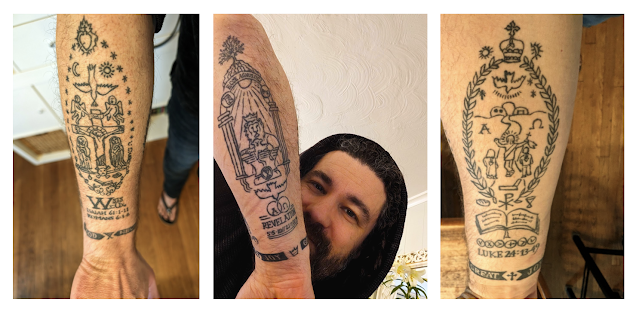
This is a special Eastertide post that's in a 3-part series focusing on the ancient and fresh Christian artwork that is wrapped around my right forearm.

Due to the history and unique line work of Jerusalem Tattoos, along with the strong artistry of my friend, Kevin Shattuck, with Iconic Ink, I get the privilege to talk with curious people who lean in and wonder about the meaning behind each of my tattoos. One Eastern Orthodox brother said, "It's like you have your own icons to turn you back to Christ every time you look at your arm."

Some have even wondered if I could try doing an Instagram or TikTok video sharing about the history and symbology of the various pieces. Maybe someday. But for now, you can read the post below.

Quick History of Jerusalem Tattoos

For a pithy overview of where this particular style of tattoos comes from, it originates in North Africa nearly 800 years ago. In this area of the world, Christians have often suffered intense persecution, particularly among Coptic Orthodox Christians. One family, the Razzouks, were Christians living in Egypt in the 1300s. Seeking to escape the violence, they became refugees who settled in Jerusalem where they set up Razzouk Tattoo, which still exists today and welcomes pilgrims from all over the world. 

Quick Story About Tattoo Curiosity

For this specific tattoo, one of my favorite moments was the next day after my first appointment at Iconic Ink when I walked into Trader Joe's with the fresh ink on display. It was during the pandemic when masks were still required, so all I could see were the eyes of the tall girl ready to help me in line. 

"Is that new ink?
she asked. 

"Yes," 
I said.

"What is it?"

"It's a type of tattoo
followers of Jesus in North Africa
have been using for nearly 800 years."

"What kind of followers of Jesus?"

"Coptic Christians in Egypt."

"My family is Coptic."

The smiles behind masks were evident through the creases that appeared around our eyes. I shared some more details about the Razzouks (see above) and then she said this:

"You know, it's interesting you mentioned Christians in Egypt in the 1300s. At that time in history, people from Egypt traded with people in Ireland. And for those who sailed to Ireland, but died there, Coptic Christians would give them an honorable burial. Irish Christians who died in Egypt were given the same. So people who followed Jesus across ethnicities and cultures treated each other with compassion and hospitality during a tumultuous time in history when people feared the stranger."

I smiled even more.

"Well, my last name is Sullivan and my family is Irish so you just brought the story full circle to us today."

She leaned in:

"Oh, we need to talk more about this."

That was the last time I saw Eva.

Eva's name means life. I still look for her these couple years later. Sometimes I wonder, "Who was that, God?" Regardless, she gave me a bit of life that day and helped shape the first of many conversations I have been able to enjoy with those curious about this tattoo.


Resurrection Tattoo

Resurrection Coptic Jerusalem Tattoo under Right Forearm


This tattoo on the bottom of my right forearm was my first tattoo I ever had inked. I was on sabbatical, and after a time of solitude and silence in prayer at the Abbey of the Way, I sketched this image. It honors the Emmaus Road story our congregation gets its name from as well as invites each person who sees it (including myself again and again) to welcome hope in a time of uncertainty because Jesus' loving care and pursuit of us is relentless

I call this my "Resurrection Tattoo" (the others l refer to as my "Redemption" and "Reign" tattoos) because it showcases that: 

God the Father planned to rescue us,
God the Son meets us right where we are,
and God the Spirit, transforms our story
to raise us from death to life
and move us through darkness to light,
to walk humbly with Jesus on any
road that we think is hopeless, but is
ultimately a journey brimming over 
with abundant light and life.
Our resurrected King is
resurrecting us.


The elements of the Emmaus story, seen and unseen, that I have specifically included in the tattoo are listed below with brief explanations for each, beginning from the top to the bottom.

Trinity Rule of Love

The top image is a crown centered between the sun and crescent moon with the symbol of the Trinity in it and a cross above it. This is to show that the God who is the Creator of the universe is the God of love who is self-giving. As the Father loves the Son and the love between them overflows with the Spirit, so this same love is given to us, His beloved creation.

And ultimately this love is given for those who welcome His adoption of them as His children, fully showcased in Jesus' death to pay for adoption, because "greater love has no one than this: that Someone would lay down their life for their friends." 

The God revealed in Jesus
is the One who loves us to the end.
This is the love that is beautiful,
true, and good that overcomes evil
in us and throughout the world.
This is the Love we want and
we need to rule everything.


Unseen & Seen Prince of Peace

The olive tree branches that form the oval shape around the central image represent the wholemaking peace that comes when Jesus, the Prince of Peace, is near. An oval is an ancient and fresh Coptic Orthodox representation of the divine and human, heaven and earth, the seen and unseen coming together.

When Jesus resurrected, often the first thing He would say to people when they discovered that He defeated death was, "Peace be with you." The travelers on the Emmaus road had lost so much hope and were spiritually and physically walking away from the city of peace (Jerusalem means "city of shalom"). Jesus met them on this road and would soon turn them back with new hope and peace that could face any threat of death that would come their way.

Even though the night was long,
and hope was dim,
God provided a peace
that passes all understanding
to guard these travelers
in Christ Jesus with Christ Jesus.
And their witness would soon
share this peace and multiply it
so much that the power of 
the Roman Empire and 
its promised peace
of the Pax Romana
couldn't match it.


Beginning & End of Our Story

There are three travelers on this Emmaus road: Jesus, Cleopas, and the unnamed traveler. Some historians and theologians think the unnamed might have been Luke. Others think it might have been Mary, the wife of Clopas. I tend to lean with the latter as I think Jesus is recapitulating God walking with humanity in the cool of the day to turn humanity back to His presence and peace. But the beauty of an unnamed traveler is that Luke is also inviting you to see yourself in the story as one Jesus meets with on your road. 

Jesus is not only writing the story of these two travelers, adding a new beginning and ending that they hadn't anticipated (represented by the Alpha and Omega as the first and letters of the Greek alphabet juxtaposed around them). He is also writing the story for all us who will listen to the Scriptures, meet with the Lord Jesus at His table, trust in His death and resurrection, and go into the world to share this good news of the Chi-Rho (meaning, "Christ," "Messiah," "anointed King," represented in the bottom half of the tattoo by the first two letters of Christ's name, which in Greek are "X" and "P"). 

Above the Chi-Rho (Messiah) 
is the symbol of the open grave
because the tomb is empty,
but the throne will never be.

Christ Jesus is alive.
Death is defeated.
Our hearts burn and come alive
with the surprise and stirring
of this personally-transforming,
history-altering,
world-restoring
Gospel that the grave is open
and will never be shut forever
on all who walk with Jesus
in the wonder of this wild.
Jesus is the Alpha and Omega,
the beginning and end
of the greatest story,
the Redeemer, Healer, and Savior
of everything we hope is true.
He is making all things new,
including us.

God is truly with us
and for us forever.


The Story of God, the Story of Us

The final piece of the tattoo above the verses Luke 24:13-49 that pull together the context of all the imagery is an open book, or an open story, honoring the Hebrew Scriptures that pointed to Jesus as God with us, the New Testament letters that reflected on what His life, death, resurrection, and ascension means for His people and for the world, and invite us into the Story of God that we get to live in now until Jesus returns to reconcile heaven and earth.

The symbols below the open book are a simple and concise way to share the Story of God through the 6-Act Arc of Creation, Crisis, Covenant Community, Christ, Church, and Consummation. The Bible touches on all these parts of the story, helping us understand and enter into the story we get to live in, one that is filled with creation, communion, and blessing, more than the mere chaos, chance, and the need for constant change we often drown in when we swim in our 21st century Western culture.

My dream for Emmaus City Church is being a people who are transformed by Jesus and live to embody the story above where:

More are Welcome on the Emmaus Road.
More Get to Hear the Story of God.
More Encounter the Presence of Christ.
More Find the Peace They Need.

More become part of the
"thousands of nameless,
faceless Christians (who) humbly submit
to the task of contributing
their bucket to the torrent,"
resurrected unseen saints
who love their neighbors,
walking Emmaus roads,
revealing Jesus to many more
in word, actions, and prayers
while sharing Good News 
of Great Joy that there
is an empty cross and tomb
and we live in the

Special Note About Tattoos:

God used the skin of His Son
to communicate with us.

God also chose
to write a message on Jesus' skin.
The marks that Thomas touched
are the marks that put to death
the ultimate power of death
for every human soul.
The nail prints in His hands and feet,
the gash from the spear that 
was thrust in His side,
the marks on His scalp
from the thorny crown,
and the field of furrowed flesh
on His back — 
all are the tattoos* that illustrate
the depth of passion God has for us.

*Leviticus 19:28 reads: "Do not cut
your bodies for the dead or put tattoo
marks on yourselves. I am the Lord."
God was instructing His chosen people,
the new nation of Israel, to set
themselves apart. They were not to
imitate pagan religious practices
that used cuttings or tattoos to 
honor the dead or as an offering
to false gods.

God forbade these markings because
they reflected a belief that the dead
could intercede (plead with gods
or advocate) for the living. To conclude,
as some do, that this passage prohibits
modern tattoos is to misread it.

Tattoos: Telling the Secrets of the Soul
pgs. 145, 162, 170


Many blessings of peace and presence,

Rev. Mike “Sully” Sullivan


Saturday, February 21, 2026

Lenten Mind of Christ | God Meets Us in Our Messy Reality


God Goes Before Me by House on Rocks

The prodigality of God's love
scandalizes the hell out of us.
And thank God it does.
We can breathe deep and
consent to God's presence
with us here and now.

+ Having the Mind of Christ 


The person with the Spirit ...
we have the mind of Christ.
+ 1 Corinthians 1:15-16

And the peace of God,
which transcends all understanding,
will guard your hearts and your minds
in Christ Jesus.

+ Philippians 4:7

What does it mean to have the mind of Christ right here, right now during this season? Can the Spirit help me make the right judgment calls? And can the peace of God guard my heart and mind in Christ Jesus? Is there an opportunity in anxiety to meet Jesus in the mess? And after asking God the real questions in the real pain with a curious faith, am I willing to be asked questions by Jesus in return?

Chapter 4: God Meets Us in Our Messy Reality in Having the Mind of Christ is a helpful companion in considering the questions above. And perhaps there is something below that will help you be present with Christ right now with all that's going on in your heart and mind.
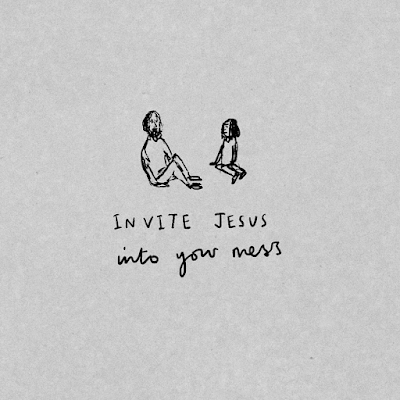

Jesus in Your Mess by House on Rocks


God Meet Us in Our Messy Reality
The Difficulty of Being 
Where We Really Are
(i.e. Trying to Hustle God)

Like the greatest friend (John 15:13) on the worst day of your life, God meets us in our messy reality. The God who is love, who is always present and at work, who looks just like Jesus, always meets us right where we really are, in the middle of whatever mess we find ourselves in. 

Every moment is always the right time 
and place to meet God. 
In fact, God often has to wait for us 
because we tend to expend 
enormous amounts of energy 
trying to be anywhere 
than right where we really are.

The habit of insulating ourselves from what's really happening is a survival technique many of us developed early in childhood. We hide from ourselves and others as a strategy of self-protection. We cope through escape and distraction, numbness and bypassing. We assume somewhere else is better than here and work hard to avoid being present to our current reality, especially if it's painful. The good news is God waits patiently for us, inviting us to come back to this moment, ministering communion-in-love right in the middle of our messy reality. 

Jesus knows our tendency
to be anywhere
but right in the middle 
of our messy reality,
which is why He spends a lot of time
calling people to deal straight with Him,
to be honest about what they want
and how they feel.

For those who choose to get real about their hidden agendas — whether caught in their sinfulness (John 8:2-11; Luke 5:5-9) or their shame (Luke 19:1-6) —they experience profound transformation in Jesus' presence.

Maybe this is part of why Jesus came eating and drinking with sinners (Matthew 11:19): they were people who would actually be real with Him. They were present to their own messy reality and weren't seeking to hide it from Jesus. Jesus delights to meet people right where they really are; He esteems and acclaims those who lack guile and pretense (John 1:47; 4:17-18), who are willing to name what they want.

What do you want Me
to do for you?

Most people in the Gospels, it seems, approached Jesus with ulterior motives and hidden agendas. They tried to test or impress Jesus, or hide from Him, or recruit Him for a self-justification project. We call this a hustle because this dynamic is best identified by two prevalent definitions: "busy movement and activity" and "a fraud or swindle." To hustle in a spiritual sense is to expend lots of energy to try to gain something from God (and others) by hiding, performing, or pretending instead of simply recognizing and expressing our actual state of being. Jesus doesn't indulge these fraudulent ways of relating, He subverts them. He frustrates these games because He knows that to indulge and feed a hustle would validate what is fraudulent in us. This, too, is how He loves us: He resists the deceptive and coercive ways humans attempt to relate to each other.

This dynamic isn't unique to the Gospels: the entirely of Scripture reveals that hustling is prevalent in humanity's interactions with the divine. Whether because of fear or shame or a bit of both, we rarely shoot straight with God. We try to either avoid God or get something out of God. Why is this? Because coming face to face with God — right where we are, just as we are — is often a humbling, terrifying experience (for example, Isaiah 6:5; Luke 5:8). But we can take heart that God looks just like Jesus  fiercely committed to unveiling our hustle and calling us to get real about our messy reality, because it's the only way to grow.


I am with You by House on Rocks


God Meets Us in Our Messy Reality
Being Present to God in Reality
(The Choice to Reckon)

When we say "our messy reality," we aren't so much talking about how things are out there in the world as much as we are talking about the internal state of our hearts, and our willingness to be aware of and present to it, instead of pretending or denying. Some refer to this as authenticity. Some call it living clean. Paul at one point admonishes the Thessalonian church to "keep awake and be sober" (1 Thessalonians 5:6). Jesus prizes this ability to be present inside and out.

For example, Jesus greets Nathaniel with, "Here is truly an Israelite in whom there is no deceit!" (John 1:47), probably alluding to the happy person in Psalm 32:2, "in whose spirit there is no deceit." This most likely refers to someone who owns and names and faces their wrongdoing. He praises Nathaniel for his integrity: his inner and outer world align.

Jesus knows that God fully meets us in our messy reality, so it's necessary for us to be right where we really are.

Those who encounter Jesus
find that they must choose:

Stay committed to their hustle
... or meet with God.

Wish they were somewhere 
/ someone different
... or meet with God.

Demand God be other than God is
... or meet with God.

Impress others
... or meet with God.

Be right
... or meet with God.

Recruit Jesus 
to be a part of their religious project
... or meet with God.

Maintain and solidify 
their power and status
... or meet with God.

Those who attempt to meet Jesus in pretense, self-justification, or illusion usually become hostile and angry at Him when He calls them into reality. For them, the power and presence of God's grace and truth are lost.

The soul sickness of the modern person is one of living anywhere but the present moment. This isn't new. Centuries ago, French philosopher Blaise Pascal wrote, "All of humanity's problems stem from man's inability to sit quietly in a room alone." Our minds are little personal time machines: we can travel to the past, wallowing in regret or nostalgia, or to the future, indulging in worry or fantasy. Our modern, technologically enhanced lives only amplify this condition. We have myriad ways to distract ourselves from the present moment: entertainment, social media, food, drink, work, our task lists, exciting experiences, daydreams, video games ... 

We have collectively mastered
the thing that will keep us 
feeling distant from God:
the habitual practice of
not being right here,
right now,
open to reality.

This keeps us feeling distant 
from God because the primary domain
God has access to us is 
right here,
right now,
right where we really are,
as we really are.

We can give ourselves permission to simply be right where we really are. We don't need to fix it, or hide it, or compensate for it, or emotionally beat ourselves into a frenzy as a way of doing penance. We can just be here. And we can meet God here. This is how we avail ourselves, in faith, to communion-in-love.

(1)
Attune to reality 
and let go of spiritual bypassing.
Be mindful of bringing awareness
to current experience 
without judgment or condemnation

(2) 
Admit the details of messy reality,
own it, and face it.
The best place to be
when we are wrong is in agreement
with God about that wrong.
This is what it means to confess:
to agree with God about reality.
This is a courageous, intentional act.
And we notice what's real in
the kindness of God, 
which is the very thing that leads us
to repentance and transformation.

(3)
Accept God meeting you right here
in messy reality.
God is so real that this place
and this time is where we have access
to God's presence and power.

God loves the actual you,
not the idealized / perfect version of you.

What emerges from the Old and New Testaments is that sin and death stand in opposition to God and God's good plans for creation. Like cancer, sin and death infest our world and seek to choke out life and goodness. 

Like a good doctor, 
God does not detest the patient 
with the cancer.
Rather, God detests the cancer
in the patient.


Over and over in the Scriptures
we see that God is not driven
away by our sinfulness,
but actually draws near to us
in the midst of it.
(Genesis 3:9; Isaiah 6:5-8;

I lived as though God loved an idealized me, a future me, a less wretched and more faithful me ... but not the actual me. Shame becomes toxic when it becomes an identity and condemnation sets itself up at the core of who we are. This is different from conviction of sin. There's a big difference between being convicted of specific sin and living in ongoing, vague condemnation in our hearts and minds. If this strategy worked to bring victory over sin, then Christ died for nothing. We would have just needed God to crank up the condemnation rather than absorb it on the cross in Christ. We don't need the power of the Spirit or the cross of Jesus Christ to merely feel worse about what's happened in the past or may never happen in the future. We don't need the power of the Spirit or the cross of Jesus Christ to avoid, ignore, or bypass the area of our lives that cause us concern, grief, fear, or shame.

The revolution in my life began
when I understood and internalized
the truth that God doesn't love me
because I'm good;
God loves the busted and blessed,
broken and beautiful me.

because this is the you that God
has always known and always loved,
and loves right now.
You're not going to surprise God
by getting real.

The safest place in the world 
is to be who you really are
before a God who is always there,
waiting for you right in the middle
of your messy reality.


Come to Me by House on Rocks

God Meets Us in Our Messy Reality
Naming Reality
(Ex. Christ-Centering Prayers)

Prayer Practice 1

Sit still in a chair or lie down on the floor.
Take several deep, cleansing breaths.
Begin with a simple affirmation,

"God is now here."

With each breath,
use a word (like "here" or "Jesus")
to offer your attention
in surrender to God.

As you notice your mind running after
thoughts and feelings that come,
into the past or the future,
simply use your word ("here," "Jesus")
to bring your attention back
to the present moment.

The object isn't to master this or even
have some kind of spiritual experience.
It's simply a surrender to the God
who meets us in our messy reality.

Prayer Practice 2

Find a space you can be alone, quiet.
Take several deep breaths, become present.

Bring to mind a situation in life
you care a lot about and wonder if or how
God cares about it.
Name this situation in God's presence,
seeing the people involved,
feeling the emotions involved.
Tell God why you care about this.

Name what you want God to do.
Tell God what you wish was happening.
Tell Him why it's hard to believe
He cares about this like you do.
Use the last verses of Psalm 44 if helpful:

Rouse Yourself!
Why do You sleep, O Lord?
Awake, and do not cast us off forever!
Why do You hide Your face?
Why do You forget our affliction
and oppression?
For we sink down to the dust;
our bodies cling to the ground.
Rise up, come to our help.
Redeem us for the sake
of Your steadfast love.

Stay here for as long as you need to,
until your heart is poured out
to God about this situation.

When you're ready, imagine Jesus
standing in front of you,
looking directly at you with 
a steady, attuned presence, 
receiving your emotions and
your questions just as they are,
without any blame or shame.
Imagine Jesus mirroring
the state of your heart back to you.

See His face change to resonate
with how you feel right now.
Imagine Him becoming
"greatly disturbed in spirit
and deeply moved" (John 11:33)
and going with you to your "tomb,"
the place of your pain.
Imagine Him weeping with you
about this situation.

Allow yourself to soak in His care
for you and for what you care about
right now.
What is Jesus saying to you?
What is He doing?

Now allow yourself to set aside
whatever it is you hope Jesus will do
about your situation, and shift your prayers
from, Why aren't You doing something? to
Jesus, I trust You that you care about this
more than I do. Show me how 
You're at work in this situation.

Try persisting in the prayer when this
situation comes to mind.
Jesus, I trust You that you care about this
more than I do. Show me how 
You're at work in this situation.

Make a note if anything changes or 
shifts in your awareness of your soul.
But if nothing happens, that's OK, too.
God can handle your anger, sadness, pain.
Don't rush through this or feel like
you have to complete the whole thing
if you aren't ready.
Return to this prayer practice,
intending to simply meet God
right where you are each time.

For some reason we think
that spiritual progress is marked
by lack of struggle in life ...
this is simply not the case.
Spiritual progress is learning 
to confront struggle in a new way
so that we don't struggle with the fact
that life is fraught with struggle.

+ Martin Laird

The mystery through all time and space
of God's participation and presence
in the suffering of all living things
makes the sign of the cross
an affirmation of all that is,
ever was, and ever shall be.

+ Fr. Maximos Constas

Adapted excerpts from
"God Meets Us in Our Messy Reality"
and
"God Cares About it More"
in 
Having the Mind of Christ
pgs. 70-86, 100-101

Christ is all,

Rev. Mike "Sully" Sullivan