Showing posts with label Church. Show all posts

Tuesday, August 25, 2026

Summer Common Grace: Working with Jesus in the World


Faith, Work, and Economics (FWE)
can be integrated into the local church
as part of the vital importance
of holistic discipleship
in following Jesus. 

+ Skye Jethani & Luke Bobo

Summer is almost finished, so you might be thinking, "Sully, why bring up work?" I understand. Rest is a seriously good thing. And I think if we truly believed and lived in the rest God gives in His grace, we would find that the work He has offered us is actually part of His Good News and His common grace.

Ever since reading Amy Sherman's Kingdom Calling: Vocational Stewardship for the Common Good, Tim Keller and Katherine Leary Alsdorf's Every Good Endeavor: Connecting Your Work to God's Work, and Steve Garber's Visions of Vocation: Common Grace for the Common Good and The Seamless Life alongside attending the Soma Faith & Work Summit and being introduced to Made to Flourish and the Theology of Work Project (along with Letters to the Exiles quirky and thoughtful "Creative Service" video), I have grown in wonder at the plan and purpose for humanity that God has given us from the beginning of creation that will continue into new creation. Along with Skye Jethani and Luke Bobo's Discipleship with Monday in Mind and much more, I feel we have a growing abundance of wise, practical, and inspiring resources to help us see how our work is connected with God's work where we spend much of our time.

Below are some excerpts from resources including Discipleship with Monday in Mind that help capture some of this bigger picture, so that even as you might be looking forward to a vacation or getting back to work after one, you can look for the grace of good in every nook, cranny, or alcove of your working world.

Faith, Work, and Economics
Integrated into a Life
of Following Jesus

In Christian Mission in the Modern World, John Stott concluded that, "We must begin with vocation." We must see the entire biblical text as a coherent narrative of creation, fall, redemption, and consummation, revealing God's design and desire for human flourishing. We must regain the transforming truth that the Good News of Jesus speaks to every aspect of human existence, calling us to discipleship in all areas of life.

Scripture tells us that, as image bearers, we have been created by a working God – with work in mind. That means, in part, that we have been created with community and collaboration in mind; work is not an isolated activity, but an interdependent one. We presently live in a broken and fallen world where our work is not what it ought to be. The Good News is that, through the redemptive work of Jesus, the work we do and the workplaces we inhabit are profoundly changed by the Gospel.

With a growing understanding of the church's mission in the world, we will enthusiastically embrace our congregation's everyday work life. We will grasp with new conviction and passion that economic flourishing matters and that a primary work of the church is the church at work. + Tom Nelson, President of Made to Flourish 

Infusing Thoughtful Language
as We Work with
Good News in Mind

We help each other see that everyone is in full-time ministry. This emphasis dovetails well with biblical teaching of the priesthood of all believers (1 Peter 2:4-10). So we avoid phrases such as, "secular work," "kingdom work," "full-time Christian work," and "moving from success to significance." We're also careful to avoid language that minimizes temporality. We avoid ideas encapsulated in expressions like "living for the line (eternity) rather than the dot (temporality)." We also try to eschew devaluing the material world with phrases like, "What really matters are people's souls." Another common phrase we might jettison, "Make your life count for God," since it can diminish people's sense of their intrinsic value as embodied image bearers in the here and now.

To summarize some of the key thoughts and excerpts: 
When we worship with Jesus' Church at a service, mass, or Divine Liturgy in a corporate worship setting, we step into this sacred time and space together with God to experience again how earth continues to be filled with heaven as the Word, Mysteries or sacraments, Spirit, and songs shared with the communion of saints unveil God with us again and again. 
Then, when we ask, "Hey, what's on your calendar this week?" our tangible worship of God together connects to our cared for life in the liturgy of our days, so that when we ask God for wisdom, courage, and help during our work week, we know and experience how He answers from the overflow of the Kingdom of heaven. 
We don't want people to think that worship is something that takes place merely on one day of the week. It's something we get to do when we gather, and it's something we get to do when we scatter. All work can be a form of worship that, when done well and ethically, is done "heartily, as for the Lord" (Colossians 3:23-25).

We want to be governed by the motto that "the Church is where faith and life connect." Faith should inform all of life, of which work is a significant part. We want to be Jesus' Church for the city. We want to seek to be the kind of local church that, if we were to shut our doors, the city would mourn. "There's not a square inch that doesn't belong to Jesus" (an adaption of a famous quote by Dutch theologian Abraham Kuyper).

Affirming All Vocations:

Preparing lattes matters to God. Changing dirty diapers matters to God. Cooking a meal matters to God. Developing an Excel spreadsheet matters to God. As someone once said, "If it is not sinful work, it is sacred work." Work is not only sacred but an opportunity to worship. The ability to work is a gift and a sacred practice. Work is an opportunity to worship, as we join God in the everyday invitation to represent Him.

To communicate the sacredness of work with the gathered Church, you can have "Faith at Work" interviews every 1-2 months. During the interview, ask five basic questions:

1. What type of work do you do? 
2. How do you try to do that work as a follower of Jesus? 
3. How does sin (i.e. selfishness, laziness, apathy, greed, injustice) seem to affect your work? 
4. How do you try to serve your neighbors through your work? 
5. How can we pray for you?

We can also incorporate this with the time with the kids. Child-friendly props are brought in, and teachers ask questions such as, "What do you want to do when you grow up?" and "How can you serve Jesus through that type of work?" The aim is to get children thinking about faith and work at an early age.


Another complementary approach (i.e. switch every other month) is to emphasize, celebrate, and affirm a different industry each month. For example, January can be education. February can be finance. March can be technology, healthcare, research, or childcare. Choose a person involved in that area and ask these basic questions:

1. What type of work do you do? 
2. How did you feel called to do what you're doing? 
3. What are certain opportunities or obstacles you're facing in your work? 
4. How does your faith speak to those obstacles? 
5. How can we pray for you?

One more set of questions (i.e stories of servants and stewards, 1 Corinthians 4:1) you might ask is: 

1. How do you cocreate with God through the work that you do? 
2. Where do you experience brokenness? 
3. Where do you experience restoration and redemption through the work you do? 
4. How do you sense that your work is part of God's greater work?

The cumulate effect can be holy and inspiring:

1. People have a sense of how God made them, and therefore of the good works that they are created to walk in.
2. People, in their work context, understand the stewardship or cultural mandate of Genesis 1 and 2 and what they are stewarding and what aspects of God's character are being reflected.
3. People take the command to "love your neighbor as yourself" seriously, and they see their work as a way of loving their neighbor.
4. People realize that the workplace can be a rich context in which to proclaim the gospel.

Working the Good News:
Commissioning People to Their Work

After conducting an interview during the time the Church is gathered, invite all congregants that are in that particular industry to stand and lead a commissioning service much like you would to commission someone to go to another city or another country to share the Good News of Jesus.

You can commission people in law, the arts, the health industry, at home, and more. This strengthens the vision to see all of life as sacred when it comes under the reign of Jesus instead of deepening the divide between sacred and secular.

For example, after commissioning those in the tech industry at Bellevue Presbyterian Church in Bellevue, Washington, Pastor Ryan Beattie said a female visitor hurriedly approached Beattie and said, "It's our first Sunday visiting here. My husband had never seen his faith relating to his work." The commissioning example was powerful for this man. In New York City, Jon Tyson mentions that someone said during a similar commissioning, "That was the most powerful moment in my entire life in church. Thank you." Such examples simply underscore the fact that we were never meant to live a compartmentalized life; our faith should inform our parenting, our citizenship, and our work.

Another approach is before opening the Word, invite a person representing a particular vocation to come forward. For example, have a schoolteacher come up and read a prayer for all educators. Then invite all teachers to stand and have the congregants clap and cheer for them. Then commission all of them to go and educate. Commissioning services have a powerful ability to affirm people in their work.

Working the Good News:
Preaching & Teaching About Work

The sermon or homily in a worship service provides an ideal time to teach on the importance of faith and work integration. For example, a sermon around Labor Day Weekend with a focused prayer and commissioning time can make an impact.

In this next generation, many people don't talk about "careers" as much as "callings." We want to believe our work is more than a job for personal advancement. We want to understand how our work relates to a larger vision how it contributes to the common good and even to God's cosmic purposes. Teaching on faith and work helps make a concrete connection on how we can use our knowledge, gifts, and talents to make a difference in the lives of others.

We can also incorporate anecdotes and illustrations that draw from the variety of vocations represented by people in the congregation. Doing so speaks of those vocations in a way that affirms the dignity of the vocation.  

Another practice during a service is to host a forum featuring people from different occupations who talk about what they do and why it's beneficial for people. After sharing, congregants are allowed to ask questions. Often there can be more questions than there is time to answer them. Then have the entire congregation pray that God would make these sisters and brothers flourish in their callings.

Christ is all,

Rev. Mike "Sully" Sullivan

Friday, July 31, 2026

The Mass in Mass? | An Invitation to be Curious about Christ


Washington Cathedral 3rd Station: Resurrection "The Walk to Emmaus" by Rowan LeCompte + Irene Matz LeCompte


A Christian is the one who,

wherever he or she looks, 

finds Christ and
rejoices in Him.

+ Alexander Schmemann, 

For the Life of the World


Five Ancient, Yet Fresh Words


For many when they consider Jesus, they think of a religious building's space and all the negative, neutral, or curious things that happened there. After all, a service of worship, or mass for most people in Massachusetts, can be a bit of an odd, mysterious thing. 

Why do people do this religious stuff
like gathering together on a weekend
to pray, listen, and maybe even sing?

Why is it called a mass?
What is it for?

Is it just a tradition,
a means to brainwash a person
into a certain set of morals or sayings,
or a time to receive good advice for life?
Or is it more?

Five ancient, yet fresh words – 
liturgy, ekklesia, catholicsacrament, and mass
 – have helped me engage the questions above.

Liturgy
means the
"work of the people"
(John 6:29).

Ekklesia
This Greek word for church means
"a public gathering of people
for a service to society"
(Matthew 16:18-19).

Catholic
The word means
"according to the whole,"
showcasing that who we are
and what we do is in
connection with Jesus' Church
who came before us and
who are around the world today.
We are a multigenerational
multiethnic, multicultural,
and global family.
We believe in humble harmony
with people who have
followed Jesus as Lord and Savior for
the past two millenia and who have
passed down His apprenticeship
to us through scriptural writings,
teachings, traditions, and practices.

Sacrament
The "mystērion" or sacred reality that
present and active in this world
by His Spirit who hovers over
and works in and through
(Genesis 1:2Job 11:7
Originates from the Latin phrase
ite – missa est,
which means “go – you are sent out”
(John 20:21-22).

In understanding a bit more
of the meaning of these five words,
I have begun to grasp more of what Jesus
is actually inviting us to trust Him with 
when He meets us on our roads
and 
we come
cautiously, curiously, and courageously, 
to explore faith with Him and others.

According to Jesus in the story of the Bible, faith is trusting in the Gospel or Good News that God created a very good world to be with us in and invited us to bring forth its potential. And even though we rebelled and invited in the selfishness, erosion, and destruction that we see in us and around us, God continued to pursue us and made the way through Jesus – via His whole-making life, death-defeating death, and victorious resurrection and ascension – to heal and save us. He came to restore everything that is broken in us and around us and to make all things new for those who put their trust in and give their devotion to Him. 

So the goal of an ekklesia 
or congregation
that believes in Jesus
is to share the story 
of Him and His people
that is catholic
as we reveal the meaning of life
found in the
 Story of God.

We do this so that we
and people we love encounter
God's presence and action
in Jesus by the Spirit through
His people who obey His Word in
the Scriptures and 
partake of His sacraments
during the liturgy of each mass.

As our lives are centered
on Jesus and His Way, 
we remember, learn, rehearse,
believe, and participate with God
in His good work of blessing others
on the go as we are sent
into the everyday places of life,
redeemed and redeeming,
being transformed along the way.

It's true. A service of worship with Jesus’ Church is a bit of a curious thing. But it's also full of a story worth sharing and living into


The Road to Emmaus by Daniel Bonnell


An Invitation for You to Be Curious


After reading the words above, if you have grown in your curiosity to connect with someone who can share more about Jesus with you, we'd love to meet you. Or if you're not quite ready for that yet, feel free to email us at info@emmauscitychurch.com and we'll respond.

Depending on your history or background, you may still be wondering why you're even considering Jesus. It's OK. Whatever your story, God knows it and He has been walking with you even if you don’t believe in Him. Why? Because that’s so many of our stories.

On the road to Emmaus, Jesus met two people who thought He was dead after being crucified, and they were walking away from any connection to Him. But He pursued them and met them where they were even when they didn't recognize Him. He walked with them, talked with them, and stayed with them. And when they invited Him to come in and eat a meal with them in the town of Emmaus, He broke bread with them – and then they realized it was Him. After this stunning moment (which included Him disappearing from their sight at that time), they returned to Jerusalem immediately (in the middle of a doubtful and dangerous night no less), racing to tell their friends that somehow death had been defeated and nothing would be the same. They experienced a history-altering and personally-transforming moment with Jesus, and then they walked with a faith, hope, and love that changed their lives and others. And when they shared this good news, Jesus revealed Himself with them and ministered to all who were present (see Luke 24:13-49).

We are praying for you
that you will also come to experience
this type of encounter
with Jesus so you will 
and understand the great grace
that God provides for all
who meet Jesus on their journey of life.

Bonus Reflection:


Rev. Mike “Sully” Sullivan

Tuesday, May 26, 2026

A Parable from Iran | Moving Outward Like Fields on Fire


" ... Life Fields on Fire ... "
A Parable
by Jeff Christopherson

In the booth beside Eli sat a foreign-looking man with heavy hands and tired eyes carefully reading a worn leather book in a foreign script. Eli noticed him because the man traced the pages with astonishing tenderness, as though touching something alive.

The Quran?

The waitress leaned over quietly.

“That’s Farzad,” Janet whispered.
“Came here from Iran a few weeks ago.
Sweetest man you’ll ever meet.”

A few minutes later,
Farzad glanced up and smiled politely.
“You are pastor?”
he asked in careful English.

Eli blinked.
“How did you know?”

Farzad pointed gently.
“In my country,
only pastors wear ties
that look like they are choking them.”

Eli laughed harder than the joke deserved
and then picked up his cup of coffee
with his left hand and walked over to his booth.

“No, I joke. I see your badge.”
Eli looked down and saw
that his hospital credentials
was still clipped to his lapel.

“I’m Eli. You must be Farzad.
Welcome to our little slice of heaven,”
he said extending his open hand.

Without asking,
Eli slipped into his booth and
immediately noticed an embroidered cross
on a bookmark.

“Are you a Christian, Farzad?”

Farzad spoke slowly,
searching for words.

He told Eli about
underground house churches in Iran.

 About worshipping quietly in apartments
with curtains drawn tight.

About government raids.

About believers beaten during interrogations.

About his two brothers disappearing
after refusing to renounce
 allegiance to Christ.

As he spoke,
there was no theatrical bitterness in him.
Only grief somehow braided seamlessly
with joy.

“We had little security,”
Farzad said softly.
“But Jesus was very near.”

The diner noise faded around them.
Forks clinked.
Neon buzzed in the windows.
Customers laughed.
Eli heard none of it.

As the rain rolled down the glass like tears,
Eli asked quietly, “Were you afraid, brother?”
Farzad smiled.
“Yes. Always.”

Then he leaned forward and said softly,
“But fear is not the worst thing for Church.”

Eli felt something tighten in his chest.

“In Iran,” Farzad continued,
“we knew that every meeting
could be our last.
So, we could not waste time.”


The words landed 
with almost unbearable weight.
“We could not waste time.”

Eli’s thoughts drifted immediately to
budget meetings that consumed entire evenings
while no one prayed.

Of his sermons smoothed and polished
for approval rather than repentance.

Of his own strange addiction
to keeping everyone mildly happy.

Farzad pointed to his open Bible.
“In the book of Acts,” he said,
tapping the page gently,
“the Church there always moved outward.
Always.
Like fields on fire.”

He paused.
“But some churches,
even in my country,
become like fireplaces.”

Eli stared at him.
“Fireplaces?”

“Yes.”
Farzad’s eyes were kind.
“Safe. Warm. Contained.
Nice for people already inside.
Not nice for those suffering in the cold.”

The words pierced him clean through.
Eli looked down into his coffee.
It had gone cold.
And for a moment,
he saw himself almost from above
— years spent maintaining 
religious machinery
while convincing himself
motion was the same as mission.

Spinning wheels.
Activity without Kingdom advance.
And yet beneath the sorrow
rose something else.
Not condemnation.
Calling.

It was an old and familiar feeling. 
Almost a hazy recollection. 
It was like hearing a distant foghorn 
across a vast ocean of lesser memories.

Farzad reached across the table 
and placed a rough hand over Eli’s wrist.

“You are tired,” 
he said gently. 
“But maybe not because 
you work too hard.”

Eli swallowed but said nothing. 
He stared at the table and nodded.

The stranger smiled softly and said, 
“Maybe the tiredness comes 
from your soul longing for its calling.”

The rain outside had stopped.
Car tires hissed along wet pavement 
under streetlights that turned 
the wet road gold.

Eli felt suddenly exposed before God 
— not as a fraud necessarily, 
but as a man who had 
slowly fallen asleep at the wheel. 

And for the first time in years, 
he wanted to wake up. 
Not to abandon the Church. 
But to recover her. 

To remember that 
the Great Commission 
was not a framed slogan 
on the foyer wall 
but a blazing summons 
worthy of a whole life.

Janet came with the bill, 
but neither man looked up.
Farzad had a small smile 
as he took the bill. 
Softly now, almost mischievously, 
he said,

“In Iran,
we prayed for pastors
all the time.”

“Why pastors?”

“Because if shepherds
forget Jesus’ mission,
then the sheep become his pets.”


Eli snorted and laughed suddenly, 
and then to his embarrassment 
he began to cry.

Not polished pastoral tears.
Real ones.
The kind of tears that come
when a man realizes
God has not abandoned him after all.

The tears of someone
who heard God calling him back.

Bonus Posts:


Christ is all,

Rev. Mike "Sully" Sullivan

Wednesday, December 17, 2025

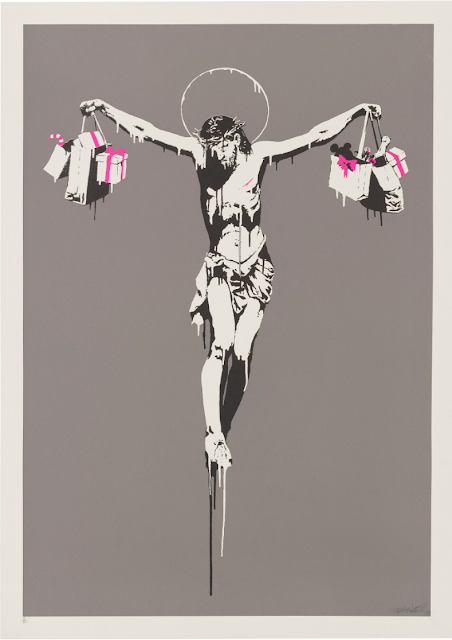
Advent SOG | Christ with Shopping Bags or Generous Christ?


"Christ with Shopping Bags" by Banksy, 2004 A.D.
 

The god of Consumerism
or the Generous Christ?

For this time between Jesus' advents,
He has chosen to redeem a people
to live now in light
of His coming Kingdom. ...

But has our identity as Christians
been shaped by consumerism?

+ Teena Dare


This week as we continue in Advent (i.e. season of watching and waiting for the arrival of Jesus' coming), when the days are short, the nights are long, and the darkness lingers, I need to be called back again and again to the Word who is life, light, and love for me (John 1:4-5, 14). 

I need the Word of life that
creatively gives rather than consumes. 

I need the Word of light that
reveals hope rather than conceals fear. 

I need the Word of love that
dwells in the darkness
 rather than only comforts with ease.

Do I try to escape the darkness
by trying to consume more or
do I wait in the dark and receive
what can only be given by the Light
who enters the darkness
and the darkness cannot overcome?

The Surge School article, "Consumerism" in Quarter 2: Gospel Formation helped me consider the questions above. Teena Dare's article is a provocative and convicting piece about the god of consumerism's intersection with the story of God (especially in light of Advent)In continuing to learn about my own habits of consumption, along with desiring to see Emmaus City Church grow more into a contrast community in a consumer culture, Teena's words are a prophetic reminder. 

This week, would you consider pausing for a moment with me to take stock of where our minds, bodies, and hearts are running to right now, fully realizing the tension that Teena (and I) admit to:

When big drama and grand beauty
is given to us
from the comfort of our couches
without requiring anything from us,
it can feel tiresome
to want to engage
our hearts, minds and bodies
with God through His story
and in His world.

The generous Christ counters
the god of consumerism by inviting us into


Creation

In the beginning (in Genesis 1-2) God created the world as very good. In Western circles, we have often started the story with the crisis in Genesis 3 and ended it with escape from this world. This dualistic theology that rejects God's love for creation provided a striking opportunity for the powers of consumerism to sing a more alluring song. 
When the gifts of creation are disconnected from the giver, our hearts grow cold towards God's generosity and we become critical consumers. When Christian doctrine treats the material world as evil or meaningless, we look elsewhere to make sense of our rich enjoyment of God's gifts. A biblical doctrine of creation returns things back to their rightful place. A right view of creation rejects the consumer story by inviting us to rejoice in the God who provides abundantly and confess our dependence on Him (1 Timothy 4:46:17). It also reorients us as cultivators of the world rather than passive consumers (Genesis 1:27-28).

Crisis

The consumer story tells us that the problem with the world is that we need more. But the true story locates brokenness in our rebellious hearts. Our first ancestors divorced their will from the Father's and everything went off the rails. They began to look to the rest of the world to meet their needs because they chose not to be whole through complete dependence on their Maker. Where once they cultivated blessing freely for the sake of the world, now they began to fight for it. Not only did the earth rebel against humanity but humanity rebelled against their responsibility to love the Earth. Instead of developing the Earth in a sustainable way, we have forcibly extracted its rich resources at a rate that prohibits continuous replenishment and flourishing. The land wants rest but our appetites won't allow it. Our nation suffers from diseases related to overconsumption while other nations are dying from the lack of basic necessities. Many Americans may have an abundance of consumer goods but we are more depressed and anxious than ever before. And while the affluent certainly experience the destructive effects of consumerism, it is the most vulnerable that bear the brunt of overconsumption. It is always the poor, both locally and internationally, that feel the full effects of our consumer lifestyles. Whether it's their proximity to a landfill, diminishing natural resources in their country, erosion of integral landscapes, inaccessibility to clean water and healthy food, or the volatile global economy 
 the vulnerable disproportionately absorb the effects of our idolatry.

Covenant Community (Israel)

Throughout Israel's (i.e. God's people) story, God longs to form them as a just and generous people in the midst of nations that worshipped power and greed. Israel's law was meant to subvert the idolatrous ways of Egypt that had surely shaped them over 400 years ... In the same way, we need the wisdom of the Old Testament to help us live all of life in the midst of our idolatrous culture. What Ten Commandments might the god of consumerism give to his worshippers and how can Scripture form us in a distinct way?

Ten Commandments
of the god of Consumerism

| 1 | 
I am the god of consumerism. 
Serve me, and I'll bring you the profit 
your heart desires. 

(In contrast, in God's economy, good business is cultivating blessing from his world to love your neighbor.)

| 2 | 
Promote your products and services 
as the very things that bring wholeness, ultimate satisfaction, and identity.

| 3 | 
Use my name however you'd like. 
Remember, I exist to serve you as along as you continue to serve me.

| 4 | 
Technology has granted you power
to work around the clock, logging hours seven days (and nights) a week. Take advantage of this to get ahead of the competition. 

(In contrast, in a world exhausted and ravaged by a lack of rest, we are called to use our vocational power to protect Sabbath rest for every person, animal, and plot of land in our care. As we honor the rhythms of day and night, the boundaries of family and work life, and weekly Sabbath rest in Christ, we point to a countercultural reality: work is not the ultimate aim of life (Exodus 20:8-11).)

| 5 | 
Honor the new way of things
above the integrity of any principles your parents or previous generations taught. 

(In contrast, we need to listen intently to the wisdom of the generation before us and heed their critiques. Sometimes they can see the idols of our day better than we can (Proverbs 13:1).)

| 6 | 
Addictive substances work 
in your products help to ensure success and a little slander of your competitors is OK. 

(In contrast, we are called to honor the image-bearing dignity of our competitors, employees, and customers (James 3:9-10).)

| 7 | 
Sex sells. 
Advertising with overexposed skin draws people in. And sexual joking in the office is all in good fun.

| 8 | 
Don't worry about fair wages 
for your workers in distant lands. 

(In contrast, scripture perpetually calls on God's people to care for the poor. A fundamental way to do that is to ensure they receive adequate wages and are not taken advantage of.)

| 9 |
Fudging numbers is necessary

and hiding the less attractive aspects of your business is a necessity in today's world. White lies are harmless. 

(In contrast, transparency in your budget and use of materials are a great means of accountability (Proverbs 12:22).)

| 10 | 
Capitalize on discontentment 
bred into our society. Make sure your products give out in a few years. Make your customers long for the newest model, the next experience, the novel idea. Covet others' success, and motivate your employees with that same spirit of extreme competition. 

(In contrast, honor the integrity and beauty of God's creation in the products and services you provide. God doesn't make junk, and we shouldn't either. Let your work serve actual needs rather than invent new ones. And model contentment in Christ as you grow and develop your business for His glory.)

Christ
Sacrificial Love Required
in a Suffering World
We need a savior to restore us to the true glory of being human, revealed most fully in the suffering love of the cross. We cannot save ourselves from the problems we have created and perpetuated.  
If salvation is found in having "more," than we are the saviors. We save ourselves by securing the things we want and need. We save the poor by giving away our unwanted items or by stimulating the economy and assuming it'll find its way to the margins. We save our kids by ensuring that they have what we didn't. When we worship the wrong things, we look to the wrong savior.  
Jesus didn't look to material goods to save Himself, but was often homeless, hungry and humiliated by the pomp of the powerful. He personally felt the powerful temptation to turn to comfort and wealth to blunt the suffering that love requires in a broken world. We need this kind of savior to redeem us from our idolatry. 
We can't save ourselves and we can't save the world. We need Jesus to redeem all things from the ravages of our greed and restore the flourishing He intended for the world. We need Him to forgive us for the way our complacency and selfishness have made us passive – but willing – participants in this global consumer religion.

Church

We have been called and are being sanctified so that our lives can point to a different way. The world is longing for hope, to rediscover a life of purpose and mutuality. We have an incredible opportunity for us to embody lives of generosity, self-sacrifice, communal commitment, and creative stewardship to a world that needs a new way. This is what our salvation is for. The sad reality is that even our identity as Christians has been shaped by consumerism. We readily accept the privileges that we receive in Christ but shirk off the related responsibility. We often consider church attendance, spiritual disciplines, and communal life as Christian commodities that we can consume when it serves our needs. When it gets uncomfortable, inconvenient, or stops being novel or interesting, we start to notice these things drop off. Work takes center stage or the stresses and grief of life in a broken world lead us to seek easier comforts that seem to satisfy what life in Christ hasn't. Community is hard and sometimes our Christian community doesn't show up for us when we really need them. This is deeply painful and we've been trained to withdraw and find other ways to numb that pain. But the church is not simply the commodity of community that we can opt in and out of. It is the primary identity that God calls us into and empowers us to cultivate. He has formed a people who collectively reveal His coming Kingdom as we love each other sacrificially and invite others into this family of mutual care (John 13:35). There is no option for us to be faithful to our calling apart from playing our part in the body of Christ. We also desperately need each other if we want to live distinct lives in our pervasive consumer culture. Some members of our family may be creatively pursuing ways to lower their carbon footprint. Some are incredibly generous and radically hospitable to their neighbors even if they struggle to meet their own needs. And still others are working creatively to produce alternatives to our broken consumer systems. We need to learn and grow together and support each other as we play our part in being a witness to the watching world.

Consummation

When Jesus returns to make all things new, it will be unparalleled celebration with people across all cultures. There will be an intimate exchange of color, flavor, and friendship beyond what our imagination can bear. But many of us don't feel the longing for that day because we are satisfied with far too little and consumed with daily demands and comforts that blind us from what we're missing. Luke 14:15-24 tells a parable of a great banquet that echoes true. Who is ultimately invited to the banquet? It is the poor, the blind, the lame, and those from the margins of the city. This isn't because the host doesn't invite the wealthy or middle class, but they are too busy to accept the invitation. In the early church, it was simply accepted that poor Christians were exceptionally rich in faith. The rich looked to them for spiritual wealth. Our culture tells us to respect and associate with the affluent and influential, but we know we're at a Kingdom feast when the marginalized are given the places of honor. When we share a dinner table and love materializes in generosity and mutual pursuit of Christ, we learn where life is truly found. We have much to learn from the global church to this end. In more communal and less materialistic societies this way of Christ is uniquely on display. All of our lives culminate in a single moment. That day when we will meet our King, no accomplishment or affirmation or storehouse of wealth will rival the most precious words we all long to hear: "Well done, good and faithful servant." Let us be counted faithful by investing in the people and places that Jesus identified with during His life and ministry (Matthew 25:31-46).

Fasting
Counter-Spiritual Formation
Consumerism has formed us through daily, embodied practices that shape our hearts, minds, and appetites. Through these habits we have conformed our lives to the pattern of the age. 
The counter-formation of disciplines, like fasting, are helpful to form us into our true identity: beloved children of God who have died to sin (and must die daily to the powers of consumerism) and been made alive with Christ. Fasting reminds us of our baptismal identity. As Jesus fasted in the desert, feeling the pull of temptation, I imagine He closed His eyes and was right back at the Jordan. Remembering what it felt like to go under the water – cut off for a moment from the air that sustained his lungs – and emerged, surrounded by the perfect love of the Father and Spirit. That moment under the water pointed to the not so far off day when His breath would fail Him as He hung on the cross. In those final moments, He would again entrust Himself to the perfect love of the Father. That love must have been incredibly tangible in those forty days in the desert. Each day, as He died to His bodily desire for bread, the perfect communion of the Trinity sustained Him and transformed Him. The only love that is powerful enough to conquer death was forming Jesus into the full glory of humanity.  
To be fully human in a deeply broken world, we must be freed from the bondage of sin. In order to behold the glory of the risen Christ, we must join Him in His death. We fast to begin to sense the difference between real hunger and the endless cravings that have become inordinate in our lives. To repent of ways that we have made ourselves into people who fulfill every desire with everything but Christ. As we forgo our daily bread, we recognize our need to feast on the Bread of life (John 6:35). As we feel discomfort, we take notice of what our hearts look to for comfort and invite the Spirit to reform us to find satisfaction in Him. We die to our insatiable appetites and experience the joy of deeper communion with Jesus.
I encourage you to take time to plan and prepare for a 24-hour fast from food and spending. (Of course, if you are pregnant or nurturing infants or have medical conditions that preclude you from fasting from food, you can choose something else to abstain from.) As you fast, reflect and write down what God is revealing to you about where you find life and how He is calling you to repent and be renewed in Him.

+ Adapted excerpt from Surge School
Quarter 2: Gospel Formation article,
"Consumerism," by Teena Dare

Previous Post: 

Waiting is the Womb

Other Advent Posts: 


Many blessings of peace and presence for you,

Rev. Mike “Sully” Sullivan