Showing posts with label Art of Neighboring. Show all posts

Thursday, May 28, 2026

Love Your Neighbor | Let in a Ray of Fresh & Unexpected Light


4 Reflections on Jesus' Response
to "Who is My Neighbor?"
in the Gospel of Luke (10:25-37)
 to Live into (Extra) Ordinary Time

"The story of the Good Samaritan as told by Jesus is designed to split open the worldview of its hearer and let in a shaft of new and unexpected light. Instead of the closed world of Jesus's hearers, in which only their own kith and kin were properly to be counted as neighbours, Jesus demands that they recognize that even the hated and feared Samaritan is to be seen as a neighbour." 
+ N.T. Wright 


"Who is my neighbor? The neighbor was the Samaritan who approached the wounded man and made him his neighbor. The neighbor ... is not he whom I find in my path, but rather he in whose path I place myself, he whom I approach and actively seek." 
+ Gustavo Gutiérrez  


Walking with Jesus transforms us
to see others through His eyes.

Welcoming and loving our neighbors
like He does will give us
the gift of stopping the rush of life
to listen to and have compassion
on those we get the privilege
to cross paths with where
we work, live, and play.


"The Jericho Road is a winding, meandering road. It's really conducive for ambushing ... In the day of Jesus it came to be known as the 'Bloody Pass.' And you know, it's possible that the priest and the Levite looked over that man on the ground and wondered if robbers were still around. Or it's possible that they felt that the man on the ground was merely faking. And he was acting like he had been robbed and hurt, in order to seize them over there, lure them for quick and easy seizure. And so the first question that the Levite asked was, 'If I stop to help this man, what will happen to me?' But then the Good Samaritan came by. And he reversed the question: 'If I do not stop to help this man, what will happen to him?'" 
+ MLK   


"There are no ordinary people. You have never talked to a mere mortal. ... It is immortals whom we joke with, work with, marry, snub and exploit ... Our merriment must be of that kind (and it is, in fact, the merriest of kind) which exists between people who have, from the outset, taken each other seriously – no flippancy, no superiority, no presumption." 
+ C.S. Lewis 


Fresh Wind
+ UNITED, 2022 A.D.

Spirit sound, rushing wind,
Fire of God fall within,
Holy Ghost, breathe on us,
We pray.

As we repent, turn from sin,
Revival embers smoldering;
Breath of God,
Fan us into flame …

We need a fresh wind,
The fragrance of Heaven.
Pour Your Spirit out … 
(ask x2)!

For hearts that burn with holy fear,
Purified in faith and deed;
Refiner's fire,
Strengthen what remains.

So we the Church who bear Your light,
Lamp aflame, city bright
King and Kingdom come
Is what we pray …

We need a fresh wind,
The fragrance of Heaven.
Pour Your Spirit out …
(ask x2)!

A holy anointing, 
The power of Your presence. 
Pour Your Spirit out … (ask x2)!

Let all the redeemed
Prophesy and sing,
“We can hear the wind blowing
(blowing x3)!”

Move upon our praise,
Sons and daughters sing,
“We can hear the wind blowing (x3)!”
(Repeat + Chorus)

Bonus Neighbor Posts:


Christ is all,

Rev. Mike “Sully” Sullivan

Monday, December 9, 2024

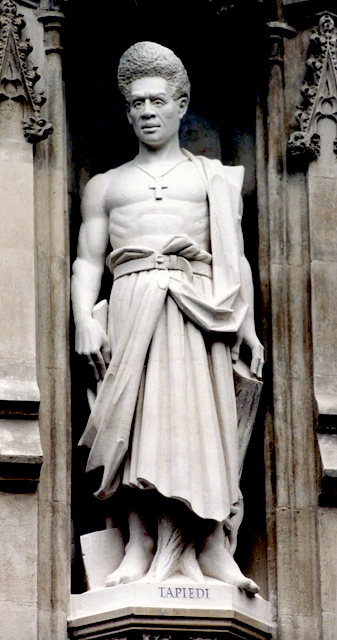
Joy in the Dark | Lucian Tapiedi of New Guinea, "Stay Put"


Lucian Tapiedi of Papua New Guinea at Westminster Abbey

 "I'll stay with 
the fathers and sisters."

+ Lucian Tapiedi,
1921-1942 A.D.

As the season of Advent continues, I am reminded again of the introduction to Our Church Speaks: An Illustrated Devotional of Saints from Every Era and Place:

Saints often are peculiar people
who stand out in a particular time and place. 
In fact, the times when saints shine
the most are times of darkness.
They give glimpses of Jesus’ Light,
which darkness cannot overcome.

And we, as part of Jesus’ Church,
are called to live as Advent people 
who anticipate Jesus’ coming
into our darkness today to overcome it. 
Ultimately, our hope rests in the God of Advent
who drew near to us in Jesus’ first coming
and will come again
to take away the darkness forever
and be our eternal Light.
That hope is what saints have embodied
as our sisters and brothers across time,
ethnicities, Christian traditions,
nationalities, and more.

This post features an excerpt from Our Church Speaks about Lucian Tapiedi who practiced joy as 

an act of resistance 
against all the forces of despair: 
violence, war, debt, death ... 
all of the things that can cause us 
to think life in this world 
is not worth living.


Lucian Tapiedi
Martyr of Papua New Guinea

Lucian Tapiedi was among a group of clergy, teachers, and medical missionaries ministering in Papua New Guinea in the 1930s and 1940s. The son of a Papuan sorcerer, Tapiedi came to faith in Christ at an Anglican mission school. He studied at St. Aidan's Teacher Training College and served as a teacher and evangelist. Tapiedi was known for his joyful spirit and love for learning, physical recreation, and music.

On January 4, 1942, the Japanese Empire launched an invasion of New Guinea as part of their offensive campaign across the Pacific. Philip Strong, Anglican bishop of New Guinea, instructed missionaries, evangelists, and clergy to remain at their posts, despite the extreme risks. "If we all left, it would take years for the local church to recover from our betrayal of our trust. If we remain — the local church would not perish, for there would have been no breach of trust in its walls, but its foundations and structure would have received added strength for the future building by our faithfulness unto death." Tapiedi and all of the bishop's staff chose to stay at their posts and suffer death, if necessary. With the Japanese invasion imminent, Tapiedi instructed his married colleagues, "Take your wives and families to the bush and hide. I am single. I'll stay with the fathers and sisters; it doesn't matter if the Japanese get me." Tapiedi was among 333 Christians who were murdered during the Japanese invasion and occupation of New Guinea. Bishop Strong suffered bombings and machine-gunning and only narrowly escaped death himself. The fruit of the martyrs' sacrifices resulted in a renewal of the New Guinea church after the war.

Scripture

"Only let each person lead the life
that the Lord has assigned to him,
and to which God has called him.
This is my rule in all the churches ...
So, brothers and sisters, in whatever
condition each was called,
there let him remain with God."
+ 1 Corinthians 7:17, 24

Meditation: 
The Power of Staying Put

When a monk joins a monastery, he or she takes a vow of stability, promising to live out the rest of their days in that place. The idea is that true spiritual formation in community can happen only when there is stability. If the members of the community keep rotating in an out, then the rhythms of work and rest, conflict and forgiveness, giving and receiving, leading and following, cannot knit a group of people together. If you have to keep replanting the tree, you'll never harvest any fruit. 

So many of us experience fruitlessness in our Christian life because we keep replanting the tree, so to speak, as we move from neighborhood to neighborhood, city to city, in search for a better life. What we often do not realize is the affect that our leaving has on the people in the rearview mirror. How does our leaving affect those who are left? How does it affect the communities we leave behind?

To be fair, sometimes the leaving is good and necessary
 — a departure to care for a sick relative, or to serve an urgent need, or to proclaim the Gospel to an unreached people. Then we commission our best to go forth with the Lord's blessing. 

However, most leaving is of a different sort. We tend to leave because the grass is greener, the taxes lower, the housing cheaper, the jobs better, the people kinder. When Christians leave their neighborhood and city for a better life elsewhere, we tell a lie to the people we leave behind. We tell them that we were only there for what we could get out of it. We tell them that the Christian life is the same as any other life. When Christians leave, our absence speaks a word to our former cities, and it is a word of rejection.

If Christians are to embody
the love of Jesus 
to our neighbors and city,
then it must begin with 
and 

We might not make 
formal monastic-style vows, 
but we ought to be 
very resistant to uprooting.
It is a profoundly Christian thing to

What would it take to
uproot you from your place?
How redemptively stubborn are you?
when going is so much easier?

Lucian Tapiedi knew
Even when staying became perilous, 
he did not budge.
His refusal to abandon his place
was the greatest testimony
to the Gospel that he could speak.
He knew this because he knew that

God is wonderfully stubborn in that way.
Jesus just won't budge.
Come hell or high water,

Prayer

O eternal Lord God, You hold all souls in life: Shed forth upon your whole Church in Paradise and on earth the bright beams of Your light and heavenly comfort; and grant that we, encouraged by the good example of Your holy martyr Lucian Tapiedi and all of those who have loved and served You, may enter with them into the fullness of Your unending joy; through Jesus Christ our Lord. Amen.

pgs. 148-150

The Celebrity & The Saint

The celebrity demands,
"Look at me!"
The saint whispers,
"Look at God."

The celebrity says,
"Try to be like me,
but you'll never be like me."
The saint says,
"Why would anyone want to be like me?
Who has God made you?"

The celebrity is ever ascending,
climbing the tower of Babel
to the double-platinum throne.
The saint is ever descending,
saying, "Please have my seat, I insist."

The celebrity offers you everything
you want but can never have.
The saint offers you the thing you fear
but will redeem your soul.

The celebrity is a Ferrari
screaming down the highway
with music blaring.
The saint is the freshwater creek
beside the highway
that almost nobody ever notices
and is nearly impossible to hear
over the roar of traffic.
Yet the water murmurs
as it wanders over stones
and around oak roots.
It is not silent.

+ Ben Lansing & D.J. Marotta,
Our Church Speaks


Many blessings of peace and presence,

Rev. Mike “Sully” Sullivan

Wednesday, August 28, 2024

Love Over Fear | Releasing the Goodness of Fierce Forgiveness


The Chosen Season 4, Episode 5: Matthew 5:39-41

Forgiveness is not giving
yourself over to the attacker;
it's giving yourself over
to another way of being.
A way that disempowers the threat.

Forgiveness is not passive
or laissez-faire;
it is fiercely engaged:
"I am willing to forgive ... "

Love Over Fear

In the final chapter in the book I wanted to finish reading before the school year starts this week, Love Over Fear: Facing Monsters, Befriending Enemies, and Healing Our Polarized World, Dan White chose to focus on forgiveness in a way that I continue to see as distinctly and desperately needed in my life and in 21st century American Christianity as a whole. The entire chapter reminded me of this quote by Celestin Musekura in Forgiving As We've Been Forgiven: Practices for Making Peace that I continue to come back to:

If Christ is risen, death is defeated. 
Even our deepest hatred 
can be transformed into love.

Read on to learn more and at the end of the post see how the picture above relates to forgiveness.

Forgiveness Tells a New Story

Jesus provides practices and responses of forgiveness that are disruptive. They are infused with "I will not devolve into your way of speaking, of hurting, of mocking, of gossiping, of shaming, or humiliating," nor "will I repay evil with evil but evil with good."

Jesus is inviting His disciples into writing a new story, a new way of engagement, powered by forgiveness. We cannot choose what hurt and pain happen to us, but we can always choose how to relate to what happens to us.

Part of forgiveness is finding
a new story to live by
rather than the one given to us
by those who hurt us,
gossip about us, oppose us,
lie about us, and hate us.
Living by the old story
draws us into the
same practices that hurt us.

Leaving the standoff of "Us vs. Them"
means shifting from the status 
of the victim to the one voluntarily
pouring out love.
This shift is a shift of power.

Power does not emanate from someone
with the loudest mouth
or the biggest sword;
it originates from the agency of love
by God's Spirit.

To live in a new story,
we must see ourselves differently.

Jesus is reframing the story, the characters, and their roles. 

Who Rules Your Story?

Typically, the one who has been wronged rehearses their offenses, over and over and over again. This replay is our grievance story that stirs up our Crock-Pot of desire for vindication. Psychologist Joan O'C Hamilton explains this story:

Initially, a grievance story is simply one's
version of what happened. But over time,
it can become something more malignant
— a detail-packed, often obsessively
repeated, subtly or not-so-subtly
distorted account that embellishes
the role of a villain who is
responsible for one's misery.

Researcher Fred Luskin states,

"The problem with our stories 
is they always focus on 'them'
 — the other person — 
and why he won't change 
or what she won't do. 
That gives them power 
they shouldn't have." 
The constant focus and attention 
on the insult and the offender 
gives them absolute power over us; 
they rule the story. 

Who rules your story? 

Do you want to live by the narrative
of vindication and vengeance rather
than generosity and grace?

I concede there is a moral high
when we punish someone 
who has wronged us.
But it is an addiction like
crack cocaine that will
string us along into death.

Jesus is flipping the story of who holds power. Forgiveness is not powerlessness; it actually might be the only thing powerful enough to transform your enemy. Jesus is giving us insight into the monsters. We see them as desperate, as one who stands before you and pleads, without actually saying it, "Help me, give me the one thing that can overcome my hate, my fear, give me love, the love of Jesus." When we become the forgiver, we begin to disrupt the cycle of who holds power.

Releasing Goodness

To forgive could feel like surrender, a retreat in the context of a battle. But Jesus offers us forgiveness not as a white flag but as a weapon. Wonder of wonders — God suffered for us instead of exacting suffering on His enemies. Jesus absorbed our sin, our grief, and our injuries. We begin to see ourselves dealing with others the way God deals with us, releasing goodness — full of compassion, flowing in mercy.

It is not God's judgment
but God's kindness
that leads to repentance,
a change of heart 
(Romans 2:4).

Can forgiveness
change our enemies?


Shauna Hodges woke one morning, peered out the window, and was startled by the oversized Confederate flag waiving on her neighbor's porch. Shauna and her neighbor Mike had always been on different pages politically, creating some awkwardness in their exchanges, but never in conflict. Shauna is a black churchgoing mother. Mike is an Irish churchgoing grandfather. Shauna is single, and her house is filled with baby toys, piled-up dishes in the sink, and Cheerios littering the floor from her two-year-old.

Mike's home is filled with memories from his life — pictures of his grandkids, a medal of honor hanging over the fireplace mantel, and his well-worn recliner where he reads the Sunday newspaper. They come from different worlds and conveniently stayed out of each other's way, but this flag hanging on Mike's porch really stung Shauna; a daily reminder of slavery every time she walked outside. She did not want her child to see it on a regular basis. What could she do?

She asked her church small group for counsel. Enraged, a few of them began to plan how to rip it down under cover of night. A few others said to "just ignore it," and maybe he'll take it down after a while. None of their answers resonated.

With courage and kindness, she walked across the street to have a conversation. He did not answer the doorbell; with trembling hands she scribbled a note and left it: "Hi neighbor, I'd like to invite you over to get a cup of coffee, and chat about your flag." She carried a pit in her stomach as she waited for his response; two long weeks went by. 

As she was taking a walk with Gracian, her son, on a Saturday afternoon, she noticed Mike pull into his driveway, so she bolted to his house like the paparazzi. She was there with a forced smile to greet him as he exited his car. Mike made it clear he was not interested in connecting. She pressed, "I'm not your enemy; I just want to talk." He relented, "Fine, tomorrow."

Knocking on his door the next day, she wished she had never started pushing this snowball down the hill; it felt bigger than she was. As he let her in, she saw the signs of life, pictures of grandchildren, newspapers stacked, and war paraphernelia on the walls.

They talked for an hour, nibbled on muffins she baked, laughed some, and shared about kids, and grandkids and eventually talked about the flag. He was stubborn, but she was able to unfold a bit of why it hurt her. Relenting halfway, "I'll take it down for you, even though it doesn't make a lick of sense." A few days later, the flag came down. Shauna put a little gift basket on his porch, with a blueberry pie, and another note: "I want you to know how much it means to me." Over that following year, a relationship began to sprout. He shoveled her driveway once when she was snowed in. He even offered to watch her kid if she ever needed a break.

In an urgent moment, she took him up on his offer, while Gracian was taking a nap. When came home to relieve Mike of his babysitting duties, Gracian was still sleeping, they lingered awkwardly at the dining room table. Mike broke the ice: "I've been thinking about the flag thing." He began to see that the flag communicated racism. Then the bombshell: "Honestly Shauna, you are the first black person I've been friends with." Mike was reconsidering who he was and who she was. Shauna's overtures of affection had started breaking the cycle of polarization.

From the outset, Shauna had decided she would forgive Mike for his disparaging feelings toward black folks, the unknowing insensitive remarks that leaked out of his mouth. Christ's words rang in her ears: "Father, forgive them, for they do not know what they are doing." Though she initially feared him, she sought to disrupt him with friendship. She positively spoke truth to him, but it was wrapped in connection and compassion. This changed his world.

The Burning Coals

Neuroscience has proven that pummeling your ideological enemy with factoids and arguments will not change your enemy's mind. Shauna's practices toward Mike and the Jesus-practices of forgiveness (see Matthew 5:39-41, pic at the top from The Chosen, and Walk the Extra Mile below) go far beyond tossing information; they give space for the wrongdoer to feel something different, to see us no longer as their enemy, but as a human. 

Jesus' kenotic-love
did not demand reciprocity;
it did not seek to control
the outcomes, 
but it did seek to
affectionately win us over,
to make friends of those
opposed to Him.

"If your enemy is hungry, feed him; if he is thirsty, give him something to drink. In doing this, you will heap burning coals on his head" (Romans 12:20). Here the apostle Paul is giving us some guidance for those who are hardheaded. As we read this, one portion sticks out: "heap burning coals" on an enemy's head. What did he mean by this?

The most dramatic picture we have of burning coals touching our body comes from Isaiah 6:5-7, an act of mercy, of God's initiative to ease Isaiah of his anxiety in God's presence. God, in essence, is saying, "You've done a lot of things that have offended Me, stuff you probably can't even recall, but I forgive you, I want to be near you." These coals are a symbol of God's preemptive forgiveness, an action of God to be near us, with us, close to us.

The coals in this passage are placed on Isaiah's lips because he has already verbalized his wrongs ("Woe is me!"). The coals Paul speaks of in Romans are placed on the head, not on the mouth — the hardness of the head vs. the openness of the mouth. This act of forgiveness (heaping hot coals) isn't given to one who asks for it; they might actually be closed off to it. 

The passage about
heaping hot coals on the head
is about the emotional discomfort
an enemy will experience
when you waken their conscience
through affection;
when they feel kindness
in the face of their meanness.

We cannot manipulate 
someone's response.
We can only heap hot coals
on their head hoping that
they feel the love.

A Jesus-Practice of Forgiveness:
Walk the Extra Mile

The audience Jesus is speaking to has a boot on their neck, upwards to 80% of their income is taken from them in taxes, which keeps them in poverty. According to Roman law, a soldier could command you to carry their gun and gear, so you had to submit. The law limited it to one mile as to prevent soldiers from creating permanent servants on the road. 

Jesus says when this happens to you, keep going after the one-mile mark. The moment you enter into second mile. What is going on?

You are triggering something
that the enemy is not anticipating,
and you force the enemy
to see you differently ...
a human being with dignity,
agency, and the will to serve. 
Your humility invites the one 
who sought to humiliate you 
into humbling themselves.

Jesus exceeds combating our enemy
into awakening our enemy.

Love Over Fear:
The Aikido of Forgiveness
+ pgs. 200, 203-213

Bonus Love Over Fear Quote: 

By dying as He did,
Christ shows that He loves us
in such a way that
He can descend into our private hells.

His love is so empathetic and compassionate
that it can penetrate all barriers
that we construct out of hurt and fear,
in order to enter right into
our despair and hopelessness.

We see this idea expressed
powerfully in John 20.
Twice John presents the disciples
as huddled behind closed doors,
locked in because of fear.
Twice John has Jesus come through
the locked doors and stand
in the midst of that frightened
 and depressed group and
breathe peace into them.

That image 
 
Christ going through locked doors 
 is perhaps the most consoling image
within our entire faith.

Put simply, it means God can help us
even when we cannot help ourselves.
God can empower us
even when we are too weak
and despairing to even, minimally,
open the door to let Him in.

There is no hell 
 no private hell of wound, depression,
fear, sickness, or even bitterness 
 
that God's love cannot and will not
descend into.
Once there, (God's love)
will breathe out
the peace of the Holy Spirit.

+ Fr. Ronald Rolheiser,
Prayer: Our Deepest Longing

Bonus Forgiveness Post:


Next Post:


Other 2024 Reading Recs:

Tuesday, October 25, 2022

CN | B.L.E.S.S. Like Jesus: Begin with Prayer Practices & Stories


Jesus lived out the B.L.E.S.S. practices in His daily life on Earth, and He did that by beginning with prayer. I know it's risky and can feel uncomfortable, but only God knows the impact you and I can make in someone's life when we choose to be a B.L.E.S.S.ing. And it all begins with prayer. + B.L.E.S.S.: 5 Everyday Ways to Love Your Neighbor


To close 2022, Emmaus City Church will finish the year focusing on living into the Way of Jesus through B.L.E.S.S. practices. The first found in B.L.E.S.S.is Begin with Prayer:

In prayer, we open ourselves to God and the leading of His Spirit. In prayer, we focus our minds to recognize His promptings. In prayer, we receive the direction we need to discover the people God is calling us to bless. + pg. 47

Following the message last weekend, each person in Emmaus City Church was encouraged to shape each day with 3 prayer practices:

1) Morning Wake Up: Pray "Our Father" or Lord' Prayer to anchor in your child of God identity and Kingdom of God purpose for the day

2) Midday Mission: Thank the Lord Jesus for saving you and pray for Him to save someone (and ask how He wants you to be a witness to that someone)

3) Evening Examen: Practice offering gratitude for grace-filled moment(s) in the day, and ask the Spirit to help you see the grace you might have missed

The second prayer focus has also been a practice this week for our Surge Tables from various congregations throughout Worcester County. The intentionality and opportunities to act in faith given from this practice have not been lost on me or others I have heard from. In many ways, each day has fulfilled this quote:

When you begin with prayer, God begins to change your heart, and you begin to feel what God feels for other people. When God's Spirit allows you to feel what God feels, you get ideas that come from God, like "Send a text to your neighbor to see how he's doing" or "Ask your friend if she's got time for coffee this week." ... If you and I are going to be blessings to the people around us and take the mission of Jesus seriously, we are in for an adventure. + pgs. 42, 46

While my experiences with my neighbors and friends in Worcester are stories I'm game for sharing in person, for the sake of honor and anonymity, this post will feature a few stories from B.L.E.S.S. in the section, "Crazy Things Begin with Prayer" in Chapter 3: B: Begin with Prayer that I hope encourage you today. And remember, if you sense Jesus inviting you to join in this fun and sometimes a little crazy adventure:

We never know how God will answer our prayers, but we can expect that He will get us involved in His plan for the answer. 
Holocaust survivor Corrie ten Boom

Louie's Story: "Go Tell That Guy God Loves Him"

One day Louie went to the mall, and for whatever reason he noticed a guy sitting on a bench. He said he had a strange sensation: Go tell that guy God loves him. Of course, Louie didn't want to do that. (Would you want to walk up to someone you don't know at all and say, "Hey, God loves you"?) So he did what most of us might: he shrugged it off and kept on shopping. 

When Louie came out of a store in another part of the mall a bit later, there was that same guy again. Again, Louie felt an inner nudge. Go over there and tell him God loves him. He blew it off again. Then a third time, he saw the same guy. Again, he got the same prompting. Finally, he said, "Alright!" He walked up to the guy and said, "I don't want to seem weird or anything, but I feel like I'm supposed to tell you that God loves you." 

Immediately, the stranger's eyes filled up with tears, and he said, "This morning I was at the end of my rope. I told God, 'If You're real, show me You love me today.' I don't know who you are, but you're the third random person in the mall today who's come up to me and said 'Hey, I don't know you, but God loves you.' No one's ever said it to me once before, and now it's happened three times in one day."

Dean and Janice's Story: "Send Someone to Tell Me How to Be a Christian"

My friend Dean, who works in college ministry at a large state university, has made it a practice over the years to begin every day, instead of waiting for God to grab his attention, to be intentional in giving his attention to God. He begins each day with a prayer to be a blessing to his neighbors and asks God for divine appointments. His prayer is very simply that he would meet and talk to people God wants him to bless. And then he just goes through his day assuming whomever he talks to might be that divine appointment.

I remember one story he hold me about someone canceling an appointment with him. Instead of filling the time with emails or an Instagram post, he decided to pray. He asked, "God, how do You want me to use this time?" As he sat still, listening to God, the name of a student, "Janice," came to him. He sensed he was supposed to talk to her about Jesus. Janice had never been with a local church and was not a Christ-follower, but she had been to a college small group a couple times. So he called and asked to connect over coffee. She said, "Sure."

When they met, he just told her, "Janice, I was praying and your name came to mind, and I felt like I was supposed to share with you how you can become a follower of Jesus." Janice stood there in silence. First came a tear ... and then sobbing. Dean immediately recoiled and said, "Oh, I'm so sorry. I shouldn't have just blurted that out ... did I say something that offended you?"

"No. Not at all," Janice said. "I just can't believe you said that. Last night I decided to go to a Bible study in my dorm. They were talking about what it means to be a Christian, and I couldn't stop thinking about it. All night, I couldn't sleep. I didn't know what to do about it. So I prayed this morning, asking God to bring someone to me today to tell me how to become a Christian." She smiled and said, "And here you are. I just can't believe it!" 

Marco and Victoria's Story: "They Helped Me Find My Way Back to God"

Marco had heard me teach on the B.L.E.S.S. practices and began to pray for his friend Victoria. At a very young age her family quit attending church, and by the time she was an adolescent, she had experienced so much pain that even if there was a God, she reasoned, He wasn't a nice guy. So during middle school, she began to tell people she was an atheist, and her Christian friends ... were not very kind. 

Her young adulthood was filled with searching for what was missing. She got married, but then cheated on her husband and destroyed the relationship. She decided to move far from home where she sought out happiness in sexual adventures that ultimately ruined her emotionally, relationally, and financially. 

Victoria met Marco after moving back to where she grew up. He began to pray for her and listen to her story of searching. Their friendship was slowly turning into a romance. Marco had the wisdom not to push faith, Jesus, or God on Victoria. He understood that he was to be the salt of the earth, but also that rubbing salt into a wound like she had would be very painful. So he helped Victoria heal.

Victoria began to ask Marco questions about spiritual things, and Marco asked her if she would like to go visit his church with him. She was very skittish about being around Christians; the voices of her middle school friends still echoed. He reassured her it wouldn't be like that, and eventually, she showed up, unsure, but with an open heart. Over the next few weeks, Victoria not only went with Marco, she also joined a smaller group of people from the church that ate together every week. This group became friends, and in time it became a transforming community in her life. She later said, "What I found in that group were some genuinely amazing people. It was those people who helped me find my way back to God." 

There are a couple reasons I will never forget the day that Marco baptized Victoria. First, because she courageously told the whole church her heart-breaking but beautiful story — and after she was baptized, the people she feared would judge her gave her a raucous standing ovation. And second, because I got to see Marco use simple, everyday ways of B.L.E.S.S.ing to love his friend to salvation. 

That blessing turned into a mutual one when Victoria and Marco got married. And Marco's simple prayer for Victoria grew into a beautiful family with three children.

A Practice of Prayer: Plan, Prepare, Places, People

Plan: Perhaps you might decide to pray for five minutes before you get out of bed and five minutes at night before you go to sleep (ex. compline). Or you might set a reminder on your phone to pray during your lunch hour or some other time of the day. Plan to pray for your neighbors by name. 
Prepare: As you pray, ask God to prepare your heart for the adventure. Ask God to give you eyes to see how He is leading and the courage to follow Him. Be bold: ask Him to give you divine appointments with each of the people named, as well as others. 
Places: As you pray, make a mental map of the places you'll visit during the day. Ask God to help you be sensitive to your surroundings and guide you to places where He wants you to be a blessing. 
People: Ask God to show you how to be a blessing to your neighbors (ex. your 8 closest at home or at work as described in The Art of Neighboring). As you pray, envision the faces of each of your neighbors and ask God to show you how you can be a blessing in their lives today. 
What if instead of waiting for God to grab our attention, we were intentional about giving it to Him? 

What if we began each day with a prayer to be a blessing to our neighbors and asked God for divine appointments?

Every day, we get to seek to find how God can use each of us to bless the world, and this adventure begins with prayer. Remember that when you pray for people you are already blessing them. There are people you come across every day who have never had someone pray for them. Pray for their physical health, their relationships, their emotional well-being, their careers, and their finances. Begin with prayer and there's no telling where Jesus might send you and what He might lead you to do. It's life-changing.  
Let the adventure begin. 

+ excerpts above from Chapter 3: B: Begin with Prayer in B.L.E.S.S.: 5 Everyday Ways to Love Your Neighbor


Here are links to other recent City Notes (CN) books:

With presence, peace, and many prayerful blessings,

Rev. Mike “Sully” Sullivan