
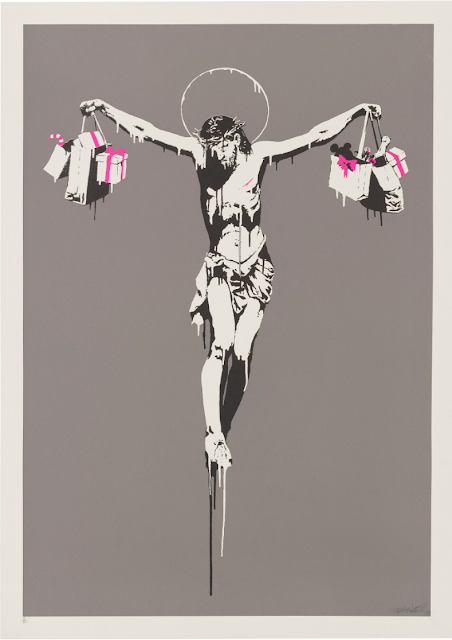
 |
| "Christ with Shopping Bags" by Banksy, 2004 A.D. |
The god of Consumerismor the Generous Christ?
For this time between Jesus' advents,He has chosen to redeem a peopleto live now in lightof His coming Kingdom. ...
But has our identity as Christiansbeen shaped by consumerism?
+ Teena Dare
This week as we continue in Advent (i.e. season of watching and waiting for the arrival of Jesus' coming), when the days are short, the nights are long, and the darkness lingers, I need to be called back again and again to the Word who is life, light, and love for me (John 1:4-5, 14).
I need the Word of life that
creatively gives rather than consumes.
creatively gives rather than consumes.
I need the Word of light that
reveals hope rather than conceals fear.
reveals hope rather than conceals fear.
I need the Word of love that
dwells in the darkness
rather than only comforts with ease.
dwells in the darkness
rather than only comforts with ease.
Do I try to escape the darkness
by trying to consume more or
do I wait in the dark and receive
what can only be given by the Light
who enters the darkness
and the darkness cannot overcome?
do I wait in the dark and receive
what can only be given by the Light
who enters the darkness
and the darkness cannot overcome?
The Surge School article, "Consumerism" in Quarter 2: Gospel Formation helped me consider the questions above. Teena Dare's article is a provocative and convicting piece about the god of consumerism's intersection with the story of God (especially in light of Advent). In continuing to learn about my own habits of consumption, along with desiring to see Emmaus City Church grow more into a contrast community in a consumer culture, Teena's words are a prophetic reminder.
This week, would you consider pausing for a moment with me to take stock of where our minds, bodies, and hearts are running to right now, fully realizing the tension that Teena (and I) admit to:
When big drama and grand beauty
is given to us
from the comfort of our couches
without requiring anything from us,
it can feel tiresome
to want to engage
our hearts, minds and bodies
with God through His story
and in His world.
from the comfort of our couches
without requiring anything from us,
it can feel tiresome
to want to engage
our hearts, minds and bodies
with God through His story
and in His world.
The generous Christ counters
the god of consumerism by inviting us into

Creation
In the beginning (in Genesis 1-2) God created the world as very good. In Western circles, we have often started the story with the crisis in Genesis 3 and ended it with escape from this world. This dualistic theology that rejects God's love for creation provided a striking opportunity for the powers of consumerism to sing a more alluring song. When the gifts of creation are disconnected from the giver, our hearts grow cold towards God's generosity and we become critical consumers. When Christian doctrine treats the material world as evil or meaningless, we look elsewhere to make sense of our rich enjoyment of God's gifts. A biblical doctrine of creation returns things back to their rightful place. A right view of creation rejects the consumer story by inviting us to rejoice in the God who provides abundantly and confess our dependence on Him (1 Timothy 4:4, 6:17). It also reorients us as cultivators of the world rather than passive consumers (Genesis 1:27-28).
In the beginning (in Genesis 1-2) God created the world as very good. In Western circles, we have often started the story with the crisis in Genesis 3 and ended it with escape from this world. This dualistic theology that rejects God's love for creation provided a striking opportunity for the powers of consumerism to sing a more alluring song. When the gifts of creation are disconnected from the giver, our hearts grow cold towards God's generosity and we become critical consumers. When Christian doctrine treats the material world as evil or meaningless, we look elsewhere to make sense of our rich enjoyment of God's gifts. A biblical doctrine of creation returns things back to their rightful place. A right view of creation rejects the consumer story by inviting us to rejoice in the God who provides abundantly and confess our dependence on Him (1 Timothy 4:4, 6:17). It also reorients us as cultivators of the world rather than passive consumers (Genesis 1:27-28).
Crisis
The consumer story tells us that the problem with the world is that we need more. But the true story locates brokenness in our rebellious hearts. Our first ancestors divorced their will from the Father's and everything went off the rails. They began to look to the rest of the world to meet their needs because they chose not to be whole through complete dependence on their Maker. Where once they cultivated blessing freely for the sake of the world, now they began to fight for it. Not only did the earth rebel against humanity but humanity rebelled against their responsibility to love the Earth. Instead of developing the Earth in a sustainable way, we have forcibly extracted its rich resources at a rate that prohibits continuous replenishment and flourishing. The land wants rest but our appetites won't allow it. Our nation suffers from diseases related to overconsumption while other nations are dying from the lack of basic necessities. Many Americans may have an abundance of consumer goods but we are more depressed and anxious than ever before. And while the affluent certainly experience the destructive effects of consumerism, it is the most vulnerable that bear the brunt of overconsumption. It is always the poor, both locally and internationally, that feel the full effects of our consumer lifestyles. Whether it's their proximity to a landfill, diminishing natural resources in their country, erosion of integral landscapes, inaccessibility to clean water and healthy food, or the volatile global economy – the vulnerable disproportionately absorb the effects of our idolatry.
The consumer story tells us that the problem with the world is that we need more. But the true story locates brokenness in our rebellious hearts. Our first ancestors divorced their will from the Father's and everything went off the rails. They began to look to the rest of the world to meet their needs because they chose not to be whole through complete dependence on their Maker. Where once they cultivated blessing freely for the sake of the world, now they began to fight for it. Not only did the earth rebel against humanity but humanity rebelled against their responsibility to love the Earth. Instead of developing the Earth in a sustainable way, we have forcibly extracted its rich resources at a rate that prohibits continuous replenishment and flourishing. The land wants rest but our appetites won't allow it. Our nation suffers from diseases related to overconsumption while other nations are dying from the lack of basic necessities. Many Americans may have an abundance of consumer goods but we are more depressed and anxious than ever before. And while the affluent certainly experience the destructive effects of consumerism, it is the most vulnerable that bear the brunt of overconsumption. It is always the poor, both locally and internationally, that feel the full effects of our consumer lifestyles. Whether it's their proximity to a landfill, diminishing natural resources in their country, erosion of integral landscapes, inaccessibility to clean water and healthy food, or the volatile global economy – the vulnerable disproportionately absorb the effects of our idolatry.
Covenant Community (Israel)
Throughout Israel's (i.e. God's people) story, God longs to form them as a just and generous people in the midst of nations that worshipped power and greed. Israel's law was meant to subvert the idolatrous ways of Egypt that had surely shaped them over 400 years ... In the same way, we need the wisdom of the Old Testament to help us live all of life in the midst of our idolatrous culture. What Ten Commandments might the god of consumerism give to his worshippers and how can Scripture form us in a distinct way?
Throughout Israel's (i.e. God's people) story, God longs to form them as a just and generous people in the midst of nations that worshipped power and greed. Israel's law was meant to subvert the idolatrous ways of Egypt that had surely shaped them over 400 years ... In the same way, we need the wisdom of the Old Testament to help us live all of life in the midst of our idolatrous culture. What Ten Commandments might the god of consumerism give to his worshippers and how can Scripture form us in a distinct way?
Ten Commandments
of the god of Consumerism
| 1 |
I am the god of consumerism.
Serve me, and I'll bring you the profit
your heart desires.
(In contrast, in God's economy, good business is cultivating blessing from his world to love your neighbor.)
| 2 |
Promote your products and services
as the very things that bring wholeness, ultimate satisfaction, and identity.
| 3 |
Use my name however you'd like.
Remember, I exist to serve you as along as you continue to serve me.
| 4 |
Technology has granted you power
to work around the clock, logging hours seven days (and nights) a week. Take advantage of this to get ahead of the competition.
(In contrast, in a world exhausted and ravaged by a lack of rest, we are called to use our vocational power to protect Sabbath rest for every person, animal, and plot of land in our care. As we honor the rhythms of day and night, the boundaries of family and work life, and weekly Sabbath rest in Christ, we point to a countercultural reality: work is not the ultimate aim of life (Exodus 20:8-11).)
| 5 |
Honor the new way of things
above the integrity of any principles your parents or previous generations taught.
(In contrast, we need to listen intently to the wisdom of the generation before us and heed their critiques. Sometimes they can see the idols of our day better than we can (Proverbs 13:1).)
| 6 |
Addictive substances work
in your products help to ensure success and a little slander of your competitors is OK.
(In contrast, we are called to honor the image-bearing dignity of our competitors, employees, and customers (James 3:9-10).)
| 7 |
Sex sells.
Advertising with overexposed skin draws people in. And sexual joking in the office is all in good fun.
| 8 |
Don't worry about fair wages
for your workers in distant lands.
(In contrast, scripture perpetually calls on God's people to care for the poor. A fundamental way to do that is to ensure they receive adequate wages and are not taken advantage of.)
| 9 |
Fudging numbers is necessary
and hiding the less attractive aspects of your business is a necessity in today's world. White lies are harmless.
Fudging numbers is necessary
and hiding the less attractive aspects of your business is a necessity in today's world. White lies are harmless.
(In contrast, transparency in your budget and use of materials are a great means of accountability (Proverbs 12:22).)
| 10 |
Capitalize on discontentment
bred into our society. Make sure your products give out in a few years. Make your customers long for the newest model, the next experience, the novel idea. Covet others' success, and motivate your employees with that same spirit of extreme competition.
(In contrast, honor the integrity and beauty of God's creation in the products and services you provide. God doesn't make junk, and we shouldn't either. Let your work serve actual needs rather than invent new ones. And model contentment in Christ as you grow and develop your business for His glory.)
Christ
Sacrificial Love Required
in a Suffering World
Sacrificial Love Required
in a Suffering World
We need a savior to restore us to the true glory of being human, revealed most fully in the suffering love of the cross. We cannot save ourselves from the problems we have created and perpetuated.
If salvation is found in having "more," than we are the saviors. We save ourselves by securing the things we want and need. We save the poor by giving away our unwanted items or by stimulating the economy and assuming it'll find its way to the margins. We save our kids by ensuring that they have what we didn't. When we worship the wrong things, we look to the wrong savior.
Jesus didn't look to material goods to save Himself, but was often homeless, hungry and humiliated by the pomp of the powerful. He personally felt the powerful temptation to turn to comfort and wealth to blunt the suffering that love requires in a broken world. We need this kind of savior to redeem us from our idolatry.
We can't save ourselves and we can't save the world. We need Jesus to redeem all things from the ravages of our greed and restore the flourishing He intended for the world. We need Him to forgive us for the way our complacency and selfishness have made us passive – but willing – participants in this global consumer religion.
Church
We have been called and are being sanctified so that our lives can point to a different way. The world is longing for hope, to rediscover a life of purpose and mutuality. We have an incredible opportunity for us to embody lives of generosity, self-sacrifice, communal commitment, and creative stewardship to a world that needs a new way. This is what our salvation is for. The sad reality is that even our identity as Christians has been shaped by consumerism. We readily accept the privileges that we receive in Christ but shirk off the related responsibility. We often consider church attendance, spiritual disciplines, and communal life as Christian commodities that we can consume when it serves our needs. When it gets uncomfortable, inconvenient, or stops being novel or interesting, we start to notice these things drop off. Work takes center stage or the stresses and grief of life in a broken world lead us to seek easier comforts that seem to satisfy what life in Christ hasn't. Community is hard and sometimes our Christian community doesn't show up for us when we really need them. This is deeply painful and we've been trained to withdraw and find other ways to numb that pain. But the church is not simply the commodity of community that we can opt in and out of. It is the primary identity that God calls us into and empowers us to cultivate. He has formed a people who collectively reveal His coming Kingdom as we love each other sacrificially and invite others into this family of mutual care (John 13:35). There is no option for us to be faithful to our calling apart from playing our part in the body of Christ. We also desperately need each other if we want to live distinct lives in our pervasive consumer culture. Some members of our family may be creatively pursuing ways to lower their carbon footprint. Some are incredibly generous and radically hospitable to their neighbors even if they struggle to meet their own needs. And still others are working creatively to produce alternatives to our broken consumer systems. We need to learn and grow together and support each other as we play our part in being a witness to the watching world.
Consummation
When Jesus returns to make all things new, it will be unparalleled celebration with people across all cultures. There will be an intimate exchange of color, flavor, and friendship beyond what our imagination can bear. But many of us don't feel the longing for that day because we are satisfied with far too little and consumed with daily demands and comforts that blind us from what we're missing. Luke 14:15-24 tells a parable of a great banquet that echoes true. Who is ultimately invited to the banquet? It is the poor, the blind, the lame, and those from the margins of the city. This isn't because the host doesn't invite the wealthy or middle class, but they are too busy to accept the invitation. In the early church, it was simply accepted that poor Christians were exceptionally rich in faith. The rich looked to them for spiritual wealth. Our culture tells us to respect and associate with the affluent and influential, but we know we're at a Kingdom feast when the marginalized are given the places of honor. When we share a dinner table and love materializes in generosity and mutual pursuit of Christ, we learn where life is truly found. We have much to learn from the global church to this end. In more communal and less materialistic societies this way of Christ is uniquely on display. All of our lives culminate in a single moment. That day when we will meet our King, no accomplishment or affirmation or storehouse of wealth will rival the most precious words we all long to hear: "Well done, good and faithful servant." Let us be counted faithful by investing in the people and places that Jesus identified with during His life and ministry (Matthew 25:31-46).
Fasting
Counter-Spiritual Formation
Consumerism has formed us through daily, embodied practices that shape our hearts, minds, and appetites. Through these habits we have conformed our lives to the pattern of the age.
The counter-formation of disciplines, like fasting, are helpful to form us into our true identity: beloved children of God who have died to sin (and must die daily to the powers of consumerism) and been made alive with Christ. Fasting reminds us of our baptismal identity. As Jesus fasted in the desert, feeling the pull of temptation, I imagine He closed His eyes and was right back at the Jordan. Remembering what it felt like to go under the water – cut off for a moment from the air that sustained his lungs – and emerged, surrounded by the perfect love of the Father and Spirit. That moment under the water pointed to the not so far off day when His breath would fail Him as He hung on the cross. In those final moments, He would again entrust Himself to the perfect love of the Father. That love must have been incredibly tangible in those forty days in the desert. Each day, as He died to His bodily desire for bread, the perfect communion of the Trinity sustained Him and transformed Him. The only love that is powerful enough to conquer death was forming Jesus into the full glory of humanity.
To be fully human in a deeply broken world, we must be freed from the bondage of sin. In order to behold the glory of the risen Christ, we must join Him in His death. We fast to begin to sense the difference between real hunger and the endless cravings that have become inordinate in our lives. To repent of ways that we have made ourselves into people who fulfill every desire with everything but Christ. As we forgo our daily bread, we recognize our need to feast on the Bread of life (John 6:35). As we feel discomfort, we take notice of what our hearts look to for comfort and invite the Spirit to reform us to find satisfaction in Him. We die to our insatiable appetites and experience the joy of deeper communion with Jesus.
I encourage you to take time to plan and prepare for a 24-hour fast from food and spending. (Of course, if you are pregnant or nurturing infants or have medical conditions that preclude you from fasting from food, you can choose something else to abstain from.) As you fast, reflect and write down what God is revealing to you about where you find life and how He is calling you to repent and be renewed in Him.
+ Adapted excerpt from Surge School
Quarter 2: Gospel Formation article,
"Consumerism," by Teena Dare
Quarter 2: Gospel Formation article,
"Consumerism," by Teena Dare
Previous Post:
Waiting is the Womb
Waiting is the Womb
Other Advent Posts:
Many blessings of peace and presence for you,
Rev. Mike “Sully” Sullivan


