Showing posts with label Surge School. Show all posts

Wednesday, December 17, 2025

Advent SOG | Christ with Shopping Bags or Generous Christ?


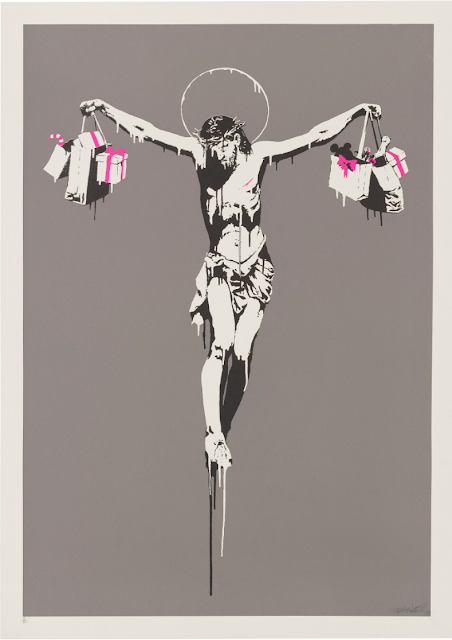
"Christ with Shopping Bags" by Banksy, 2004 A.D.
 

The god of Consumerism
or the Generous Christ?

For this time between Jesus' advents,
He has chosen to redeem a people
to live now in light
of His coming Kingdom. ...

But has our identity as Christians
been shaped by consumerism?

+ Teena Dare


This week as we continue in Advent (i.e. season of watching and waiting for the arrival of Jesus' coming), when the days are short, the nights are long, and the darkness lingers, I need to be called back again and again to the Word who is life, light, and love for me (John 1:4-5, 14). 

I need the Word of life that
creatively gives rather than consumes. 

I need the Word of light that
reveals hope rather than conceals fear. 

I need the Word of love that
dwells in the darkness
 rather than only comforts with ease.

Do I try to escape the darkness
by trying to consume more or
do I wait in the dark and receive
what can only be given by the Light
who enters the darkness
and the darkness cannot overcome?

The Surge School article, "Consumerism" in Quarter 2: Gospel Formation helped me consider the questions above. Teena Dare's article is a provocative and convicting piece about the god of consumerism's intersection with the story of God (especially in light of Advent)In continuing to learn about my own habits of consumption, along with desiring to see Emmaus City Church grow more into a contrast community in a consumer culture, Teena's words are a prophetic reminder. 

This week, would you consider pausing for a moment with me to take stock of where our minds, bodies, and hearts are running to right now, fully realizing the tension that Teena (and I) admit to:

When big drama and grand beauty
is given to us
from the comfort of our couches
without requiring anything from us,
it can feel tiresome
to want to engage
our hearts, minds and bodies
with God through His story
and in His world.

The generous Christ counters
the god of consumerism by inviting us into


Creation

In the beginning (in Genesis 1-2) God created the world as very good. In Western circles, we have often started the story with the crisis in Genesis 3 and ended it with escape from this world. This dualistic theology that rejects God's love for creation provided a striking opportunity for the powers of consumerism to sing a more alluring song. 
When the gifts of creation are disconnected from the giver, our hearts grow cold towards God's generosity and we become critical consumers. When Christian doctrine treats the material world as evil or meaningless, we look elsewhere to make sense of our rich enjoyment of God's gifts. A biblical doctrine of creation returns things back to their rightful place. A right view of creation rejects the consumer story by inviting us to rejoice in the God who provides abundantly and confess our dependence on Him (1 Timothy 4:46:17). It also reorients us as cultivators of the world rather than passive consumers (Genesis 1:27-28).

Crisis

The consumer story tells us that the problem with the world is that we need more. But the true story locates brokenness in our rebellious hearts. Our first ancestors divorced their will from the Father's and everything went off the rails. They began to look to the rest of the world to meet their needs because they chose not to be whole through complete dependence on their Maker. Where once they cultivated blessing freely for the sake of the world, now they began to fight for it. Not only did the earth rebel against humanity but humanity rebelled against their responsibility to love the Earth. Instead of developing the Earth in a sustainable way, we have forcibly extracted its rich resources at a rate that prohibits continuous replenishment and flourishing. The land wants rest but our appetites won't allow it. Our nation suffers from diseases related to overconsumption while other nations are dying from the lack of basic necessities. Many Americans may have an abundance of consumer goods but we are more depressed and anxious than ever before. And while the affluent certainly experience the destructive effects of consumerism, it is the most vulnerable that bear the brunt of overconsumption. It is always the poor, both locally and internationally, that feel the full effects of our consumer lifestyles. Whether it's their proximity to a landfill, diminishing natural resources in their country, erosion of integral landscapes, inaccessibility to clean water and healthy food, or the volatile global economy 
 the vulnerable disproportionately absorb the effects of our idolatry.

Covenant Community (Israel)

Throughout Israel's (i.e. God's people) story, God longs to form them as a just and generous people in the midst of nations that worshipped power and greed. Israel's law was meant to subvert the idolatrous ways of Egypt that had surely shaped them over 400 years ... In the same way, we need the wisdom of the Old Testament to help us live all of life in the midst of our idolatrous culture. What Ten Commandments might the god of consumerism give to his worshippers and how can Scripture form us in a distinct way?

Ten Commandments
of the god of Consumerism

| 1 | 
I am the god of consumerism. 
Serve me, and I'll bring you the profit 
your heart desires. 

(In contrast, in God's economy, good business is cultivating blessing from his world to love your neighbor.)

| 2 | 
Promote your products and services 
as the very things that bring wholeness, ultimate satisfaction, and identity.

| 3 | 
Use my name however you'd like. 
Remember, I exist to serve you as along as you continue to serve me.

| 4 | 
Technology has granted you power
to work around the clock, logging hours seven days (and nights) a week. Take advantage of this to get ahead of the competition. 

(In contrast, in a world exhausted and ravaged by a lack of rest, we are called to use our vocational power to protect Sabbath rest for every person, animal, and plot of land in our care. As we honor the rhythms of day and night, the boundaries of family and work life, and weekly Sabbath rest in Christ, we point to a countercultural reality: work is not the ultimate aim of life (Exodus 20:8-11).)

| 5 | 
Honor the new way of things
above the integrity of any principles your parents or previous generations taught. 

(In contrast, we need to listen intently to the wisdom of the generation before us and heed their critiques. Sometimes they can see the idols of our day better than we can (Proverbs 13:1).)

| 6 | 
Addictive substances work 
in your products help to ensure success and a little slander of your competitors is OK. 

(In contrast, we are called to honor the image-bearing dignity of our competitors, employees, and customers (James 3:9-10).)

| 7 | 
Sex sells. 
Advertising with overexposed skin draws people in. And sexual joking in the office is all in good fun.

| 8 | 
Don't worry about fair wages 
for your workers in distant lands. 

(In contrast, scripture perpetually calls on God's people to care for the poor. A fundamental way to do that is to ensure they receive adequate wages and are not taken advantage of.)

| 9 |
Fudging numbers is necessary

and hiding the less attractive aspects of your business is a necessity in today's world. White lies are harmless. 

(In contrast, transparency in your budget and use of materials are a great means of accountability (Proverbs 12:22).)

| 10 | 
Capitalize on discontentment 
bred into our society. Make sure your products give out in a few years. Make your customers long for the newest model, the next experience, the novel idea. Covet others' success, and motivate your employees with that same spirit of extreme competition. 

(In contrast, honor the integrity and beauty of God's creation in the products and services you provide. God doesn't make junk, and we shouldn't either. Let your work serve actual needs rather than invent new ones. And model contentment in Christ as you grow and develop your business for His glory.)

Christ
Sacrificial Love Required
in a Suffering World
We need a savior to restore us to the true glory of being human, revealed most fully in the suffering love of the cross. We cannot save ourselves from the problems we have created and perpetuated.  
If salvation is found in having "more," than we are the saviors. We save ourselves by securing the things we want and need. We save the poor by giving away our unwanted items or by stimulating the economy and assuming it'll find its way to the margins. We save our kids by ensuring that they have what we didn't. When we worship the wrong things, we look to the wrong savior.  
Jesus didn't look to material goods to save Himself, but was often homeless, hungry and humiliated by the pomp of the powerful. He personally felt the powerful temptation to turn to comfort and wealth to blunt the suffering that love requires in a broken world. We need this kind of savior to redeem us from our idolatry. 
We can't save ourselves and we can't save the world. We need Jesus to redeem all things from the ravages of our greed and restore the flourishing He intended for the world. We need Him to forgive us for the way our complacency and selfishness have made us passive – but willing – participants in this global consumer religion.

Church

We have been called and are being sanctified so that our lives can point to a different way. The world is longing for hope, to rediscover a life of purpose and mutuality. We have an incredible opportunity for us to embody lives of generosity, self-sacrifice, communal commitment, and creative stewardship to a world that needs a new way. This is what our salvation is for. The sad reality is that even our identity as Christians has been shaped by consumerism. We readily accept the privileges that we receive in Christ but shirk off the related responsibility. We often consider church attendance, spiritual disciplines, and communal life as Christian commodities that we can consume when it serves our needs. When it gets uncomfortable, inconvenient, or stops being novel or interesting, we start to notice these things drop off. Work takes center stage or the stresses and grief of life in a broken world lead us to seek easier comforts that seem to satisfy what life in Christ hasn't. Community is hard and sometimes our Christian community doesn't show up for us when we really need them. This is deeply painful and we've been trained to withdraw and find other ways to numb that pain. But the church is not simply the commodity of community that we can opt in and out of. It is the primary identity that God calls us into and empowers us to cultivate. He has formed a people who collectively reveal His coming Kingdom as we love each other sacrificially and invite others into this family of mutual care (John 13:35). There is no option for us to be faithful to our calling apart from playing our part in the body of Christ. We also desperately need each other if we want to live distinct lives in our pervasive consumer culture. Some members of our family may be creatively pursuing ways to lower their carbon footprint. Some are incredibly generous and radically hospitable to their neighbors even if they struggle to meet their own needs. And still others are working creatively to produce alternatives to our broken consumer systems. We need to learn and grow together and support each other as we play our part in being a witness to the watching world.

Consummation

When Jesus returns to make all things new, it will be unparalleled celebration with people across all cultures. There will be an intimate exchange of color, flavor, and friendship beyond what our imagination can bear. But many of us don't feel the longing for that day because we are satisfied with far too little and consumed with daily demands and comforts that blind us from what we're missing. Luke 14:15-24 tells a parable of a great banquet that echoes true. Who is ultimately invited to the banquet? It is the poor, the blind, the lame, and those from the margins of the city. This isn't because the host doesn't invite the wealthy or middle class, but they are too busy to accept the invitation. In the early church, it was simply accepted that poor Christians were exceptionally rich in faith. The rich looked to them for spiritual wealth. Our culture tells us to respect and associate with the affluent and influential, but we know we're at a Kingdom feast when the marginalized are given the places of honor. When we share a dinner table and love materializes in generosity and mutual pursuit of Christ, we learn where life is truly found. We have much to learn from the global church to this end. In more communal and less materialistic societies this way of Christ is uniquely on display. All of our lives culminate in a single moment. That day when we will meet our King, no accomplishment or affirmation or storehouse of wealth will rival the most precious words we all long to hear: "Well done, good and faithful servant." Let us be counted faithful by investing in the people and places that Jesus identified with during His life and ministry (Matthew 25:31-46).

Fasting
Counter-Spiritual Formation
Consumerism has formed us through daily, embodied practices that shape our hearts, minds, and appetites. Through these habits we have conformed our lives to the pattern of the age. 
The counter-formation of disciplines, like fasting, are helpful to form us into our true identity: beloved children of God who have died to sin (and must die daily to the powers of consumerism) and been made alive with Christ. Fasting reminds us of our baptismal identity. As Jesus fasted in the desert, feeling the pull of temptation, I imagine He closed His eyes and was right back at the Jordan. Remembering what it felt like to go under the water – cut off for a moment from the air that sustained his lungs – and emerged, surrounded by the perfect love of the Father and Spirit. That moment under the water pointed to the not so far off day when His breath would fail Him as He hung on the cross. In those final moments, He would again entrust Himself to the perfect love of the Father. That love must have been incredibly tangible in those forty days in the desert. Each day, as He died to His bodily desire for bread, the perfect communion of the Trinity sustained Him and transformed Him. The only love that is powerful enough to conquer death was forming Jesus into the full glory of humanity.  
To be fully human in a deeply broken world, we must be freed from the bondage of sin. In order to behold the glory of the risen Christ, we must join Him in His death. We fast to begin to sense the difference between real hunger and the endless cravings that have become inordinate in our lives. To repent of ways that we have made ourselves into people who fulfill every desire with everything but Christ. As we forgo our daily bread, we recognize our need to feast on the Bread of life (John 6:35). As we feel discomfort, we take notice of what our hearts look to for comfort and invite the Spirit to reform us to find satisfaction in Him. We die to our insatiable appetites and experience the joy of deeper communion with Jesus.
I encourage you to take time to plan and prepare for a 24-hour fast from food and spending. (Of course, if you are pregnant or nurturing infants or have medical conditions that preclude you from fasting from food, you can choose something else to abstain from.) As you fast, reflect and write down what God is revealing to you about where you find life and how He is calling you to repent and be renewed in Him.

+ Adapted excerpt from Surge School
Quarter 2: Gospel Formation article,
"Consumerism," by Teena Dare

Previous Post: 

Waiting is the Womb

Other Advent Posts: 


Many blessings of peace and presence for you,

Rev. Mike “Sully” Sullivan

Monday, December 1, 2025

Advent | Waiting is the Womb in Which We Are Formed Well


Tale of 3 Cities Mural in Honor of Spencer Barr outside Custard Factor in Digbeth during Mental Health Awareness Week

I think it’s during the wait in the dark,
more than any other time,
that Christ is being formed in us.
In a sense,
waiting is the womb of the Kingdom
in which we are formed.

+ Marlena Graves,
A Beautiful Disaster


Advent beings with an always needed reflection on waiting with hope in the darkness, whether it's a mental, emotional, spiritual, and/or physically tangible darkness. 

As expressed by Fleming Rutledge
in her instant classic,

Advent: The Once and Future
Coming of Jesus Christ
:

Advent begins in the dark
(and involves waiting in the dark)
... our hope lies in ...
the God of Advent
who drew near to us in Jesus
and who will come again
to take away the darkness forever
and be our eternal light.

Waiting. Hoping. Surviving. I think the mural above does a beautiful job of expressing the head space we're often in when we wait. The sun is still shining somewhere. There is a promise illustrated through a rainbow illuminating the layers of light. But there is is also a storm raging as thunder distracts us and lightning strikes too close to home. I also appreciate the poetry to complement the mural and moment:

I'm waiting for sanity,
As I paint my clarity. 
"The world is a charity, 
The poem ends here."

During one of our previous Surge Tables, we looked at the god of consumerism and the generous Christ. The reading provides a vision of a contrast community in a consumer culture, a gracious and generous counter to entitlement and greedy spending of time and money on entertainment and escape, people who are "waiting" with the prayer, "Jesus, You are more than enough." An adaptation to the thoughtful poem above in light of this theme of waiting could be:

I'm praying for sanity,
As Jesus brings mystery. 
"His Story is charity, 
His Kingdom is near."

As Surge often helps me again listen to seeds of wisdom in relation to waiting, I also return to a series of quotes that have benefited me the past 5+ years. These wise words are by Marlena Graves, one of my favorite authors, who penned A Beautiful Disaster: Finding Hope in the Midst of Brokenness. And during this season of Advent, the sacred time of learning afresh how to wait in the dark with a spark of hope, I continue to find Marlena's words to be potent.

I think it’s during the wait in the dark, more than any other time, that Christ is being formed in us. In a sense, waiting is the womb of the Kingdom in which we are formed. 
Most of the time, we don’t exactly know how we are being formed. But while we wait and learn to pay attention to the details of life right in front of us, we discover that God’s grace is “always hidden under the strangest appearances,” as the 18th century Jesuit priest, Jean-Pierre de Caussade says. Life all around us is full of nooks and crannies, of delights and wonders – some of which have always been there but we’ve yet to see. The season of waiting slows us down so that we notice … and we don’t want to become so agitated that we leave the womb before it’s time.
If waiting functions as the womb of the Kingdom, then we must be on our guard when our souls become agitated and we lose our peace. ... Waiting can also teach us to joyfully appreciate what we have instead of despising it because of what we don't have. Ah, waiting! It is the gift that keeps on giving but a gift that not even the best of us welcome, at least not initially. Waiting becomes a form of fasting from our need to exert control over our circumstances and others. When we experience delayed gratification, we begin to surrender our need for control. However, relinquishing control can bend us out of shape because we don't know how to function otherwise.   
God uses waiting to enlarge our souls. While we are waiting on God, He is often waiting on us. He is waiting on us to fully surrender ourselves to Him. Once we surrender, we can move forward. In this womb, this wilderness experience, we are being, and also becoming, who we are ... Moreover, the poor in spirit are able to recognize and receive all the riches of God's grace. 
Waiting tempers disordered passions and allows us to deal well with reality. We might come to understand that things aren't as bad as we thought or are far worse than previously imagined; God uses the wait time to develop in us fortitude that keeps us from being destroyed by our circumstances. We realize that we don't need this or that thing or relationship to be whole, whereas before, when we had what we thought we wanted and weren't waiting on anything, we never thought we could live without it. ... In our contentment, we are able to reach the point where we can say to God, "Not my will but yours be done," and mean it.

Other Quotes from A Beautiful Disaster


Waiting is an art that our impatient age has forgotten. It wants to break open the ripe fruit when it has hardly finished planting the shoot. But all too often the greedy eyes are only deceived; the fruit that seemed so precious is still green on the inside, and disrespected hands ungratefully toss aside what has so disappointed them.
The blessedness of waiting is lost on those who cannot wait, and the fulfillment of promise is never theirs. They want quick answers to the deepest questions of life and miss the value of those times of anxious waiting, seeking with patient uncertainties until the answers come. They lose the moment when the answers are revealed in dazzling clarity.  
Whoever does not know the austere blessedness of waiting – that is, of hopefully doing without – will never experience the full blessing of fulfillment.
Not everyone can wait: neither the sated nor the satisfied nor those without respect can wait. The only ones who can wait are people who carry restlessness around with them.


Many blessings of peace and presence for you,

Rev. Mike “Sully” Sullivan

Monday, May 22, 2023

CN | The Seamless Life: Coherence + Continuity + Congruence


Catch a glorious vision of hope in Christ, a coherent life, a seamless life. + Dr. Sutrisna Harjanto


As we anticipate starting Surge School again, I keep coming back to Dr. Steven Garber's dedication to his grandchildren at the beginning of his beautiful little book, The Seamless Life:

Live into the vision of a seamless life, a coherence between who you are and why you are, giving meaning to what you do with the lives that are yours.

This is what we hope to see happen within the hearts, minds, and everyday living of participants that partner with us for Surge School, fully knowing that to capture a vision of a seamless life will be a process that takes time, care, community, challenge, and invitation into wonder. 

Laura Fabrycky captures a bit of what this wild venture can be like:

Exercise the daily struggle to see the world truthfully, to know it in its heartache and pain, and to keep loving it still. See your own corner of the world better, honor its complicated goodness and beauty, and love your places and people with creativity, courage, and above all, hope.

Our goal or telos for Surge is to help people see the world through the eyes of Jesus, knowing its heartache and pain, and then choosing how to faithfully love it still. 

Steven Garber is a helpful sherpa in leading us along on such a path, and below are some adapted excerpts from The Seamless Life to provide you with a window into what engaging Surge School could be like for you in the year ahead. Ultimately, the telos or goal will be to connect your daily life and work with God's abundant life and work, your story with the story of God for the life of the world.

The Seamless Life: At Work in the World and Making Sense of Life

The most important questions always are: 

Who or what is our reason for being? 
Why do we do the things we do? 
What does it all mean?

Our vocations grow out of our beliefs about the way things are, about what matters and what doesn't matter; what we do with life is born out of our commitments about the meaning of life.

With Jesus, we are invited to live a life, a coherent life, in which what we believe about God and the world is worked out in the way we live in the world. Begun on our knees, we step into our work day by day, contributing to our community, offering an unusual blend of competence and character to the watching world. We are invited to be good at what we do and to be good human beings who image the God we were created to be like (Romans 8:29; 2 Corinthians 3:17-18), a "common grace for the common good" (Matthew 5:43-48).

But to see a story where the complexity of life is honored, and the importance of work is understood, is rare. The best stories are the truest stories, the ones in which we recognize ourselves, full of hope and honor, but also prone to self-deception and self-destruction.

Because vocation is a rich and complex word and is never the same word as occupation, we are always more than our work, though our work matters. We create, but we sweat. We do our best but still disappoint.

Sometimes, heaven meets earth in and through our work, and it becomes almost sacramental—and then sometimes we curse the very work of work. We are our best and our worst at work. And yet, we are invited into a good story, one we could not write for ourselves on our own—because a good story tells the truth about what we do and why we do it. The challenge everyone everywhere faces is connecting the deeper story of who we are with what we do, day by day, year after year. Coherence and continuity matter.

We yearn for the things we love to be the way that we live, even as we realize that the two will never be the same, completely and absolutely, this side of heaven reconciling with earth. We long for what we do to grow out of who we are, for our occupation(s) to be rooted in our vocation. That is the hope of everyone's heart.

Can we pray and workora et labora—at the same time, a life where praying and working are held together, offered as one heart and therefore one life? Can we see and experience "a thin place," where heaven and earth meet in a remarkable way? 
The most important questions are perennial questions, asked and asked again, because they matter—whether we live in the fifth century (when the Benedictine tradition was asking similar questions like the ones above) or the twenty-first century; whether we are African or Russian, whether we are men or women, whether we are tinkerers or prime ministers. They are human questions because human beings ask them. 
To see seamlessly is the hope, perhaps even to see sacramentally, where we have eyes to see where heaven and earth meet—where ora et labora become one—right in the middle of our ordinary lives, lived as they must be in ordinary places.


The Christian life is the lifelong practice of attending to the details of congruence — congruence between ends and means, congruence between what we do and the way we do it, congruence between what is written in Scripture and our living out what is written ... the congruence of the Word made flesh in Jesus with what is lived in our flesh.

Congruence also occurs often enough in a child unselfishly at play; a conversation in which words become as movements in a ballet, revealing all manner of beauty and truth and goodness; a meal bringing friends into a quiet awareness of affection and celebration in a mingling of senses and spirits that provides something like a Eucharistic dimension to the evening.

+ Eugene Peterson

An Invitation to Consider Surge School New England

If some of these thoughts intrigue you and stir curiosity and a hunger to learn more, consider participating in Surge School New England.

May God's Kingdom come, His will be done.
Jesús nuestra Rey, venga Tu reino! 
🙏💗🍞🍷👑🌅🌇


With presence, peace, and many blessings,

Rev. Mike “Sully” Sullivan


Monday, January 30, 2023

Surge Story | Generous Cross-Shaped Peacemaking Presence


"Christ The Redeemer" Lit Up With Flags Of Countries


We called on the Prince of Peace for the welfare of the city and He showed up. + Jim Mullins, The Symphony of Mission: Playing Your Part in God's Work in the World 


When we finished our series on Baptism (Who We Are) this summer, our final message was entitled, "Rooted in Being Baptized as Jesus' Servants (For the Life of the World)." To help close the message, I shared a recent story about how Jesus' Church in the city of Phoenix, including three Surge Network churches, embodied this baptismal identity tangibly among their Muslim neighbors. This story is also included in Quarter 3 of Surge School readings in The Symphony of Mission, which we are currently immersing in right now. The story provides an embodied fulfillment of these words:

How can the world come to know the love of Christ by experience? What's the best apologetic for proclaiming the cross to a cynical world? The best commentaries about the cross are not written in books; they are written on the scars of Christians throughout the world. The primary way the self-giving love of Christ is displayed to the world is through the sacrificial service of God's people. As we pour our lives out on behalf of our neighbors, we dramatize what Christ has done on the cross.

+ The Symphony of Mission, pg. 56

"If (Christians) Really Believed Jesus, It Would Change the World"  

(When I lived in Turkey) Hamid said something I will never forget – a clue to the very question I had been pondering. He said, "Do you remember when we read Luke 6, where Jesus commands people to sacrificially love their enemies? That was my favorite part!" He continued, "How many Christians have read these words? Because if so many Christians view Muslims as their enemy, wouldn't they be obligated to do good things for them? If they really believed these words, they would be building schools in Afghanistan, welcoming Muslim refugees at the airport, and inviting every Muslim they know to join them for dinner." 

And then with seriousness in his voice (Hamid) looked at me and said, "Jim, you should go back to America and teach Christians about this. If they really believed Jesus, it would change the world!" That was the day a Muslim commissioned me to preach the gospel to Christians. Amid the irony, I sensed that there was something profound about what he was saying, a connection between the sacrificial love of Christians and the perceived credibility of the cross. However, I wouldn't make that connection until some five years later when I was staring at the business end of a semiautomatic rifle.

The Cross and a Peacemaking Presence Prayed For in the Face of Violence

(Now back in the United States) A group of armed bikers was organizing an event outside of a local mosque where they would bring weapons, burn copies of the Qur'an, draw lewd pictures of Muhammad, and scream obscenities at people as they entered to pray. The particular mosque they had chosen was in a neighborhood with the largest percentages of refugees in the state. These people had been displaced from their homes and families and were trying their best to navigate the challenges of living in a new culture. All of them had experienced some form of suffering and danger: torture, natural disasters, ethnic cleansing, war. When I looked at the Facebook event for this rally, I saw that hundreds of people had already signed up to tell these globally homeless people to go back home. 

I remembered the words of Hamid and how he had challenged me to call Christians to obey the words of Christ. So in an act of overstated slacktivism, I expressed my disgust on Facebook. It was a well-worded mini-rant that made me feel better about myself. Then I closed my computer to pray, not the bold prayers of faith but the deflated prayers of a disheartened disciple. I had a sense that Jesus's name was about to get dragged through the mud once again and that violence was imminent. I was especially concerned because I had friends who attended that mosque and I didn't want them hurt. I also imagined how horrible it would make Christians feel if someone surrounded our church with guns, ripped up the Bible, and slandered Jesus. The thought was awful. I felt helpless.

After logging back onto Facebook a few hours later, I saw that several people had commented on my post, and I was struck by one comment in particular. Erin, a woman from my church (Redemption Tempe), thought we should do something about the rally, that it wasn't enough to make a Facebook post. Since this was happening in our city, we were implicated. We needed to respond.

Honestly, I was reluctant and afraid, but I knew she was right. Her post prompted me to reach out to Adam Estle, the executive director of Evangelicals for Middle East Understanding, and our mutual friend, the president of the mosque. We met for dinner and dreamed up a little plan. With only about twenty-four hours notice, Adam and I invited followers of Christ from around the city to join us at the mosque to be a prayerful presence in a place of hostility.

We didn't go there to protest or even counterprotest (as the media suggested). Our aim was to create a physical barrier of protection with our bodies and a spiritual wall of protection through our prayers. We committed to being a calming, quiet, friendly, peaceful, and prayerful presence. We wanted our response to be marked with the fruit of the Spirit: love, joy, peace, patience, kindness, goodness, faithfulness, gentleness, and self-control (Gal. 5:22-23).

Our strategy was to arrive early so that we could fill the sidewalk in front of the mosque, thus forcing the hostile protestors to the other side of the street. We also wanted to be the first people our Muslim neighbors would see when they exited the mosque, so they'd be greeted by followers of Christ holding out hands of friendship rather than by protesting holding handguns.

But the main reason we were lined up on the sidewalk was to turn our bodies into a physical barrier of protection for our Muslim neighbors. We wanted to dramatize the cross. We stood between the masked men with guns (a lot of guns!) and our Muslim friends because Jesus stood for us. Because Jesus had absorbed our death to give us life, we were willing to absorb bullets to defend the lives of our neighbors. He put himself in harm's way for us, so as his disciples, we were compelled to put ourselves in harm's way for our Muslim neighbors. There wouldn't be a single bullet that would pierce the body of a Muslim unless it went through the body of a Christian first. We didn't organize the Love Your Neighbor Rally with heroic moxie but with trembling hands and nervous prayers for protection.


The Prince of Peace Showed Up on the Hottest (& Most Dangerous) Day of the Year

Two types of people participated: those who were afraid and those who didn't really understand the danger. I didn't expect many people to show up. With each hour that passed there were new waves of hostility posted on social media. Almost all local and national media outlets were covering the event and using sensational language that seemed to make things worse. The organizers of the protest were calling people to bring as many weapons as they could carry on their motorcycles – and to be ready to use them. ISIS was tweeting ominous threats about blood being spilled in the streets, local businesses were closing shop, and (to make matters worse) it was the hottest day of the year. It was not hard to find a reason to stay home that day.

People from our group started arriving around 5:00 p.m. At first, there were just a few of us, and we didn't really know what to do. We were awkward, not accustomed to being at a protest. My fears of a low turnout seemed confirmed. But then, at about 5:20 p.m., we saw one of the most beautiful things I've ever seen in my life: hundreds of Christians began to stream down the street in groups of five or ten, putting themselves in danger in order to love their Muslim neighbors. There were soon as many Christians assembled to be a peaceful presence as there were protestors: more than two hundred Christians from about fifteen local churches. There were also a number of people from other backgrounds who had been invited by their Christian friends. We had decided to wear blue shirts (a calming color), and as I saw that flood of blue shirts coming down the street, I began to imagine them as God's tears: tears of sorrow as he wept over this broken city and tears of joy to see his people unified in sacrificial love.

When everyone had arrived, we spread out on the sidewalk along the front of the mosque. We stayed calm, prayed, sang some worship songs, and had great conversations. Almost everyone held up signs that had been made by Josh Harp, a pastor at Via Church, which said "love your neighbor" on one side and explained our purpose on the other side. We asked people to avoid yelling, chanting, or bringing signs with antagonistic slogans. We asked them instead to pray, to tell stories of positive friendships with Muslims, to describe calmly what we were doing, and to explain how Jesus was our motivation.

On the other side of the street were more than two hundred protestors. Many of them were masked, wore bulletproof vests, and carried pistols, knives, and semiautomatic weapons. They were from many backgrounds, including atheism and neo-Nazism. A few even claimed to be Christians. Their signs and chants said some of the most vulgar things you could imagine – I won't repeat them here. They burned Qur'rans and held up indecent pictures drawn ahead of time at a "Draw Muhammad" contest they'd held before coming to the protest.


Though our first job there was to pray for and be a human shield for our Muslim friends, we also encouraged our people to pray for and try to reach out to the protesting bikers. After all, they were created in God's image too, and behind their masks and bulletproof vests were genuine fear and pain that needed the healing of the gospel. We reminded one another that we weren't there to be against anybody, because our enemy is not flesh and blood but the spiritual powers that produce such hatred: sin, idolatry, Satan, and demons.

Throughout the protest we sent a handful of blue shirts over to the protestors' side of the street. Some in our group had brought ice cold water on that blistering hot day to share with the protestors. We looked for the loudest and angriest people there and tried to engage them in conversation. It was clear they wanted to be heard, so we thought maybe we could help de-escalate the situation by simply listening. As we listened, we realized that there was real fear under all that anger. It grew out of thousands of hours of being discipled by sensationalist YouTube videos and talk radio shows. They were genuinely afraid. However, almost none of them (except a handful of people who had served in the military) had met an actual Muslim. Many of the veterans were struggling with PTSD, and some had lost limbs in Iraq or best friends in Afghanistan. The most formative years of their adult lives had been spent learning to view Muslims as the enemy. Now they felt rage when they heard a few words of Arabic conversation at a grocery store. 

So we listened, and kept on listening. Several of our conversations with the protesters ended in tears, prayer, and a deep sense of longing for God to mend this hemorrhaging world. I remember so much from that night: our Muslim friends who handled everything with such poise, the hard work of police officers, a petite nineteen-year-old girl in a blue shirt who showed kindness to a furious three-hundred-pound protester who was wearing a bulletproof vest and was armed with an AR-15. I remember the many conversations about Christ we had with the nonbelievers who joined our group, with our Muslim friends, and with the protesters. 
But what I remember most vividly is our times of prayer. It seemed like each time the protesters got louder, we prayed more fervently and the Spirit extinguished the waves of hostility. Standing in the most hostile street in the city that night, we worshiped God and experienced a real sense of the presence of Christ. Throughout the nights we saw groups of protesters walk away in a contemplative manner. Some of them turned their "F--- Islam" shirts inside out. Some even seemed to have a change of heart and sought out the leaders of the mosque to apologize. By the end of the night, there hadn't been one shot fired, one punch thrown, or one person arrested. 
We called on the Prince of Peace for the welfare of the city – and he showed up.

Suffering for the Sake of Others is the Best Apologetic for the Cross

The next morning, I woke up and started to thank God for what had happened the night before. I was grateful to be no longer standing in front of masked men with guns, but I actually felt saddened that it was all over. I assumed that the beautiful night of the church's unification in missional peacemaking was just going to drift into our memories and ultimately be forgotten. But when I checked my email, I realized that something bigger was going on. 

Waiting for me were dozens of emails, Facebook messages, tweets, and voicemails from Muslims around the world expressing their gratitude for the many Christians who had shown love by forming a human shield in front of that mosque. The messages came from Pakistan, Saudi Arabia, Indonesia, Turkey, and Afghanistan as well as many different cities within the United States. 

I wondered how they had heard about the events of that night and then realized that a Muslim man had snapped a picture that beautifully captured an image of the sacrificial love that existed all across the city and had shared the picture on social media. The picture was of four people from Missio Dei Communities (a local church in the Phoenix area), and the caption said, "It is reported that more Christians showed up to stand in solidarity with the #PHxMosque this evening than protesters." This photo was shared 6,079 times on Facebook and probably just as many times on Twitter, mostly by Muslims. Many news reports had been written by local and international media, some of them even quoting us as we pointed to the cross as our motivation. For example, Vice News quoted me as saying, 

"One of the main reasons we set up here on this sidewalk right now is to create a physical barrier between the mosque and our Muslim friends and potential violence and hostility. ... If they suffer, we suffer with them. To stand in between the potential pain and danger they are in in the same way that Jesus stood in between it for us." 

In the months that followed, we had dozens of opportunities to speak to groups of Muslims and have coffee with Muslim friends. In almost all of those instances we were asked the question, Why did you do it? In those moments we were able to share how we had been reconciled to the God of peace and were therefore compelled to be peacemakers. We were able to proclaim the self-giving love of Christ that was displayed on the cross. We shared the gospel with thousands of Muslims.

That season helped me realize that the sacrificial love of Christians – when we suffer for the sake of others – is the best apologetic for the cross. 
The service movement in the symphony of mission displays the sacrificial love of Christ through lives of selfless service. As we generously give our lives to serve others, we imitate and display the generous love of Christ and his work on the cross. When as followers of Christ we generously share our time, money, knowledge, possessions, homes, and lives, we dramatize the generous sacrificial love of Christ that was displayed on the cross. 
Love is costly. Real love is the mess of childbirth, the burnt arms of firefighters, the scars from dogs' teeth on the arms of a civil rights leader, and the sore knees of a factory worker who has punched the clock for forty years to put food on the table. Love is ultimately expressed through sacrifice.   
We are called to be entrepreneurs of blessing, inventors of neighborly kindness, and artists of shalom – employing our whole minds, including our imaginations, in loving God and our neighbors.

+ Special City Notes (CN) excerpt above from Chapter 5: Service: Displaying the Love of Christ by Washing the Feet of the World, pgs. 95-99, in The Symphony of Mission, also featuring stories about how moving truck employees, Uber and Lyft drivers, waitresses, barbers, cyclists, and more are being "entrepreneurs of blessing." Jim also recounts the story above in the article "RT: 1 Year Ago Today: Love Your Neighbor Rally". And to close, here is one more great story from The Symphony of Mission followed by two complementary posts:


Soli Jesu gloria.

Rev. Mike "Sully" Sullivan

Email Pastor Mike | Website | Visit Us | Support Us | Facebook Us