Showing posts with label Contrast Community in Consumer Culture. Show all posts

Wednesday, December 17, 2025

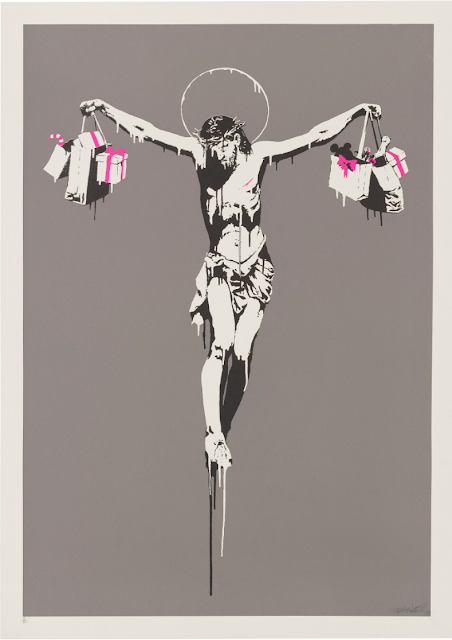
Advent SOG | Christ with Shopping Bags or Generous Christ?


"Christ with Shopping Bags" by Banksy, 2004 A.D.
 

The god of Consumerism
or the Generous Christ?

For this time between Jesus' advents,
He has chosen to redeem a people
to live now in light
of His coming Kingdom. ...

But has our identity as Christians
been shaped by consumerism?

+ Teena Dare


This week as we continue in Advent (i.e. season of watching and waiting for the arrival of Jesus' coming), when the days are short, the nights are long, and the darkness lingers, I need to be called back again and again to the Word who is life, light, and love for me (John 1:4-5, 14). 

I need the Word of life that
creatively gives rather than consumes. 

I need the Word of light that
reveals hope rather than conceals fear. 

I need the Word of love that
dwells in the darkness
 rather than only comforts with ease.

Do I try to escape the darkness
by trying to consume more or
do I wait in the dark and receive
what can only be given by the Light
who enters the darkness
and the darkness cannot overcome?

The Surge School article, "Consumerism" in Quarter 2: Gospel Formation helped me consider the questions above. Teena Dare's article is a provocative and convicting piece about the god of consumerism's intersection with the story of God (especially in light of Advent)In continuing to learn about my own habits of consumption, along with desiring to see Emmaus City Church grow more into a contrast community in a consumer culture, Teena's words are a prophetic reminder. 

This week, would you consider pausing for a moment with me to take stock of where our minds, bodies, and hearts are running to right now, fully realizing the tension that Teena (and I) admit to:

When big drama and grand beauty
is given to us
from the comfort of our couches
without requiring anything from us,
it can feel tiresome
to want to engage
our hearts, minds and bodies
with God through His story
and in His world.

The generous Christ counters
the god of consumerism by inviting us into


Creation

In the beginning (in Genesis 1-2) God created the world as very good. In Western circles, we have often started the story with the crisis in Genesis 3 and ended it with escape from this world. This dualistic theology that rejects God's love for creation provided a striking opportunity for the powers of consumerism to sing a more alluring song. 
When the gifts of creation are disconnected from the giver, our hearts grow cold towards God's generosity and we become critical consumers. When Christian doctrine treats the material world as evil or meaningless, we look elsewhere to make sense of our rich enjoyment of God's gifts. A biblical doctrine of creation returns things back to their rightful place. A right view of creation rejects the consumer story by inviting us to rejoice in the God who provides abundantly and confess our dependence on Him (1 Timothy 4:46:17). It also reorients us as cultivators of the world rather than passive consumers (Genesis 1:27-28).

Crisis

The consumer story tells us that the problem with the world is that we need more. But the true story locates brokenness in our rebellious hearts. Our first ancestors divorced their will from the Father's and everything went off the rails. They began to look to the rest of the world to meet their needs because they chose not to be whole through complete dependence on their Maker. Where once they cultivated blessing freely for the sake of the world, now they began to fight for it. Not only did the earth rebel against humanity but humanity rebelled against their responsibility to love the Earth. Instead of developing the Earth in a sustainable way, we have forcibly extracted its rich resources at a rate that prohibits continuous replenishment and flourishing. The land wants rest but our appetites won't allow it. Our nation suffers from diseases related to overconsumption while other nations are dying from the lack of basic necessities. Many Americans may have an abundance of consumer goods but we are more depressed and anxious than ever before. And while the affluent certainly experience the destructive effects of consumerism, it is the most vulnerable that bear the brunt of overconsumption. It is always the poor, both locally and internationally, that feel the full effects of our consumer lifestyles. Whether it's their proximity to a landfill, diminishing natural resources in their country, erosion of integral landscapes, inaccessibility to clean water and healthy food, or the volatile global economy 
 the vulnerable disproportionately absorb the effects of our idolatry.

Covenant Community (Israel)

Throughout Israel's (i.e. God's people) story, God longs to form them as a just and generous people in the midst of nations that worshipped power and greed. Israel's law was meant to subvert the idolatrous ways of Egypt that had surely shaped them over 400 years ... In the same way, we need the wisdom of the Old Testament to help us live all of life in the midst of our idolatrous culture. What Ten Commandments might the god of consumerism give to his worshippers and how can Scripture form us in a distinct way?

Ten Commandments
of the god of Consumerism

| 1 | 
I am the god of consumerism. 
Serve me, and I'll bring you the profit 
your heart desires. 

(In contrast, in God's economy, good business is cultivating blessing from his world to love your neighbor.)

| 2 | 
Promote your products and services 
as the very things that bring wholeness, ultimate satisfaction, and identity.

| 3 | 
Use my name however you'd like. 
Remember, I exist to serve you as along as you continue to serve me.

| 4 | 
Technology has granted you power
to work around the clock, logging hours seven days (and nights) a week. Take advantage of this to get ahead of the competition. 

(In contrast, in a world exhausted and ravaged by a lack of rest, we are called to use our vocational power to protect Sabbath rest for every person, animal, and plot of land in our care. As we honor the rhythms of day and night, the boundaries of family and work life, and weekly Sabbath rest in Christ, we point to a countercultural reality: work is not the ultimate aim of life (Exodus 20:8-11).)

| 5 | 
Honor the new way of things
above the integrity of any principles your parents or previous generations taught. 

(In contrast, we need to listen intently to the wisdom of the generation before us and heed their critiques. Sometimes they can see the idols of our day better than we can (Proverbs 13:1).)

| 6 | 
Addictive substances work 
in your products help to ensure success and a little slander of your competitors is OK. 

(In contrast, we are called to honor the image-bearing dignity of our competitors, employees, and customers (James 3:9-10).)

| 7 | 
Sex sells. 
Advertising with overexposed skin draws people in. And sexual joking in the office is all in good fun.

| 8 | 
Don't worry about fair wages 
for your workers in distant lands. 

(In contrast, scripture perpetually calls on God's people to care for the poor. A fundamental way to do that is to ensure they receive adequate wages and are not taken advantage of.)

| 9 |
Fudging numbers is necessary

and hiding the less attractive aspects of your business is a necessity in today's world. White lies are harmless. 

(In contrast, transparency in your budget and use of materials are a great means of accountability (Proverbs 12:22).)

| 10 | 
Capitalize on discontentment 
bred into our society. Make sure your products give out in a few years. Make your customers long for the newest model, the next experience, the novel idea. Covet others' success, and motivate your employees with that same spirit of extreme competition. 

(In contrast, honor the integrity and beauty of God's creation in the products and services you provide. God doesn't make junk, and we shouldn't either. Let your work serve actual needs rather than invent new ones. And model contentment in Christ as you grow and develop your business for His glory.)

Christ
Sacrificial Love Required
in a Suffering World
We need a savior to restore us to the true glory of being human, revealed most fully in the suffering love of the cross. We cannot save ourselves from the problems we have created and perpetuated.  
If salvation is found in having "more," than we are the saviors. We save ourselves by securing the things we want and need. We save the poor by giving away our unwanted items or by stimulating the economy and assuming it'll find its way to the margins. We save our kids by ensuring that they have what we didn't. When we worship the wrong things, we look to the wrong savior.  
Jesus didn't look to material goods to save Himself, but was often homeless, hungry and humiliated by the pomp of the powerful. He personally felt the powerful temptation to turn to comfort and wealth to blunt the suffering that love requires in a broken world. We need this kind of savior to redeem us from our idolatry. 
We can't save ourselves and we can't save the world. We need Jesus to redeem all things from the ravages of our greed and restore the flourishing He intended for the world. We need Him to forgive us for the way our complacency and selfishness have made us passive – but willing – participants in this global consumer religion.

Church

We have been called and are being sanctified so that our lives can point to a different way. The world is longing for hope, to rediscover a life of purpose and mutuality. We have an incredible opportunity for us to embody lives of generosity, self-sacrifice, communal commitment, and creative stewardship to a world that needs a new way. This is what our salvation is for. The sad reality is that even our identity as Christians has been shaped by consumerism. We readily accept the privileges that we receive in Christ but shirk off the related responsibility. We often consider church attendance, spiritual disciplines, and communal life as Christian commodities that we can consume when it serves our needs. When it gets uncomfortable, inconvenient, or stops being novel or interesting, we start to notice these things drop off. Work takes center stage or the stresses and grief of life in a broken world lead us to seek easier comforts that seem to satisfy what life in Christ hasn't. Community is hard and sometimes our Christian community doesn't show up for us when we really need them. This is deeply painful and we've been trained to withdraw and find other ways to numb that pain. But the church is not simply the commodity of community that we can opt in and out of. It is the primary identity that God calls us into and empowers us to cultivate. He has formed a people who collectively reveal His coming Kingdom as we love each other sacrificially and invite others into this family of mutual care (John 13:35). There is no option for us to be faithful to our calling apart from playing our part in the body of Christ. We also desperately need each other if we want to live distinct lives in our pervasive consumer culture. Some members of our family may be creatively pursuing ways to lower their carbon footprint. Some are incredibly generous and radically hospitable to their neighbors even if they struggle to meet their own needs. And still others are working creatively to produce alternatives to our broken consumer systems. We need to learn and grow together and support each other as we play our part in being a witness to the watching world.

Consummation

When Jesus returns to make all things new, it will be unparalleled celebration with people across all cultures. There will be an intimate exchange of color, flavor, and friendship beyond what our imagination can bear. But many of us don't feel the longing for that day because we are satisfied with far too little and consumed with daily demands and comforts that blind us from what we're missing. Luke 14:15-24 tells a parable of a great banquet that echoes true. Who is ultimately invited to the banquet? It is the poor, the blind, the lame, and those from the margins of the city. This isn't because the host doesn't invite the wealthy or middle class, but they are too busy to accept the invitation. In the early church, it was simply accepted that poor Christians were exceptionally rich in faith. The rich looked to them for spiritual wealth. Our culture tells us to respect and associate with the affluent and influential, but we know we're at a Kingdom feast when the marginalized are given the places of honor. When we share a dinner table and love materializes in generosity and mutual pursuit of Christ, we learn where life is truly found. We have much to learn from the global church to this end. In more communal and less materialistic societies this way of Christ is uniquely on display. All of our lives culminate in a single moment. That day when we will meet our King, no accomplishment or affirmation or storehouse of wealth will rival the most precious words we all long to hear: "Well done, good and faithful servant." Let us be counted faithful by investing in the people and places that Jesus identified with during His life and ministry (Matthew 25:31-46).

Fasting
Counter-Spiritual Formation
Consumerism has formed us through daily, embodied practices that shape our hearts, minds, and appetites. Through these habits we have conformed our lives to the pattern of the age. 
The counter-formation of disciplines, like fasting, are helpful to form us into our true identity: beloved children of God who have died to sin (and must die daily to the powers of consumerism) and been made alive with Christ. Fasting reminds us of our baptismal identity. As Jesus fasted in the desert, feeling the pull of temptation, I imagine He closed His eyes and was right back at the Jordan. Remembering what it felt like to go under the water – cut off for a moment from the air that sustained his lungs – and emerged, surrounded by the perfect love of the Father and Spirit. That moment under the water pointed to the not so far off day when His breath would fail Him as He hung on the cross. In those final moments, He would again entrust Himself to the perfect love of the Father. That love must have been incredibly tangible in those forty days in the desert. Each day, as He died to His bodily desire for bread, the perfect communion of the Trinity sustained Him and transformed Him. The only love that is powerful enough to conquer death was forming Jesus into the full glory of humanity.  
To be fully human in a deeply broken world, we must be freed from the bondage of sin. In order to behold the glory of the risen Christ, we must join Him in His death. We fast to begin to sense the difference between real hunger and the endless cravings that have become inordinate in our lives. To repent of ways that we have made ourselves into people who fulfill every desire with everything but Christ. As we forgo our daily bread, we recognize our need to feast on the Bread of life (John 6:35). As we feel discomfort, we take notice of what our hearts look to for comfort and invite the Spirit to reform us to find satisfaction in Him. We die to our insatiable appetites and experience the joy of deeper communion with Jesus.
I encourage you to take time to plan and prepare for a 24-hour fast from food and spending. (Of course, if you are pregnant or nurturing infants or have medical conditions that preclude you from fasting from food, you can choose something else to abstain from.) As you fast, reflect and write down what God is revealing to you about where you find life and how He is calling you to repent and be renewed in Him.

+ Adapted excerpt from Surge School
Quarter 2: Gospel Formation article,
"Consumerism," by Teena Dare

Previous Post: 

Waiting is the Womb

Other Advent Posts: 


Many blessings of peace and presence for you,

Rev. Mike “Sully” Sullivan

Thursday, December 11, 2025

Isaiah's Advent | Peace as God's Disruption of Violent Disorder


Christ Swords into Plowshares Icon by Kelly Latimore

Advent
creates space 
for bold expectation.

Every Advent 
begins with a single candle 
— small, flickering, often fragile. 
It seems almost laughable 
against the surrounding darkness. 
Yet from the beginning, 
this is what Jesus' Church dared 
to call hope (peace, joy, love): 
a fragile flame that refuses to go out 
(i.e. defiant celebration), 
even when night seems endless.

Advent's original fire is
the light that resists despair
and joins God's peacebuilding 
revolution in our own time.


This year, Emmaus City Church's weekly Advent devotional was created by Peace Catalyst International. It begins with these words about recovering this subversive season:

The story of Advent tells 
is anything but safe.
It begins with prophets
crying out under empire,
with a teenage girl singing
about the downfall of the mighty,
with shepherds who hear good news
that threatens the established order.

Advent began, in the generations
after Jesus' life, as a season of
repentance, longing, and resistance.
Early Christians observed it as a time
of fasting and vigilance,
a preparation not only to remember
Christ's birth but to live in readiness
of His coming reign of justice and peace.

This story echoes
Isaiah's visions of peace (Is. 2:1-4),
John the Baptizer's call to repentance (Lk. 3:9),
each proclaiming that God's justice
is breaking in despite the empire.

Advent was a declaration of loyalty
to another Kingdom 
— God's reign of shalom —
amid the kingdoms of this world.

Hope
as prophetic imagination
rather than merely optimism.

Peace 
as God's disruption of violent order
and justice restored
more than just calm sentiment.

Joy 
as defiant celebration
in the face of suffering
instead of only individual happiness.

Love
as incarnational solidarity
over temporary affection.

+ pgs. 5-7

Since we are in the second week of Advent, this post will focus on the theme of peace as seen through the lens of Isaiah, the prophetic book Emmaus City is journeying with during Advent through Christmastide and Epiphany (i.e. December and January).

God's Disruption of Violent Disorder

Isaiah's vision of swords beaten into plowshares (Is. 2:4) and Zechariah's prophecy of a humble king "who will proclaim peace to the nations" (Zech. 9:10) arose under empires that claimed to bring order through domination. The so-called Pax Romana promised stability through crucifixion. The prophets dared to imagine another kind of peace: one that dismantles fear and restores right relationships between peoples and with God.

The first Christians understood peace as profoundly social. Their gatherings were not spiritual escape but embodied witness to a different order. St. Paul proclaimed that in Christ "He Himself is our peace, who has made the two groups one" (Eph. 2:14-18). As theologian Gerhard Lohfink notes, the Church's nonviolence "was not an ethical option but the visible shape of salvation itself."

Writing at the close of the first century, St. Clement of Rome urged believers to bear witness before rulers "with humility and fear," showing that the Way of Christ was steadfast goodness in the face of hostility. Origen insisted that Christians "no longer take up the sword against any nation," and instead "by our prayers defeat all demons that stir up wars." The second-century philosopher St. Justin Martyr testified that those who once fought "have changed their swords into ploughshares and their spears into pruning-hooks. 

Such peace was not private serenity
but public defiance  
a radical political alternative
to the empire's false order.
It was a visible, communal witness that
the Pax Christi exposes 
the Pax Romana as counterfeit:
peace not through
domination or control,
but through forgiveness,
justice, and
restored relationship.

In the East, St. Basil of Caesarea's monastic rules envisioned peace as shared life rooted in simplicity, forgiveness, and hospitality. The desert communities of Egypt and Palestine likewise pursued nonviolence and communal equality as an alternative to imperial hierarchy — an embodied peace lived out in solidarity with one another.

To recover Christ's peace is to reclaim its downward, disruptive movement. It is to re-enter history — to pursue the kind of healing that confronts injustice rather than baptizes the ruling powers. True peace does not float above conflict; it enters it, disarming fear, dismantling domination, and daring to believe that God's reign of shalom is breaking in.

To confess Christ's peace, then, 
is to enter a politics of vulnerability, 
truth, and repair. 
It is to resist the false comfort 
— national, ecclesial, or personal — 
that rest's on another's suffering.
It means building tables
where enemies become neighbors,
exposing illusions of security
built on exclusion, and
risking love as the only power
capable of undoing violence.

For peacebuilders today, this work is anything but sentimental. It is slow, costly, and imaginative — a holy defiance that transforms conflict and heals division, trusting that even now, under empire's shadow, God's shalom is taking root. 

Lighting Advent's Candle of Peace

Advent calls us back into this kind of peace — public, courageous, and communal. This is not quietism or control; it is active participation in God's redemptive work, confronting domination with compassion and violence with vulnerability.

When we light the candle of peace, we testify that Christ's reign has begun, even amid conflict and fear. Advent peace confronts the world's violence with the Lamb's gentleness. 

To walk in this peace 
is to live with eyes open — 
to name the lies that sustain our safety,
 to choose love 
when indifference would be easier, 
to stay tender in a world 
that rewards hardness. 

This is the division
Jesus' true peace creates:
between truth and illusion,
justice and complacency,
mercy and control.

So we light the candle of peace,
defying every false peace
built on fear, and
following the One whose peace
heals and brings justice
to the world.

Peace isn't just quiet or calm. It doesn't mean pretending everything is fine when people are being hurt or left out. God's peace means setting things right — helping people feel safe, loved, and included.

When Jesus was born, 
angels sang "peace on earth,"
not because everything was easy,
but because God was coming close
to heal what was broken.

God's peace grows when we choose gentleness instead of getting even, when we listen to people who are left out, and when we share what we have so everyone has enough.

Peace doesn't just happen;
it's something we make together,
little by little,
the light spreading in the dark.

Here are some ways to simply "walk or prepare the way of peace" — small actions that bring healing and fairness where things feel broken:

+ Include someone who's alone
+ Protect against unkindness
+ Say sorry first
+ Share what you have
+ Pray for people who are hurting

Light the second candle, and say, "Guide our feet into the way of peace." (Luke 1:79) 

+ adapted excerpt from 
pgs. 17-21,

Next Posts


With presence and peace in Christ,

Rev. Mike “Sully” Sullivan


Friday, September 1, 2023

Who Would Hate Emmaus City Church in Worcester, Mass.?


Would Hitler hate what Emmaus City Church is doing? 


Funny question, right? Who cares what Hitler hates? It's not like we want to be associated with anything he likes. Sure, he probably wouldn't like us because we enjoy celebrating all the different kinds of people who represent all the diversity of languages, nations, and ethnicities in our city. He also wasn't a fan of Dietrich Bonhoeffer's life and writings. And we love Bonhoeffer and Life Together

There's also the fact that it's OK to be weak in Emmaus City. Why? Because God's grace is sufficient in weakness. We believe in a God who made Himself a servant even unto death for the sake of men, women, and children from every tribe, tongue, and nation. In Jesus, God's power is made perfect in weakness because His grace, not His force, is sufficient to transform us (2 Corinthians 12:9-10).

But according to a video from almost a decade ago that I recently rediscovered, there may be another reason why Hitler would hate Emmaus City GroupsThe title of the video is "Why Hitler Hates Sentralized," made for the Sentralized Conference that occurred back in 2014, but in many ways would still be just as relevant to what we are working to do in 2023. Sentralized was hosted by Forge who our friends with Renaissance in the greater Boston area are connected with, and was started by Alan Hirsch and Michael Frost, two voices (and Aussie voices at that) in Jesus' Church I continue to be thankful I can listen to and learn from. 

Check out the video link. It humorously captures the fun and the seriousness of the calling Jesus has given His Church. Some of my favorite quotes from the video include:

"There will be actual practitioners, not just scribes."

"They share about doing the stuff, not just thinking the stuff."

"The people will get crazy ideas of living out the Kingdom and
opening their homes up!"

"Next up they will think THEY are the church instead of focusing on going to church!"

"They'll become friends of sinners! 
Do you want them to become like Jesus? 
That Shiner Bock drinking, 
barbecue eating glutton that believed 
everyday people could be everyday missionaries?" 

"They will seek the welfare of their cities! 
They will learn to make their communities livable!"

"They will enter the ethos and ethics of the Kingdom of God!"

"They will hear 'can do' stories and will start trying it at home ... here, there, everywhere!"

"Their lives can't be given away, 
they must hold onto comfort, safety, security. 
They'll lose the American Dream!"

"They will get on the same page and be on the road to missional.
Sent for God."


When Jesus' Kingdom Breaks Through, All Hell Breaks Loose


I'd love for all of the above quotes to continue to be associated with Emmaus City Groups. We continue to learn how to give away comfort, safety, and security while embracing how to love enemies, strangers, and friends. We're still grasping to understand the culture of our city and how we can benefit its welfare and the welfare of people who have been ignored or marginalized. And we continue to be sent, not to be served, but to serve. Jesus has given us abundant life to give away. His good news is that people can be redeemed from idolatry, shame, and death, and communities and creation will be renewed.

Walking with Jesus together and becoming more like Him is fun, dangerous, and transformative. 

Want to join us?

After all, Hitler hates all that stuff. :)

Rev. Mike "Sully" Sullivan

Email Pastor Mike | Website | Visit Us | Support Us | Facebook Us

Wednesday, September 18, 2019

CN | The Ultimate Exodus: Tiny Spider Bites + Staying Free


Any counselor will tell you that you will never be free in any area of your life that you aren't willing to confront. ... Bring the darkness into the light. + Danielle Strickland


I love The Ultimate Exodus: Finding Freedom From What Enslaves You by Danielle Strickland. I read Strickland's brief and bold work in two sittings, and I'm excited to see its potential accessibility and application for a broad variety of people unleashed, including myself. Plus, the stories are amazing. Here is a link to the two previous posts featuring excerpts from Strickland's book:

Picking Blackberries + Bushes on Fire 
+ Confrontation + Don't Be Afraid

Below is the last excerpt from this work, followed by 10 "Finding Freedom" questions.

Chapter 3 | Tiny Little Spider Bites

Moses said to God, "Who am I that I should go to Pharaoh and bring the Israelites out of Egypt"
+ Exodus 3:1

I believe local communities of believers who are surrendered to living holy loves in the midst of the chaos and darkness of our world can change the world and impact a generation. Holiness runs straight through the deep pain of the world ... And yet I was living a sleepy, easy, comfortable life. And I knew that success somehow made me even more comfortable.

Story 1 | A Terrible, Wonderful Dream

One night I had a dream – a terrible, wonderful dream that began to change everything for me. I was walking through a doorway into a new room. There was a spiderweb covering the doorway, but I didn't realize it; I just walked through without seeing it. In the corner of the doorway was a big, fat, hairy spider. I didn't see the spider, didn't realize I had been bitten. I entered the room and immediately began to feel incredibly tired. I looked around and saw a cot in the middle of the room. I went straight there and lay down. As soon as I gave into the fatigue, I become completely paralyzed. I couldn't move. I was still conscious – I could tell where I was and what was going on – but I couldn't lift a finger. I was completely alive, but asleep.

Before I knew it, tiny little spiders came from all over the room. From every corner they came pouring out. They began to devour me, one tiny little spider bite at a time. As you can imagine, I awoke from the dream horrified. I was deeply impacted by this crazy dream. But the dream kept coming. I asked some prayer people I knew to have an intervention with me to get this dream out of my life. So they gathered and we prayed. One of them suggested we should ask God for an interpretation of the dream. To my complete surprise, God revealed something that would change the course of my life forever.


In my dream, I represented the people of God. The spider represented the "fat spirit" (comfort, the world). The cot is where we end up when we've been bitten by the world's spirit. Death is where comfort ends. But it's not death in a heroic way. It's a death by small, insignificant things. It's a slow and painful slide into the reality of slavery. 


The slow, tepid pace of changing values is a major reason that slaves don't they they are slaves. Simply put, we spend time on things we value. Our values determine our time, energies, and efforts. We become enslaved to things we begin to worship. How do you spend your time? I live in a culture where work is the prominent value. Money is the other one. Spending money, to be more specific. I know a lot of people who work in such a way that it smells of slavery. They hardly ever see their kids or their spouses, can't participate in community or church life, are absent when their friends need them. Many of these people are working two jobs. Why do you work two jobs, I ask them? Money, money, money is always the answer. Why do you need more money? Once they get over the offense of me even asking the questions, they answer, "For my house, my truck, my car, my ... stuff." Stuff. Loads of it. Thousands and thousands of dollars spent on big screens, sound systems, video games, kitchen appliances, and on and on and on. We get good-paying jobs and start living at a standard that requires us to keep the job, or we up our standard so that we have to work even more. Soon, instead of working to live, we are living to work. We have become indebted to the very system we thought would liberate us. I can't tell you how many people I've met who've lost it all – kids, jobs, family, almost their own lives. When they realized they were slaves, it hit them so hard that they gave themselves over to hopelessness. Sometimes through the empty bottom of bottles of alcohol, sometimes through violence and drugs, sometimes just through depression and suicide attempts. 

I remember reading a little book by Tom Sine way back when I first started ministry. In The Mustard Seed Conspiracy he predicted a grim future where a whole generation of people would become enslaved to money, work, and stuff. It was the first time I ever heard anyone calling the situation we were heading into (with all our motors running) slavery. Unless we were deliberate about recognizing our condition and choosing a different way, he argued, this would cause a terrible reaction in world missions, the local church, and social change. Once I read The Mustard Seed Conspiracy, I realized that I wanted to be a missionary in order to escape the oppressive culture I had become compliant with. The dominant spirit of money, greed, power, and control was so strong, so pervasive, that even though I saw what needed to happen and had a desire to live differently, I kept gravitating toward it. I didn't eat when I was hungry; I ate all the time. I ate what I felt like eating, not what my body needed. I watched copious amounts of television even though I didn't want to. I lived with my husband in a big house and didn't make room for those with no family or no home. I chose to believe that wealth meant success and success meant happiness and happiness meant bliss. And so I lived as though that's what I wanted. I was a slave to my own desire.

Do you have any idea who many people would love to do exactly what Jesus asks them but are literally stuck with a mortgage and a car payment and a college fund? Maybe life is not just about the things we accumulate or what others think of us. Perhaps life is much more valuable than all that. Perhaps we are created for a spiritual purpose. To be a blessing to the earth. To bring hope and freedom and truth and beauty to the world. What if life isn't a competition about which one of us is most important? What if every one of us is important? Freedom is found in this awakened understanding of our purpose. Slavery, by contrast, starts with a temptation to forget who we really are and why we are here. All of us are born with value, regardless of the circumstances of our natural birth. We were born to change the world. We were born for freedom. Our task in life is to come into agreement with God about who we are. This understanding that our value comes from God and not from ourselves or the world around us is liberating at our core. I remember Sine suggesting different ways to live. Instead of more money and more stuff (which would require more work), I started to aim for more time for ministry, more opportunity to serve and to give. Make less, give more. 

In her book Willful Blindness, Margaret Heffernan writes of an undercurrent present in so many moral decisions made by people in circumstances and situations from around the world: the brain's natural tendency to believe the truth we want to be true rather than truth based on evidence. Willful blindness allows horrible injustices and immoral decisions to go unchecked – think the US banking mortgage collapse or the Enron scandal. Heffernan powerfully suggests these breakdowns can be avoided when as few as one or two people stop conforming to the pattern of willful blindness. Studying the traits of "whistle-blowers," Heffernan realizes that, far from troublemakers or pot stirrers, they are usually highly committed to the mission or cause at risk. They have an overriding desire for truth. They don't want to appear to be doing good; they really want to do good. And this leads them to decide for a deep moral integrity that can literally change the world.

I pray we will all be awakened to the tiny little spider bites that can lull us to sleep and lead us into slavery and death. The slide into slavery rarely comes in a glorious battle; more often it comes through small, incremental shifts in our thinking and living. The little compromises we make every day eat away at us. Nevertheless, they are based on and emanate from a big lie that we don't even notice we embrace: We surrender our identity at the door to the dominant image of the good life we're presented with. We accept the reality before us, even if it is in clear defiance of the reality God has invited us into. We settle into the values we've compromised and the lies we've embraced.

Finding Freedom Question

What cultural values  money, success, beauty, stuff, or something else  have seemed to be a particular temptation for you?

Chapter 17 | Staying Free

Do not deprive the foreigner or the fatherless of justice, or take the cloak of the widow as a pledge. Remember that you were slaves in Egypt and the LORD your God redeemed you from there.
+ Deuteronomy 24:17-18

When you know that you are not only saved from something but for something, it frees you to get to the actual work of bring God's Kingdom to the world. This journey will not be easy or quick. It will take a lot of time and effort and energy. But it will be worth it.

Story 2 | Great Surfing (and Ministry) is Working and Waiting in the Midst of Chronos and Kairos

I remember visiting Australia and going to Bondi Beach in Sydney. Bondi Beach is famous for its surf, so I walked into a rental place on the beach and asked for a surfboard. Once they quizzed me and realized I only ever saw surfing in movies (I'm an avid fan of Point Break and Blue Crush), they relegated me to a boogie board and told me to stay between the flags. I was crushed. My hopes for surfing were dashed. But I wasn't destroyed; I still embarked on the boogie board of a lifetime. By that I mean I almost died trying to bodysurf. After a few hours of being pummeled by the sheer power of the ocean and the riff of the waves, I took a break and talked to a real surfer on the shore. I asked him the secret to good surfing. What he told me was more than information; it was revelation. He told me the secret to great surfing was working and waiting. 

Catching a wave takes work. And it involves waiting. Every time. On the beach that day I realized something really important. Ministry is just like surfing.

The Scripture has two words for time: chronos and kairos. Chronos is a measurement of time in quantity. Our calendars mark off chronos, our clocks keep us in chronos, and our lives revolve around the seconds, minutes, hours, days, weeks, and years of chronos. We work and wait in chronos. Kairos is when time is suspended, when something magical happens. Time measured in quality, not quantity. Kairos is why God is always present, why now is the time, and today is the day, of salvation. God is always measuring time differently than we do  where we are trapped (on this side of eternity) in chronos, he is kairos. We love the kairos stuff. But the truth of the matter is that most of life is lived in chronos

If we are real surfers  not wannabes but people willing to put in the time working and waiting  we will be attentive to both kinds of time, chronos and kairos. Real surfers love all the time in the ocean. You can't have the wave until you do the time. If you can't swim, can't wait, can't balance, then you can't surf. Once you break yourself in and learn to swim and paddle and hang out on the board, once you sense the rhythm and learn to read the signs and signals of the ocean, real surfers love it all. They forget that it's waiting and work. They love the whole thing. God is looking for people who love the whole thing. God is not just in the kairos moment. He's in every single moment. He's in the waiting and the working. He's using every single event and thing in your life to work his purposes out in your life. He is growing your faith, stretching your perseverance, infusing you with hope, uplifting you with joy. He is training and surfing with you.

Following God is often hard work. You have to spend a lot of time swimming against the current. When you are in that moment when you think the Bible study at your place where only three people showed up is a failure and that the whole night was a waste of time. When you are telling someone about your newfound freedom and even you wish you could just stop speaking because it doesn't seem to be working. When the regret of not doing it right rings in your head for days. When you wonder why you are spending two nights a week volunteering with people when you can't even find time to go on a date with your spouse. All of those moment and people you think are a waste of your time  they are part of the ocean. They are part of the ultimate epic pattern of God. It's God's Kingdom coming to earth. All of it.

10 Requirements for Training to Surf (Minister) Kingdom Style

1 | I'm committed to being a real follower of God. It's about the substance. Can I go the distance, against the current?

2 | I will put in the practice. I will not despise the small beginnings. I will not be discouraged by crashing and falling. I will get back on my board and try again. I will use every opportunity to grow the substance of faith required for every kairos moment.

3 | I will be disciplined. This will require me waking up early to pray. To actually read God's Word for what he wants to say to me. To study and learn and engage in culture.   

4 | I will often speak about the wave. I will watch others surf  with longing and desire, yes, but also with awe and fear. I will listen and hear the kairos stories of others with joy because every time God shows up for anyone is evidence that he will show up for me, too. I will help others to fall in love with God by talking about his amazing power and the revelation of his love.

5 | I will try and not stop trying. I will fall and not stop falling if it means that one time I might be able to stand and surf for a while. I will crash and almost drown if necessary to learn to stand up and ride the wave.

6 | I will enjoy the ocean. I will choose to see time from God's perspective. I will commit to enjoying the journey – to consider it pure joy, even in the trials, to be present in the plan of salvation God has for the earth.

7 | I will spend the time. All the time I can will be spent in the ocean. Practicing, hanging, waiting, balancing, learning, trying, swimming – working and waiting.

8 | I will remind myself there is only one way to learn to surf: you have to get in the ocean. I'm going to minister. Evangelize. Pray. Serve. Sabbath. Give. Believe. By doing it, not talking about doing it, reading about doing it, listening to someone else doing it, berating myself for not doing it. I'm going to just get out and do it.

9 | I'm going to learn to surf when no one is watching. This is not about what people think of me, or what will get me the most positive feedback or best gig. This is about me and the ocean. This is a private battle. When I get really good, I won't care who is watching anymore. I'll be lost in the ocean – captured by the wave.

10 | I'll be proud to be called a surfer. I'll identify completely with the calling of God on my life. I won't apologize for not being like others or living a different way. I'll stop thinking I'm doing something wrong when I'm tired and sore. I will embrace what God has called and invited me to. This will be my joy.

There's an undeniably big moment in the middle, when the people of God take a deep, collective breath and step out into the raging body of water. It's just another step in the passage of chronos time – until suddenly the waters part, and they find themselves surfing through kairos time. God is there. God is with them. They are free. Living not just a memory of a freedom moment, but living out the ultimate freedom – slaves no longer.

Finding Freedom Questions

Can you make the commitments listed above? 
Who can join you in this invitation to waiting and working, trusting that God is with you and will lead you into the kairos moments he's preparing you for? 

10 Ultimate Exodus "Find Freedom" Questions for Prayer:

+ What are some of things – the expressions of goodness and beauty and life – that take your breath away? 
+ How might God be trying to get your attention?
+ What scares you about the prospect of greater freedom in your life? 
+ What do you need to do to move toward the pain in your journey toward freedom?
+ What can help you to embrace an emptying process so that God can do something new in and through you? 
+ Can you think of some ways you resist the emptying process of the desert in your own life? (Example: Who do you need to forgive to be free?)    
+ Is there a whisper you should be listening for? 
+ What are you afraid of? (Example: What other people think? Insignificance? Failure? Weakness? Risk?) Why don't you try going to those places, in your prayers or your thoughts or in real life, and inviting God's presence into those spaces? Let Him show up right where your fear is. Let perfect love drive fear out. You will encounter the sign of God's presence and power as you invite Him in. Trust me: He'll be much bigger than you were expecting. 
+ What disciplines can you incorporate into your life to stay active in your pursuit of freedom? 
+ What is keeping you from Sabbath rest?

Next post: CN | Abbey of the Genesee Silent Retreat by Nouwen

Here are links to previous City Notes books:

Christ is all,

Rev. Mike "Sully" Sullivan