Showing posts with label Tattoos. Show all posts

Sunday, September 13, 2026

Tattoo Special | Redemption: Wales Window + Seeds of Hope


Coptic Christian Tattoos: Redemption, Reign, Resurrection

 
"Tell Me the Story About Your Tattoos ... "

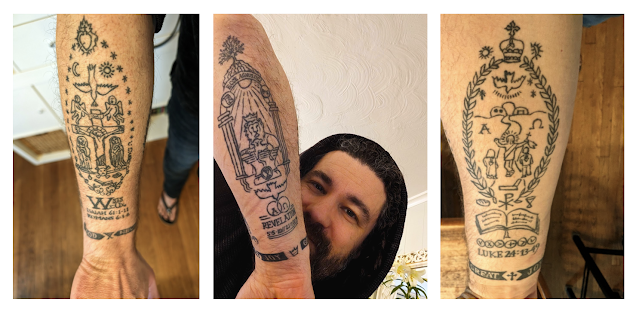
This post is part of a 3-part series focusing on the Christian artwork that is wrapped around my right forearm.

Due to the history and unique line work of Jerusalem Tattoos, along with the strong artistry of my friend, Kevin Shattuck, with Iconic Ink, I get the privilege to talk with curious people who lean in and wonder about the meaning behind each of my tattoos. One Eastern Orthodox friend said, "It's like you have your own icons to turn you back to Christ every time you look at your arm."

Some have even wondered if I could try doing an Instagram or TikTok video sharing about the history and symbology of the various pieces. Maybe someday. But for now, here is a written description.

Quick History of Jerusalem Tattoos

For a pithy overview of where this particular style of tattoos comes from, it originates in North Africa nearly 800 years ago. In this area of the world, Christians have often suffered intense persecution, particularly among Coptic Orthodox Christians. One family, the Razzouks, were Christians living in Egypt in the 1300s. Seeking to escape the violence, they became refugees who settled in Jerusalem where they set up Razzouk Tattoo, which still exists today and welcomes pilgrims from all over the world. 

Quick Story About Tattoo Curiosity

For this specific tattoo, one of my favorite moments was when I was picking up some chicken sandwiches at Popeye's for my kids, and a young woman at the counter said, "That's a cool tattoo. What does it mean?" The series of thoughts below include some of what I told her, especially with the focus on the Wales Window (see more about the Wales Window below). As she listened, she said, "I'm not really religious at all, but I really like what you're saying." My hope and prayer is that the seed of hope that was planted that day helps her turn to Jesus as her Healer, Savior, Lord, and Friend someday.

Redemption Tattoo

Redemption Coptic Jerusalem Tattoo on Right Forearm


This tattoo on the top of my forearm mirrors a Coptic tattoo that has existed for centuries. The central imagery around the cross, featuring the Spirit (dove) above with the moon and sun, the angels side by side, the two bystanders standing next to Jesus on the cross as the skull of death is under His feet, as well as the oval shape of stars can be seen in other Jerusalem tattoos that Christians from around the world go to the Razzouk Tattoo shop to have inked. 

I call this my "Redemption Tattoo" (the others in future posts I will refer to as my "Resurrection" and "Reign" tattoos) because it showcases how: 

Jesus gave Himself
to buy us back from everything
we were selling ourselves out to.
He's the Redeemer that became a slave
even unto death on the cross
so we could be freed from evil,
sin, death, and hell,
destroying the works of the devil,
overcoming death by His death.


The elements I have specifically adapted are listed below with brief explanations for each, beginning from the top to the bottom.

Sacred Heart Longing

The top image is often used in Catholic imagery to represent God's heart for us. It's a heart that is pierced by cross, crown of thorns, and spear like Jesus was, yet is still alive with compassion, a consuming fire that warms us to God's holy and whole-making presence.

The Holy Spirit in the shape of a dove, the moon and sun, and the angels watching everything that is happening on the cross showcases that all the things we see, as well as what we cannot see, were centered on this seemingly untimely death of a man from Nazareth. 

Jesus could have called 
on angels to rescue Him,
but chose out of love 
to lay down His life and 
be crucified as the Lamb of God 
who takes away the sins of the world.


+ Wales Window Jesus

The intentionality of this specific depiction of Jesus is in reference to the Wales Window that was crafted in Wales and then shipped across the Atlantic Ocean to be generously given to 16th Street Baptist Church in an act of solidarity and sorrow after the 1963 bombing of the church building by the Ku Klux Klan in Birmingham, Alabama.

Here on the cross, 
Jesus' right hand is positioned 
to showcase how He continues
to push away the destructive forces 
of violence, murder, slavery, and racism, 
even as His left hand is positioned
open to welcome
the oppressor and the oppressed
to be healed by His forgiving love
in order to transform all
who follow Him
to love their enemies
like He does.


Despite this seeming defeat of Jesus, the skull represents that death is at His feet because death is the last enemy He will defeat, not only for Himself, but for all those who are freed by Him. And underneath the skull is the tomb open to receive Him, but will never keep Him. 

+ Heaven Breaking into Earth

The oval shape of stars surround the cross and reach from the sacred heart down to the place of death. An oval is an ancient and fresh Coptic Orthodox representation of the divine and human, heaven and earth, the seen and unseen coming together, meeting in this excruciating, yet exhilarating moment of Jesus somehow overcoming for us on the cross.

On one side the stars begin to crack and reveal a break in the chains, showcasing that the evil on earth and in the hearts of humanity has no hold on what the King of heaven and earth is doing to set people free. 

On the other side, the stars begin to form into drops of water into seeds planting in the place of death, bringing forth the signs of new creation, blossoms hinting at the resurrection evident in creation itself when one seed dies and yet springs to life to bring a harvest. 


+ Servant of All

Also at the place of death is a drop of water and a towel in a basin. This is to represent how Jesus washed the feet of those who would betray, deny, and desert Him. As the King with the power to confront evil and death, He bent down in humility and vulnerability to cover a multitude of sins through His sacrifice that washes away our sins.

We're invited to join Him in this cruciform posture of love for our family, friends, neighbors, and enemies. 

We wash in silence. 
We wash through His Word. 
We serve at the feet of others, 
remembering the feet 
that were pierced to save us.


+ Worcester Saints Underground

The final piece of the tattoo above the verses Isaiah 61:11 and Romans 6:3-8 that pull together the meaning of all the imagery is a large "W" with an abbreviation of saints in "Sts" along with a "U" that's beginning to sprout.

This is a dream of my city of Worcester becoming a place where:

More are Welcome at the Cross.
More Wonder about the Cross.
More Worship the One on the Cross.
More are Witnesses from the Cross.

More become part of the
"thousands of nameless,
faceless Christians (who) humbly submit
to the task of contributing
their bucket to the torrent,"
cruciformed unseen saints
who love their neighbors,
laying down their lives
for the life of the world
while sharing that Good News
has come even from

Coptic Christian Tattoos: Redemption, Reign, Resurrection

Bonus Quote: 

By dying as He did,
Christ shows that He loves us
in such a way that
He can descend into our private hells.

His love is so empathetic and compassionate
that it can penetrate all barriers
that we construct out of hurt and fear,
in order to enter right into
our despair and hopelessness.

We see this idea expressed
powerfully in John 20.
Twice John presents the disciples
as huddled behind closed doors,
locked in because of fear.
Twice John has Jesus come through
the locked doors and stand
in the midst of that frightened
 and depressed group and
breathe peace into them.

That image 
 
Christ going through locked doors 
 is perhaps the most consoling image
within our entire faith.

Put simply, it means God can help us
even when we cannot help ourselves.
God can empower us
even when we are too weak
and despairing to even, minimally,
open the door to let Him in.

There is no hell 
 no private hell of wound, depression,
fear, sickness, or even bitterness 
 
that God's love cannot and will not
descend into.
Once there, (God's love)
will breathe out
the peace of the Holy Spirit.

+ Fr. Ronald Rolheiser,
Prayer: Our Deepest Longing

Special Note About Tattoos:

God used the skin of His Son
to communicate with us.

God also chose
to write a message on Jesus' skin.
The marks that Thomas touched
are the marks that put to death
the ultimate power of death
for every human soul.
The nail prints in His hands and feet,
the gash from the spear that 
was thrust in His side,
the marks on His scalp
from the thorny crown,
and the field of furrowed flesh
on His back — 
all are the tattoos* that illustrate
the depth of passion God has for us.

*Leviticus 19:28 reads: "Do not cut
your bodies for the dead or put tattoo
marks on yourselves. I am the Lord."
God was instructing His chosen people,
the new nation of Israel, to set
themselves apart. They were not to
imitate pagan religious practices
that used cuttings or tattoos to 
honor the dead or as an offering
to false gods.

God forbade these markings because
they reflected a belief that the dead
could intercede (plead with gods
or advocate) for the living. To conclude,
as some do, that this passage prohibits
modern tattoos is to misread it.

+ Tattoos: Telling the Secrets of the Soul
pgs. 145, 162, 170

More Tattoo Posts:

Resurrection: Emmaus Road

Many blessings of peace and presence,

Rev. Mike “Sully” Sullivan

Monday, April 6, 2026

Tattoo Special | Resurrection: Emmaus Road + Realm of Peace


Coptic Christian Tattoos: Redemption, Reign, Resurrection

 
"Tell Me the Story About Your Tattoos ... "

This is a special Eastertide post that's in a 3-part series focusing on the ancient and fresh Christian artwork that is wrapped around my right forearm.

Due to the history and unique line work of Jerusalem Tattoos, along with the strong artistry of my friend, Kevin Shattuck, with Iconic Ink, I get the privilege to talk with curious people who lean in and wonder about the meaning behind each of my tattoos. One Eastern Orthodox brother said, "It's like you have your own icons to turn you back to Christ every time you look at your arm."

Some have even wondered if I could try doing an Instagram or TikTok video sharing about the history and symbology of the various pieces. Maybe someday. But for now, you can read the post below.

Quick History of Jerusalem Tattoos

For a pithy overview of where this particular style of tattoos comes from, it originates in North Africa nearly 800 years ago. In this area of the world, Christians have often suffered intense persecution, particularly among Coptic Orthodox Christians. One family, the Razzouks, were Christians living in Egypt in the 1300s. Seeking to escape the violence, they became refugees who settled in Jerusalem where they set up Razzouk Tattoo, which still exists today and welcomes pilgrims from all over the world. 

Quick Story About Tattoo Curiosity

For this specific tattoo, one of my favorite moments was the next day after my first appointment at Iconic Ink when I walked into Trader Joe's with the fresh ink on display. It was during the pandemic when masks were still required, so all I could see were the eyes of the tall girl ready to help me in line. 

"Is that new ink?
she asked. 

"Yes," 
I said.

"What is it?"

"It's a type of tattoo
followers of Jesus in North Africa
have been using for nearly 800 years."

"What kind of followers of Jesus?"

"Coptic Christians in Egypt."

"My family is Coptic."

The smiles behind masks were evident through the creases that appeared around our eyes. I shared some more details about the Razzouks (see above) and then she said this:

"You know, it's interesting you mentioned Christians in Egypt in the 1300s. At that time in history, people from Egypt traded with people in Ireland. And for those who sailed to Ireland, but died there, Coptic Christians would give them an honorable burial. Irish Christians who died in Egypt were given the same. So people who followed Jesus across ethnicities and cultures treated each other with compassion and hospitality during a tumultuous time in history when people feared the stranger."

I smiled even more.

"Well, my last name is Sullivan and my family is Irish so you just brought the story full circle to us today."

She leaned in:

"Oh, we need to talk more about this."

That was the last time I saw Eva.

Eva's name means life. I still look for her these couple years later. Sometimes I wonder, "Who was that, God?" Regardless, she gave me a bit of life that day and helped shape the first of many conversations I have been able to enjoy with those curious about this tattoo.


Resurrection Tattoo

Resurrection Coptic Jerusalem Tattoo under Right Forearm


This tattoo on the bottom of my right forearm was my first tattoo I ever had inked. I was on sabbatical, and after a time of solitude and silence in prayer at the Abbey of the Way, I sketched this image. It honors the Emmaus Road story our congregation gets its name from as well as invites each person who sees it (including myself again and again) to welcome hope in a time of uncertainty because Jesus' loving care and pursuit of us is relentless

I call this my "Resurrection Tattoo" (the others l refer to as my "Redemption" and "Reign" tattoos) because it showcases that: 

God the Father planned to rescue us,
God the Son meets us right where we are,
and God the Spirit, transforms our story
to raise us from death to life
and move us through darkness to light,
to walk humbly with Jesus on any
road that we think is hopeless, but is
ultimately a journey brimming over 
with abundant light and life.
Our resurrected King is
resurrecting us.


The elements of the Emmaus story, seen and unseen, that I have specifically included in the tattoo are listed below with brief explanations for each, beginning from the top to the bottom.

Trinity Rule of Love

The top image is a crown centered between the sun and crescent moon with the symbol of the Trinity in it and a cross above it. This is to show that the God who is the Creator of the universe is the God of love who is self-giving. As the Father loves the Son and the love between them overflows with the Spirit, so this same love is given to us, His beloved creation.

And ultimately this love is given for those who welcome His adoption of them as His children, fully showcased in Jesus' death to pay for adoption, because "greater love has no one than this: that Someone would lay down their life for their friends." 

The God revealed in Jesus
is the One who loves us to the end.
This is the love that is beautiful,
true, and good that overcomes evil
in us and throughout the world.
This is the Love we want and
we need to rule everything.


Unseen & Seen Prince of Peace

The olive tree branches that form the oval shape around the central image represent the wholemaking peace that comes when Jesus, the Prince of Peace, is near. An oval is an ancient and fresh Coptic Orthodox representation of the divine and human, heaven and earth, the seen and unseen coming together.

When Jesus resurrected, often the first thing He would say to people when they discovered that He defeated death was, "Peace be with you." The travelers on the Emmaus road had lost so much hope and were spiritually and physically walking away from the city of peace (Jerusalem means "city of shalom"). Jesus met them on this road and would soon turn them back with new hope and peace that could face any threat of death that would come their way.

Even though the night was long,
and hope was dim,
God provided a peace
that passes all understanding
to guard these travelers
in Christ Jesus with Christ Jesus.
And their witness would soon
share this peace and multiply it
so much that the power of 
the Roman Empire and 
its promised peace
of the Pax Romana
couldn't match it.


Beginning & End of Our Story

There are three travelers on this Emmaus road: Jesus, Cleopas, and the unnamed traveler. Some historians and theologians think the unnamed might have been Luke. Others think it might have been Mary, the wife of Clopas. I tend to lean with the latter as I think Jesus is recapitulating God walking with humanity in the cool of the day to turn humanity back to His presence and peace. But the beauty of an unnamed traveler is that Luke is also inviting you to see yourself in the story as one Jesus meets with on your road. 

Jesus is not only writing the story of these two travelers, adding a new beginning and ending that they hadn't anticipated (represented by the Alpha and Omega as the first and letters of the Greek alphabet juxtaposed around them). He is also writing the story for all us who will listen to the Scriptures, meet with the Lord Jesus at His table, trust in His death and resurrection, and go into the world to share this good news of the Chi-Rho (meaning, "Christ," "Messiah," "anointed King," represented in the bottom half of the tattoo by the first two letters of Christ's name, which in Greek are "X" and "P"). 

Above the Chi-Rho (Messiah) 
is the symbol of the open grave
because the tomb is empty,
but the throne will never be.

Christ Jesus is alive.
Death is defeated.
Our hearts burn and come alive
with the surprise and stirring
of this personally-transforming,
history-altering,
world-restoring
Gospel that the grave is open
and will never be shut forever
on all who walk with Jesus
in the wonder of this wild.
Jesus is the Alpha and Omega,
the beginning and end
of the greatest story,
the Redeemer, Healer, and Savior
of everything we hope is true.
He is making all things new,
including us.

God is truly with us
and for us forever.


The Story of God, the Story of Us

The final piece of the tattoo above the verses Luke 24:13-49 that pull together the context of all the imagery is an open book, or an open story, honoring the Hebrew Scriptures that pointed to Jesus as God with us, the New Testament letters that reflected on what His life, death, resurrection, and ascension means for His people and for the world, and invite us into the Story of God that we get to live in now until Jesus returns to reconcile heaven and earth.

The symbols below the open book are a simple and concise way to share the Story of God through the 6-Act Arc of Creation, Crisis, Covenant Community, Christ, Church, and Consummation. The Bible touches on all these parts of the story, helping us understand and enter into the story we get to live in, one that is filled with creation, communion, and blessing, more than the mere chaos, chance, and the need for constant change we often drown in when we swim in our 21st century Western culture.

My dream for Emmaus City Church is being a people who are transformed by Jesus and live to embody the story above where:

More are Welcome on the Emmaus Road.
More Get to Hear the Story of God.
More Encounter the Presence of Christ.
More Find the Peace They Need.

More become part of the
"thousands of nameless,
faceless Christians (who) humbly submit
to the task of contributing
their bucket to the torrent,"
resurrected unseen saints
who love their neighbors,
walking Emmaus roads,
revealing Jesus to many more
in word, actions, and prayers
while sharing Good News 
of Great Joy that there
is an empty cross and tomb
and we live in the

Special Note About Tattoos:

God used the skin of His Son
to communicate with us.

God also chose
to write a message on Jesus' skin.
The marks that Thomas touched
are the marks that put to death
the ultimate power of death
for every human soul.
The nail prints in His hands and feet,
the gash from the spear that 
was thrust in His side,
the marks on His scalp
from the thorny crown,
and the field of furrowed flesh
on His back — 
all are the tattoos* that illustrate
the depth of passion God has for us.

*Leviticus 19:28 reads: "Do not cut
your bodies for the dead or put tattoo
marks on yourselves. I am the Lord."
God was instructing His chosen people,
the new nation of Israel, to set
themselves apart. They were not to
imitate pagan religious practices
that used cuttings or tattoos to 
honor the dead or as an offering
to false gods.

God forbade these markings because
they reflected a belief that the dead
could intercede (plead with gods
or advocate) for the living. To conclude,
as some do, that this passage prohibits
modern tattoos is to misread it.

Tattoos: Telling the Secrets of the Soul
pgs. 145, 162, 170


Many blessings of peace and presence,

Rev. Mike “Sully” Sullivan


Wednesday, August 14, 2024

Tattoo Special | Reign: Lion & Lamb + Heaven & Earth United


Coptic Christian Tattoos: Redemption, Reign, Resurrection


"Tell Me the Story About Your Tattoos ... "

This is the finale in a 3-part series of posts focusing on the ancient and fresh Christian artwork that is wrapped around my right forearm.

Due to the history and unique line work of Jerusalem Tattoos, along with the strong artistry of my friend, Kevin Shattuck, with Iconic Ink, I get the privilege to talk with curious people who lean in and wonder about the meaning behind each of my tattoos. One Eastern Orthodox friend said, "It's like you have your own icons to turn you back to Christ every time you look at your arm."

Some have even wondered if I could try doing an Instagram or TikTok video sharing about the history and symbology of the various pieces. Maybe someday. But for now, this is the final in a series of posts sharing about each tattoo. The first two were:


Quick History of Jerusalem Tattoos

For a pithy overview of where this particular style of tattoos comes from, it originates in North Africa nearly 800 years ago. In this area of the world, Christians have often suffered intense persecution, particularly among Coptic Orthodox Christians. One family, the Razzouks, were Christians living in Egypt in the 1300s. Seeking to escape the violence, they became refugees who settled in Jerusalem where they set up Razzouk Tattoo, which still exists today and welcomes pilgrims from all over the world. 

Reign Tattoo


This tattoo on the side of my right forearm was created when I was on a spiritual retreat at the Abbey of the Genesee in October 2022. During the Great Silence, a 24-hours time frame of solitude and quiet, I spent 7+ hours in the sanctuary praying, reading, meditating, and drawing. The imagery that came together during the sketching time is now on my forearm.

I call this my "Reign Tattoo" (the others l refer to as my "Redemption" and "Resurrection" tattoos) because it showcases from the top to the bottom of the tattoo that:

When all things are made new, 
its leaves providing healing for all the nations,
as heaven's cleansing waters flow on us
fully present in the presence of the Holy One
— the Word of life and the key to life  
who invites us into a family
of every tribe, tongue, and nation,
grateful to eat at the same table together,
set and served by the King of kings,
every drink full of grace and gratitude
  — Eucharist 
 
as the Spirit hovers over the waters
and the knowledge of the glory of God
the good beginning brought to a beautiful end
that's only the beginning as
Jesus keeps His Word to finish what He started.

This is good news of great joy 
in which the journey from
the cradle to the cross to the crown is
the only Story of God
in which vulnerability leads to victory
because of the overcoming Christ 
who has compassion
on the lonely, least, last, and lost
including me,
the great chief of sinners
who is greatly loved by Jesus our Savior.


Coptic Christian Tattoos: Redemption, Reign, Resurrection

Special Note About Tattoos:

God used the skin of His Son
to communicate with us.

God also chose
to write a message on Jesus' skin.
The marks that Thomas touched
are the marks that put to death
the ultimate power of death
for every human soul.
The nail prints in His hands and feet,
the gash from the spear that 
was thrust in His side,
the marks on His scalp
from the thorny crown,
and the field of furrowed flesh
on His back — 
all are the tattoos* that illustrate
the depth of passion God has for us.

*Leviticus 19:28 reads: "Do not cut
your bodies for the dead or put tattoo
marks on yourselves. I am the Lord."
God was instructing His chosen people,
the new nation of Israel, to set
themselves apart. They were not to
imitate pagan religious practices
that used cuttings or tattoos to 
honor the dead or as an offering
to false gods.

God forbade these markings because
they reflected a belief that the dead
could intercede (plead with gods
or advocate) for the living. To conclude,
as some do, that this passage prohibits
modern tattoos is to misread it.

Tattoos: Telling the Secrets of the Soul
pgs. 145, 162, 170

Many blessings of peace and presence,

Rev. Mike “Sully” Sullivan