Showing posts with label Resurrection. Show all posts

Tuesday, June 16, 2026

Juneteenth Is Near | Freedom Comes Through Faith in Action

Celebrate Juneteenth
and how Jesus brings
ultimate freedom

Now the Lord is the Spirit,
and where the Spirit of the Lord is,
there is freedom.

It is for freedom
that Christ has set us free.
You, my brothers and sisters,
were called to be free.

But do not use your freedom
to indulge the flesh;
rather, serve one another
humbly in love.

The Spirit of the Lord is on me,
because He has anointed Me
to proclaim good news to the poor.
He has sent me to proclaim freedom
for the prisoners
and recovery of sight for the blind,
to set the oppressed free.

+ 2 Corinthians 3:17;
Galatians 5:1, 13; Luke 4:18

Let's get ready for Juneteenth, the oldest known celebration of the end of slavery in the United States that began on June 19, 1865. Now a national holiday, more and more people are learning about what happened in Galveston, Texas when slaves learned of the Emancipation Proclamation on June 19, 1865, two and a half years after the initial announcement by President Abraham Lincoln on September 22, 1862.


If you want to learn more about Juneteenth,
watch this powerful documentary:

A Documentary (75+ Minutes) 
In this 2022 film, you will learn how Scripture inspired the faith of enslaved people, travel to the church where America’s first Juneteenth celebration took place, and uncover why newly liberated men and women credited God for their freedom. With special guests Ms. Opal Lee, Lecrae, and more, you’ll journey to Galveston, Texas to discover a faith stronger than suffering. 
Sho Baraka songs are featured throughout the documentary, including "Their Eyes Were Watching" and "Myhood, U.S.A., 1937".

Juneteenth also reminds us of how Jesus secured our freedom in the past, and continues to send people to various corners of the earth to proclaim to those who are enslaved to darkness and death that they have been emancipated and are free.

Complementing the Juneteenth: Faith & Freedom documentary, Rishmawy's "The Cross Between the World and Me" introduced me to connections between faith and freedom by telling more of the story behind the cover of Fleming Rutledge's The Crucifixion: Understanding the Death of Jesus Christ. 

How does faith help lead to freedom?
How do justice and mercy meet?
How does forgiveness
transform into freedom
for the forgiver and the forgiven? 


The Wales Window given to 16th Street Baptist Church

Look at the powerful stained glass above.
Then seep in some of Rishmawy's
potent words 
below. 

The artwork above is the stained glass image of the "Wales Window" given to the 16th Street Baptist Church in Birmingham, Alabama. It was donated as a gift from the people of Wales after the 1963 Klan bombing that rocked the church and robbed the life of the four little black girls in their Sunday best, a horrific scene captured in the recent 2014 film, "Selma." 
The stained glass is striking. In it, we see Christ, arms outstretched. According to the artist, the two arms outstretched are doing different things. The one is thrust out, stiff-arming the powers of death and injustice, while the other reaches out, offering forgiveness for the world. 
The central mystery of the Christian gospel is the Holy God who out of the fullness of His own perfect life stooped, became incarnate, identifying Himself with the whole of humanity, and, as the Creed has it, suffered under Pontius Pilate. 
The Savior is the Divine Son who knew no suffering, yet assumed human flesh, a Body in midst of a dominated people to suffer on our behalf and rise again. God became a gendered, embodied Jew in the 1st Century, heir to hundreds of years of political oppression at the hands of colonizing invaders (Babylonian, Persian, Greek), mostly recently of an empire, Rome, that stood as the chief political, economic, social, and religious power the world had ever seen. He grew up under the eye of the soldiers of a people who prided themselves as superior to every other people; a people who used subject nations and cultures to prop up their own; a people who threatened anyone who crossed that system with torture and death. And eventually it was under the administration of their laws, their justice, that His body hung naked, exposed, broken, shamed on a cross, tossed on the garbage heap of history, scorned even by the elite of His own people. 
I cannot do justice to the multifaceted character of Christ’s death, but the thing we must say is that the death He died, He died willingly for sin. He died in order to wipe us clean from the sins we commit as well as deliver us from the Sin we are enslaved to. He died in order to atone and liberate. He died to do justice, to ensure that forgiveness is not offered on the cheap. But for Christians, death is not the concluding word, and in His resurrection, Jesus actively and powerfully breaks the power of Sin, the World, and Death, by showing that despite appearances to the contrary, it does not have the final say of things. 
Jesus is the Resurrected One! Hope for reconciliation, both personal and cultural, comes after we’ve truly reckoned with the nature of the rupture of the Cross, confessed, and repented. This is one of what I take to be the glories of the Christian Gospel: it forces you to see the truth about the world, about yourself, about your neighbor—both the grime and the glory—and it is precisely there where the God with a broken body meets us and resurrects us. Soli Deo Gloria! 
+ Derek Rishmawy, "The Cross Between the World and Me"

God continues to free people across time and across continents to reconcile with each through the revelation that Jesus is for all of us as our Repairer of Broken Bridges (see Isaiah 58:6-12), our Liberator and King of justice and peace.

To close this post, David Rosa Jr.'s potent word provide a call to action for Jesus' Church:
 
Juneteenth—the day when word of freedom
finally reached Galveston, Texas,
more than two years after
the Emancipation Proclamation.

Freedom had been declared,
but it hadn’t yet been delivered.

And in that gap between
the legal breaking of chains and
the actual walking out of freedom,
people waited, prayed, survived.

That gap still shows up.
Even in the Church.
We preach unity.
We quote Revelation 7.
We celebrate that Jesus
tore down the dividing wall.
But if we’re honest,
there’s often a long delay
between the declaration of unity
and the lived reality of it.

The early Church felt that too.
In Jerusalem, Jews and Gentiles
were baptized into the same Spirit.
But it was in Antioch
—a diverse, complex, tension-filled city—
where the Church finally started living
what had already been proclaimed.

Different cultures, different classes,
different languages,
One Church, one Lord, one mission.
And it’s not lost on me
that it was from that kind of church,
not from Jerusalem,
that the first city movement was launched.

Antioch wasn’t perfect, but it was pivotal.
It was the space where partial unity
gave way to full participation,
where division began to break
all the way down,
where the Church stopped
just being gathered
and started being sent.

Juneteenth reminds us that
freedom delayed isn’t necessarily
freedom denied,
but it’s still a burden to carry.

And unity delayed isn’t
unity denied either,
but it’s still a call to press in,
to move closer, to build something real.

If we want to see
gospel movements in our cities,
we can’t settle for surface-level unity.
We need Antioch-level community.
Where collaboration is deep,
leadership is shared, and
mission is launched
from the margins and the middle,
not just the center.

The dream is alive.
But the delay is real.
And the Church has a decision to make.

Will we settle for proximity,
or will we press into
the kind of unity that
births robust gospel movements?

Happy Juneteenth.
Let’s not just remember the delay.
Let’s respond to it.


Book Recommendations:

+
by Jasmine Holmes

Christ is all,

Rev. Mike "Sully" Sullivan

Tuesday, April 7, 2026

A Curious Wonder | "Why Do You Believe in the Resurrection?"


 On the morning of 
Monday, March 30, 2026 
I was texted this question,
"Why do you believe in

This post is the composite of the two texts (along with a couple additional quotes from sources that helped shape my response) I sent to answer the wonderfully curious question above that a friend generously asked me a week before Easter Monday.

After all, this is a good question to ask in light of how the proclamation of Jesus' resurrection, whether conceived of as myth or fantasy or reality, has changed the course of human history even if: 

" ... There's no empirical evidence in our lives that anything could ever resurrect. ... Not only is it physically impossible, it seems to fly in the face of everything we see going on in the world around us. All of our best efforts as human beings have been used in war or in oppressing other people. And to say at the end of the day that we could possibly come back to life? It's almost like, number one, why would you want to ever come back here? And number two, how does that even work? ... "


While my answer is by no means exhaustive or particularly enchanting or wise, I hope this exchange between friends provides you with encouragement as you consider if the resurrection of Jesus could possibly be history-altering and personally-transforming good news for you.

"Why Do You Believe
in the Resurrection?"

Thank you for asking. Since I'm preaching on Matthew 28:1-10 this weekend, here are some things already on my mind:

The Gospels record women as the key eye witnesses to this event even though their testimonies in a court of law weren't allowed and were considered untrustworthy in general ... and yet the news these women shared spread dramatically as good and true news when anyone could have simply scoffed at them as second class citizens.

Jews believed in the resurrection of humanity at the end of time, but not one man in time, especially not one man claiming to be divine (i.e. the epitome of blasphemy unless Jesus, Yeshua was / is Yahweh in the flesh); and Greeks didn't value the body so a resurrection doesn't matter much because matter doesn't matter much to them ... yet they came together across ethnic and cultural differences, Jews and Greeks alongside North Africans, Asians, and more to worship Jesus, this God-man as the visible image of the one God of Israel who is Savior and Lord of all.

The disciples were not willing to be seen with Jesus when He was on trial because they were afraid, and they were hiding out of sight during His crucifixion (except a few women, including Mary Magdalene and Mother Mary, and John, most likely cloaked) and hid even more after He died because they were afraid of being crucified as traitors to the empire with Him ... why would they then claim He was resurrected and then die courageously in horrific ways (i.e. flayed to death, dragged to death, stoned, crucified upside down, etc.) shortly thereafter if before and during the crucifixion they weren't willing to die for Him?


Here is the question 
that seems unanswerable:
What did these disciples 
get out of their lie?

When someone deceives another,
the deceiver is always motivated
by some thought of advantage.
What advantage did the disciples
gain by their conspiracy?

They got mocked, hated, sneered at,
their reputation and their civil rights;
they got imprisoned, whipped,
beheaded, sawed in pieces, boiled in oil,
crucified, fed to lions and 

And under torture none ever
confessed that it was all a
lie, a myth, a fabrication?

This is amazing!
The human heart is 
exceedingly fickle,
is it not?
Especially the heart of a liar?
I do not understand what
could have made them endure
such torture except their certainty
that Jesus really did rise
and that they would too.
If they didn't believe
in the resurrection,
why would they give up
the only life they knew
was real for nothing?

If the miracle of the resurrection
didn't really happen,
then an even more incredible
miracle happened.
Twelve Jewish peasants invented
the world's most fantastic
and successful lie for no reason
at all and died for it willingly
and joyfully, as martyrs.
As did millions of others.

But what motivated 
the miracle in their lives?
An effect must have a cause
at least as great as itself,
isn't that true?
I do not see what could
have caused this miracle
of changed lives except
an even greater miracle.
The resurrection would
have such power,
but how could a lie

How did a movement based on the claimed historical resurrection of one man worshiped to be God in the flesh grow from 120 in a room to more than half of the entire Roman Empire's population (i.e. millions upon millions) by AD 400 if it could be claimed as false simply by showing the body of Jesus still in a tomb (which religious leaders and Roman guards could have easily done if Jesus' body was still there), didn't line up with a polytheistic society at all if you're going to try to start a new religion, countered the Roman Empire's gospel that Caesar is the son of god, and welcomed you into the very real possibility that if you joined this community in baptism, you and those you love could most likely die very soon by being crucified, torn apart by lions, sawed in half, burned to death, etc.?

Somehow human history has arguably been most altered by this resurrection of Jesus of Nazareth, a poor Palestinian Jew, subjugated under the Roman Empire in the backwater country even His own people didn't think much good could come out of; yet He is the turning point by which the entire globe now values the things His Kingdom of heaven highlighted, celebrated, and accelerated (ex. freedom, kindness, equality, compassion, consent, progress) as those who go searching tend to find that these almost universally accepted values find their potent and expansive roots in how Jesus' resurrection reveals the true value and purpose of human existence.

The longevity and expansiveness
of this resurrection 
is summed up beautifully
in one Catholic philosopher's pithy quote,

"Christianity has died many times
and risen again;
for it had a God who knew
the way out of the grave."

+ G.K. Chesterton

And for a lesser reason than its history-altering good news, but its personally transforming truth for me is that I would not be the man (very imperfect that I am), the husband, the father, the friend, the neighbor, the citizen, and the pastor that I am in the ways that mirror Jesus unless He is resurrected and is resurrecting me to be more through His abundant life.

I am neither an optimist
nor a pessimist.
Jesus Christ is risen from the dead!

+ Lesslie Newbigin

One more reason I believe in the resurrection is that if Jesus is the image of true humanity and true divinity, of what life on earth is intended to be, He shows us the way to live is not to avoid loss (ultimately displayed in death), but to endure through loss, trusting that part of this human life right now is facing death, enduring death, but not doing it alone, because Jesus has gone before us, and because He is the Resurrection and the Life, He will walk with us through death to show us it does not have the last word. Love generously preserving into everlasting life has the last word.

Jesus went through the Loss of all losses and came out the other side with more than what He lost. In light of the resurrection, life is more than "do good despite loss" (Stoicism). Life is more than "enjoy life despite loss" (Epicureanism). And life is more than "your loss is part of an illusion and not really real" (Platonism). The resurrection of Jesus reveals we are saved from ultimate loss and we gain more than what we lose on the other side of death.

I think the human desire for death to not have the last word, and that it actually won't based on the truth of the resurrection of Jesus Christ who has the power to, and will, restore everything sin has broken in this world when He reconciles heaven and earth into the beauty of what creation is intended to be and will be, is expressed in this C.S. Lewis quote in "Mere Christianity":

" ... The Christian says,
'Creatures are not born with desires
unless satisfaction for those desires exists.
A baby feels hunger:
well, there is such a thing as food.
A duckling wants to swim:
well, there is such a thing as water.
Men feel sexual desire:
well, there is such a thing as sex.

If I find in myself a desire
which no experience in this world can satisfy,
the most probable explanation is
that I was made for another world.
If none of my earthly pleasures satisfy it,
that does not prove that the universe is a fraud.
Probably earthly pleasures
were never meant to satisfy it,
but only to arouse it,
to suggest the real thing.
If that is so, I must take care,
on the one hand, never to despise,
or be unthankful for,
these earthly blessings,
and on the other,
never to mistake them for
the something else of which
they are only a kind of copy,
or echo, or mirage.

I must keep alive in myself
the desire for my true country,
which I shall not find till after death' ... "

The resurrection of Jesus is
'the thing' that defines Christians.
On the resurrection we stake everything ...
Christians hold on to more than morality,
enjoyment, or our souls —
we hold on to Someone.

+ Curtis Chang

Christ is all,
Rev. Mike "Sully" Sullivan


Monday, April 6, 2026

Tattoo Special | Resurrection: Emmaus Road + Realm of Peace


Coptic Christian Tattoos: Redemption, Reign, Resurrection

 
"Tell Me the Story About Your Tattoos ... "

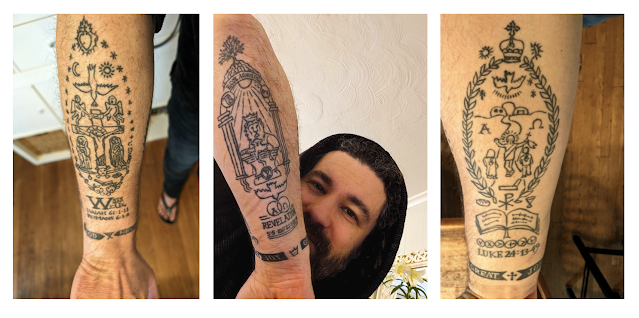
This is a special Eastertide post that's in a 3-part series focusing on the ancient and fresh Christian artwork that is wrapped around my right forearm.

Due to the history and unique line work of Jerusalem Tattoos, along with the strong artistry of my friend, Kevin Shattuck, with Iconic Ink, I get the privilege to talk with curious people who lean in and wonder about the meaning behind each of my tattoos. One Eastern Orthodox brother said, "It's like you have your own icons to turn you back to Christ every time you look at your arm."

Some have even wondered if I could try doing an Instagram or TikTok video sharing about the history and symbology of the various pieces. Maybe someday. But for now, you can read the post below.

Quick History of Jerusalem Tattoos

For a pithy overview of where this particular style of tattoos comes from, it originates in North Africa nearly 800 years ago. In this area of the world, Christians have often suffered intense persecution, particularly among Coptic Orthodox Christians. One family, the Razzouks, were Christians living in Egypt in the 1300s. Seeking to escape the violence, they became refugees who settled in Jerusalem where they set up Razzouk Tattoo, which still exists today and welcomes pilgrims from all over the world. 

Quick Story About Tattoo Curiosity

For this specific tattoo, one of my favorite moments was the next day after my first appointment at Iconic Ink when I walked into Trader Joe's with the fresh ink on display. It was during the pandemic when masks were still required, so all I could see were the eyes of the tall girl ready to help me in line. 

"Is that new ink?" 
she asked. 

"Yes," 
I said.

"What is it?"

"It's a type of tattoo
followers of Jesus in North Africa
have been using for nearly 800 years."

"What kind of followers of Jesus?"

"Coptic Christians in Egypt."

"My family is Coptic."

The smiles behind masks were evident through the creases that appeared around our eyes. I shared some more details about the Razzouks (see above) and then she said this:

"You know, it's interesting you mentioned Christians in Egypt in the 1300s. At that time in history, people from Egypt traded with people in Ireland. And for those who sailed to Ireland, but died there, Coptic Christians would give them an honorable burial. Irish Christians who died in Egypt were given the same. So people who followed Jesus across ethnicities and cultures treated each other with compassion and hospitality during a tumultuous time in history when people feared the stranger."

I smiled even more.

"Well, my last name is Sullivan and my family is Irish so you just brought the story full circle to us today."

She leaned in:

"Oh, we need to talk more about this."

That was the last time I saw Eva.

Eva's name means life. I still look for her these couple years later. Sometimes I wonder, "Who was that, God?" Regardless, she gave me a bit of life that day and helped shape the first of many conversations I have been able to enjoy with those curious about this tattoo.


Resurrection Tattoo

Resurrection Coptic Jerusalem Tattoo under Right Forearm


This tattoo on the bottom of my right forearm was my first tattoo I ever had inked. I was on sabbatical, and after a time of solitude and silence in prayer at the Abbey of the Way, I sketched this image. It honors the Emmaus Road story our congregation gets its name from as well as invites each person who sees it (including myself again and again) to welcome hope in a time of uncertainty because Jesus' loving care and pursuit of us is relentless. 

I call this my "Resurrection Tattoo" (the others l refer to as my "Redemption" and "Reign" tattoos) because it showcases that: 

God the Father planned to rescue us,
God the Son meets us right where we are,
and God the Spirit, transforms our story
to raise us from death to life
and move us through darkness to light,
to walk humbly with Jesus on any
road that we think is hopeless, but is
ultimately a journey brimming over 
with abundant light and life.
Our resurrected King is
resurrecting us.


The elements of the Emmaus story, seen and unseen, that I have specifically included in the tattoo are listed below with brief explanations for each, beginning from the top to the bottom.

+ Trinity Rule of Love

The top image is a crown centered between the sun and crescent moon with the symbol of the Trinity in it and a cross above it. This is to show that the God who is the Creator of the universe is the God of love who is self-giving. As the Father loves the Son and the love between them overflows with the Spirit, so this same love is given to us, His beloved creation.

And ultimately this love is given for those who welcome His adoption of them as His children, fully showcased in Jesus' death to pay for adoption, because "greater love has no one than this: that Someone would lay down their life for their friends." 

The God revealed in Jesus
is the One who loves us to the end.
This is the love that is beautiful,
true, and good that overcomes evil
in us and throughout the world.
This is the Love we want and
we need to rule everything.


+ Unseen & Seen Prince of Peace

The olive tree branches that form the oval shape around the central image represent the wholemaking peace that comes when Jesus, the Prince of Peace, is near. An oval is an ancient and fresh Coptic Orthodox representation of the divine and human, heaven and earth, the seen and unseen coming together.

When Jesus resurrected, often the first thing He would say to people when they discovered that He defeated death was, "Peace be with you." The travelers on the Emmaus road had lost so much hope and were spiritually and physically walking away from the city of peace (Jerusalem means "city of shalom"). Jesus met them on this road and would soon turn them back with new hope and peace that could face any threat of death that would come their way.

Even though the night was long,
and hope was dim,
God provided a peace
that passes all understanding
to guard these travelers
in Christ Jesus with Christ Jesus.
And their witness would soon
share this peace and multiply it
so much that the power of 
the Roman Empire and 
its promised peace
of the Pax Romana
couldn't match it.


+ Beginning & End of Our Story

There are three travelers on this Emmaus road: Jesus, Cleopas, and the unnamed traveler. Some historians and theologians think the unnamed might have been Luke. Others think it might have been Mary, the wife of Clopas. I tend to lean with the latter as I think Jesus is recapitulating God walking with humanity in the cool of the day to turn humanity back to His presence and peace. But the beauty of an unnamed traveler is that Luke is also inviting you to see yourself in the story as one Jesus meets with on your road. 

Jesus is not only writing the story of these two travelers, adding a new beginning and ending that they hadn't anticipated (represented by the Alpha and Omega as the first and letters of the Greek alphabet juxtaposed around them). He is also writing the story for all us who will listen to the Scriptures, meet with the Lord Jesus at His table, trust in His death and resurrection, and go into the world to share this good news of the Chi-Rho (meaning, "Christ," "Messiah," "anointed King," represented in the bottom half of the tattoo by the first two letters of Christ's name, which in Greek are "X" and "P"). 

Above the Chi-Rho (Messiah) 
is the symbol of the open grave
because the tomb is empty,
but the throne will never be.

Christ Jesus is alive.
Death is defeated.
Our hearts burn and come alive
with the surprise and stirring
of this personally-transforming,
history-altering,
world-restoring
Gospel that the grave is open
and will never be shut forever
on all who walk with Jesus
in the wonder of this wild.
Jesus is the Alpha and Omega,
the beginning and end
of the greatest story,
the Redeemer, Healer, and Savior
of everything we hope is true.
He is making all things new,
including us.

God is truly with us
and for us forever.


+ The Story of God, the Story of Us

The final piece of the tattoo above the verses Luke 24:13-49 that pull together the context of all the imagery is an open book, or an open story, honoring the Hebrew Scriptures that pointed to Jesus as God with us, the New Testament letters that reflected on what His life, death, resurrection, and ascension means for His people and for the world, and invite us into the Story of God that we get to live in now until Jesus returns to reconcile heaven and earth.

The symbols below the open book are a simple and concise way to share the Story of God through the 6-Act Arc of Creation, Crisis, Covenant Community, Christ, Church, and Consummation. The Bible touches on all these parts of the story, helping us understand and enter into the story we get to live in, one that is filled with creation, communion, and blessing, more than the mere chaos, chance, and the need for constant change we often drown in when we swim in our 21st century Western culture.

My dream for Emmaus City Church is being a people who are transformed by Jesus and live to embody the story above where:

More are Welcome on the Emmaus Road.
More Get to Hear the Story of God.
More Encounter the Presence of Christ.
More Find the Peace They Need.

More become part of the
"thousands of nameless,
faceless Christians (who) humbly submit
to the task of contributing
their bucket to the torrent,"
resurrected unseen saints
who love their neighbors,
walking Emmaus roads,
revealing Jesus to many more
in word, actions, and prayers
while sharing Good News 
of Great Joy that there
is an empty cross and tomb
and we live in the

Special Note About Tattoos:

God used the skin of His Son
to communicate with us.

God also chose
to write a message on Jesus' skin.
The marks that Thomas touched
are the marks that put to death
the ultimate power of death
for every human soul.
The nail prints in His hands and feet,
the gash from the spear that 
was thrust in His side,
the marks on His scalp
from the thorny crown,
and the field of furrowed flesh
on His back — 
all are the tattoos* that illustrate
the depth of passion God has for us.

*Leviticus 19:28 reads: "Do not cut
your bodies for the dead or put tattoo
marks on yourselves. I am the Lord."
God was instructing His chosen people,
the new nation of Israel, to set
themselves apart. They were not to
imitate pagan religious practices
that used cuttings or tattoos to 
honor the dead or as an offering
to false gods.

God forbade these markings because
they reflected a belief that the dead
could intercede (plead with gods
or advocate) for the living. To conclude,
as some do, that this passage prohibits
modern tattoos is to misread it.

+ Tattoos: Telling the Secrets of the Soul
pgs. 145, 162, 170


Many blessings of peace and presence,

Rev. Mike “Sully” Sullivan


Sunday, April 5, 2026

Easter | Jesus' Resurrection Is So Much More Than a Metaphor


Resurrection by Magnus 3D

You see,
the resurrection is actually
Jesus' most offensive act.
+ Searching for Enough

In honor of the resurrection of Jesus Christ, this post features some of Tyler Staton's reflections from Searching for Engough (alongside "Powerful & Personal Enough Good News" and "A Good Way to Die") while also complementing a previous series entitled "Yeshua" based on Frances Spufford's writings in Unapologetic.

Jesus' Most Offensive Act

If Jesus' resurrection was a metaphor ...

that makes Him a likeable revolutionary. It means we can learn from Him; we can take from His life what might be helpful for ours. We can pick Him over like any other historical figure, admiring Him for His extraordinary character, memorializing the ways He was misunderstood in His time but now, in our more sophisticated, broadly progressive culture and with the benefit of hindsight, we can understand Him properly, accurately gaining insight from Him — a wise sage from another time offering us advice from a rocking chair but not understanding our iPhones, pace of life, or money made of pixels.

If Jesus' resurrection was a metaphor ...

He was a prophet misunderstood in His time — Kurt Cobain with a more profound message. We can remember Him for what He could've been, should've been, if He had been allowed to live a full life. We can take solace in the metaphorical resurrection, meaning His teachings never died and His Spirit lived on in His few followers.

If the resurrection was a metaphor ...

Jesus was a teacher with depth and eloquence far too great for the ears of the common peasants He taught. He had a message to be pondered by the greats, and it was wasted on the uneducated, illiterate simpletons that surrounded Him. He's Will Hunting with no Robin Williams to get Him out of South Boston, so He did the best He could with the Affleck brothers.

A resurrection metaphor ...

makes Jesus a philosopher on par with the likes of Socrates, Plato, Kant, and Kierkegaard. He's pulled something so profound from a left-brained mind, the right brains will teach it in classrooms for centuries to come.

A resurrection metaphor ...

makes Jesus a social justice symbol. Actually, it makes Him the social justice symbol. His life is the one that became the model for Gandhi, Nelson Mandela, and Martin Luther King Jr. to follow. His "resurrection" is the spirit of peaceful protest that has cut a better way through some of the harshest periods of oppression in history. His life is truly a light. His life has been a light in some of the darkest nights of world history — Indian poverty, South African apartheid, American slavery.

A resurrection metaphor ...

is a way of saying that Jesus' virtue lives on, even now, in those He continues to influence, and that makes Jesus a great man. Maybe it even makes Him the greatest man. A great man about whom we have much to admire. A great man we should always remember and never forget. A man so great He was even able to die an unjust death with grace and dignity. This is not an offensive figure, not one about whom people hold polarizing opinions, not one who divides people in "sheep and goats."

Read back through the description above. Who finds there a man they disagree with or oppose?

The theologian William Willimon puts it quite honestly:

I don't need a resurrected Jesus.
Come to think of it,
I'm not sure I want
a resurrected Jesus ...
I have the illusion that
I'm in control,
that I am making a so
significant contribution
to help Jesus
that I may be eternal
on my own.

No, I don't need a 
bodily resurrected Jesus.
In fact, if I ever get one,
my life would become
much more difficult.

Here's what he's getting at. If Jesus showed us a new way to live and a better way to die, we are left to pick over His life like a swarm of vultures, gnawing at His bones for something of Him we can add to ourselves. A Jesus of life and death is a fantastic addition. To this Jesus, we come with our already full lives, having already decided who we will be, where we will go, what we dream of, and what is needed to accomplish those dreams. We add this Jesus like milk in a cup of coffee — just a splash; there's not much room left, but I'd love to get that nice caramel color.

But an actual resurrection? That requires an empty cup, contents poured out until it's bare ceramic, so it can be filled to overflowing with living water.

You see,
the resurrection is actually
Jesus' most offensive act.

A bodily resurrection means
Jesus isn't a likable revolutionary.
He can't be ...
Gandhi,
Mandela,
MLK
—
none of those men
walked out of their graves.

An actual resurrected Jesus
does not make Him a great man.
It makes Him Lord.

It means He flooded the
recurring darkness with
constant light — 
overcame systemic evil,
swallowed up personal failure,
and defeated death.
The parts of life so painful
that the best we can do
is "change the subject" — 
He cut a way through.
If Jesus really rose,
we fall on our knees in worship
or stand up in offense because 
it means He is either Lord
or thinks He is 
(and that's dangerous).

If Jesus really rose,
He is more than a great man
 — much more.
He is Lord and God.
That's what led the apostle Paul
to claim that everything hangs
on the resurrection.

If Christ has not been raised,
our preaching is useless and
so is your faith.
+ 1 Corinthians 15:14

The novelist and screenwriter 
John Irving repeated the sentiment:

Anyone can be sentimental
about the Nativity;
any fool can feel like a Christian
at Christmas.

But Easter is the main event;
if you don't believe 
in the resurrection,
you're not a believer.

The Road to Emmaus by Daniel Bonnell

Death Has Been Defeated

To believe in the resurrection of is to place the full weight of my hope in the "story of Jesus." It is to acknowledge that at the center of the harsh reality of life, there is a supernatural gap that cannot be closed by my natural means.

A dignifying sort of hope sounds something like this: The universe we inhabit is the very good creation of a very good God who is deeply grieved by the darkness that haunts the lives of His children. This God is so relentless in unwavering hope and pursuing love that He stopped at nothing to heal and redeem us. He promises justice in place of every societal failure, and justice for every last victim. He promises forgiveness to cover over every personal failure, and freedom from the guilt and shame it drags behind. He promises that life, not death, will have the final word because death has once and for all been defeated.

Resurrection means
heaven is coming to earth.

Resurrection hope means 
to begin living, even now, in
so that our very lives
become a participation
in the redemption 
of the world.

to explain the complex mess
we call the world,
and powerful enough
to redeem every square inch
through love — 
the sort of love that
never gives up,
the sort of love that
swallows up fear,
the sort of love that
heals, 
however quickly or slowly,
the sort of love that
outlasts the sting of pain.

Only Jesus offers 
a picture of love
that is stronger than death.

+ Tyler Straton
in Searching for Enough*,
pgs. 140-143

*If you are intrigued or excited by what you read, purchase Searching for Enough: The Hire-Wire Walk Between Doubt and Faith by Tyler Straton as there is more to be enchanted by in Chapter 11: Recovering the Plot and Chapter 12: A Way to Die than I can include in one post.

Bonus post about Resurrection:

+ Why Jesus' Resurrection Matters

Next post:


May God's Kingdom come, His will be done.
Que le Royaume de Dieu vienne,
que sa volonté soit faite.

愿神的国降临,愿神的旨意成就。
Nguyện xin Nước Chúa đến, ý Ngài được nên.
Jesús nuestra Rey, venga Tu reino!

🙏💗🍞🍷👑🌅🌇

With anticipation and joy,

Rev. Mike “Sully” Sullivan